Basements without windows pose unique cooling challenges, but portable and windowless models offer effective relief from heat and humidity. This guide highlights five Amazon-relevant options designed for windowless spaces, covering portable units and evaporative coolers that don’t rely on exterior openings. Each section explains features, suitability, and how to choose the right model for your basement environment.
Summary Of Chosen Products
- Dreo Portable Air Conditioners, 12000 BTU ASHRAE (8000 BTU DOE) – AP/Voice/Remote – AC515S
- COOLECH Windowless Air Conditioner with 4 Modes & 3 Speeds – 42 Inch, 28 ft/s, 1400 CFM
- FANCOLE Windowless Air Conditioner, 2100 CFM Evaporative Cooler – 3 Modes, 3 Speed
- MYICY Evaporative Air Cooler, 35″ Windowless With 3 Speeds – 12H Run Time
- COOLECH Windowless Evaporative Air Conditioner – 70° Auto Swing, 20FT Remote
Dreo Portable Air Conditioners, 12000 BTU ASHRAE (8000 BTU DOE)

The Dreo AC515S is a portable windowless cooling option that covers larger spaces up to the capacity of 12000 BTU ASHRAE (8000 BTU DOE). It features APP/Voice/Remote control, allowing integration with smart home routines, and provides both cooling and dehumidification modes. Its design prioritizes quiet operation, with a focus on reduced disruption during sleep or work in basement environments. The included drainage-free functionality helps in spaces with limited outlet options, though proper venting should be considered for best efficiency.
Key features include multiple control methods (app, remote, voice), a compact footprint for basements where space is at a premium, and a built-in drainage-free mechanism to simplify setup. It is suitable for mid-sized basements and rooms where temporary installation is preferred over a window unit. Maintenance involves standard filter checks and periodic seal checks to ensure airtight operation in tight basement layouts.
COOLECH Windowless Air Conditioner With 4 Modes & 3 Speeds
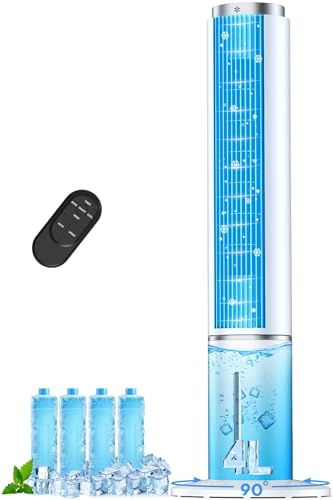
This 42-inch COOLECH unit is designed for windowless spaces and delivers up to 1400 CFM with a 90° auto-oscillation range. It includes four modes (Cooling/Normal/Sleep/Nature) and three wind speeds, enabling tailored cooling for basements with higher humidity or dryness concerns. The model advertises a large air outlet and broad cooling reach that can help balance temperature in larger basement areas without exterior openings. A high-flow evaporative mechanism supports efficient cooling, especially in climates where moisture levels are manageable without a dedicated window vent.
Considerations include the need for a water reservoir to operate as an evaporative cooler, potential need for periodic water refills, and noise levels at higher speeds. It is well-suited for basements without windows where steady, adjustable airflow is essential and where a traditional window unit cannot be installed.
FANCOLE Windowless Evaporative Air Conditioner

FANCOLE’s windowless evaporative cooler is designed for large, enclosed spaces where a window is not an option. It provides 2100 CFM of airflow and includes three modes with three speeds and a 7-hour timer plus remote control. The product emphasizes a top-fill water tank and ice-pack compatibility to boost cooling efficiency. The absence of a window vent means the unit relies on evaporative cooling rather than refrigerant-based cooling, which can be advantageous in dry basement environments but may require higher humidity management in more humid climates.
Ideal scenarios include basements with good air circulation and access to a steady water source. Maintenance focuses on water tank cleanliness, ice pack replacement, and filter upkeep to sustain optimal evaporative performance over time.
MYICY Evaporative Air Cooler, 35″ Windowless

MYICY offers a tall, 35-inch evaporative cooler designed for windowless spaces with three speeds and a remote for convenient control. It includes a 1.2-liter removable water tank for easy cleaning and refilling, with a runtime up to 12 hours in humidification mode depending on ambient humidity. The unit prioritizes ease of use, including a front-facing water level indicator and a compact footprint suitable for smaller basements or corners. The 90° oscillation helps distribute airflow throughout the room more evenly.
Considerations for basement use include humidity management and ensuring the unit remains accessible for water top-ups and cleaning. The product suits spaces where portable, low-maintenance cooling is preferred and where a windowless design is essential for installation flexibility.
COOLECH Windowless Evaporative Air Conditioner
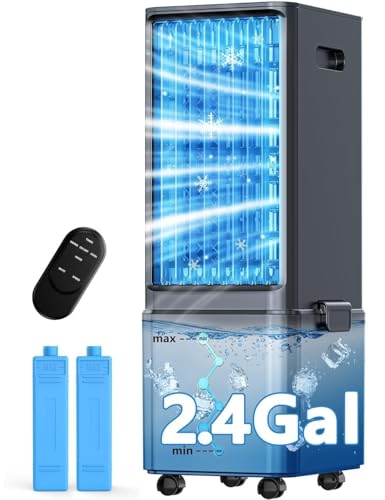
This COOLECH model emphasizes a four-mode, three-speed evaporative cooling setup with a waterless alert system to prevent operation when water is low. It features a 2.4-gallon tank and a 20-hour runtime, offering extended cooling in windowless basements. The 70° auto-swing feature distributes air across larger spaces, helping to reduce hotspots in corners or under stairs. The unit is designed for easy refurbishment and continuous operation with visual indicators for water levels and tank status.
Best used in dry basement environments where evaporative cooling is effective and where a longer runtime between refills is desirable. Users should monitor humidity levels to avoid over-dampness, particularly in already humid climates.
Buying Guide: Key Purchase Considerations For Basement Cooling Without Windows
- Cooling method: Decide between refrigerant-based portable units and evaporative coolers. Refrigerant-based units provide more consistent cooling in humid basements, while evaporative models excel in dry climates where adding humidity is acceptable.
- Basement size and airflow: Measure the space to estimate BTU or CFM needs. Larger basements require higher capacity units with broad airflow delivery, such as 12000 BTU or multi-speed fans.
- Ventilation and exhaust: Windowless units rely on internal air handling. Ensure there is enough intake and circulation; consider units with oscillating outlets or multiple fan speeds to improve distribution.
- Humidity management: Evaporative coolers add moisture; monitor humidity to avoid mold risk. Refrigerant units typically handle humidity better but require proper drainage and venting.
- Power and outlets: Check available electrical outlets and circuit load. Some portable units require dedicated circuits; plan for safe, accessible outlet placement in the basement.
- Noise levels: Windowless units can be quieter or louder depending on design. Look for decibel specifications (often labeled as dBA) if the basement is near living spaces.
- Maintenance and tank care: Evaporative units require regular water tank cleaning and refills. Refrigerant units need filter changes and periodic maintenance checks.
- Installation and mobility: For frequent re-positioning, prioritize units with wheels, handles, and compact weight. Consider storage space when not in use.
- Durability and warranty: Basements may have higher humidity and dust. Choose models with sealed components and solid warranties for longer-term use.
- Energy use: Look for models with energy-saving features or inverter technology to balance cooling performance with electricity costs.
In selecting a solution, assess the basement’s dimensions, humidity levels, and how often you need cooling. For seasonal use, a portable model with flexible control is often the best fit. For consistently dry basements, evaporative coolers can offer economical, effective cooling with proper maintenance.