Finding a compact, efficient cooling solution for campsites, tents, vans, and RVs can dramatically improve comfort during hot weather. This article highlights five top-rated portable air conditioners and evaporative coolers that are well-suited for camping, outdoor gigs, and off-grid getaways. Each entry includes key features to help you compare performance, energy use, and portability.
Summary of chosen products:
| Product | Brand | Type | Key Benefit | Approx. Cooling Focus |
|---|---|---|---|---|
| Kaniapu Portable Air Conditioner | Kaniapu | Evaporative Cooler | ||
| Piegricdiat Mini Personal AC | Ice Cooling Mini Cooler | |||
| EF ECOFLOW WAVE 3 | EF ECOFLOW | Portable AC with Battery | ||
| WISHILO Portable AC | WISHILO | Compact Tent AC | ||
| COOLECH Windowless Cooler | COOLECH | Evaporative Cooler |
Kaniapu Portable Air Conditioner

Kaniapu’s evaporative cooler offers energy-efficient cooling with low noise output. It runs on USB power and uses a large water tank to deliver 6–8 hours of cold air, suitable for campers who want a light, portable option without freon or ozone-depleting refrigerants. The unit emphasizes eco-friendliness and ease of use, making it a practical personal cooler for tents, mini spaces, or car campsites.
Features to note include a 470 ml water tank capacity, three wind speeds, three timers, and a design intended for mobility between home, dorms, offices, or outdoor setups. It is particularly advantageous for campers seeking a compact, quiet option that can operate overnight with minimal cost.
Piegricdiat Mini Personal Air Cooler

The Piegricdiat model centers on upgraded ice cooling technology with a dynamic ice cooling system and a leakage-resistant design. It is advertised as ultra-quiet, with two freezer packs offering up to 10 hours of cooling. This makes it a strong candidate for campers who want fast, personal cooling in small tents or vehicle interiors, especially during humid or hot nights when a silent device matters for sleep.
EF ECOFLOW WAVE 3 Portable A/C

The EF ECOFLOW WAVE 3 pairs high BTU capability with cordless operation, powered by a 1024Wh battery. It offers 1800W cooling and 2000W heating, with fast charging and app monitoring. Its compact 20-inch form factor is designed for vans, RVs, and off-grid camping where access to AC power is limited. It provides significant cooling for spaces up to 120–180 square feet, depending on environment, and supports mobile climate control for travel scenarios.
COOLECH Windowless Evaporative Cooler
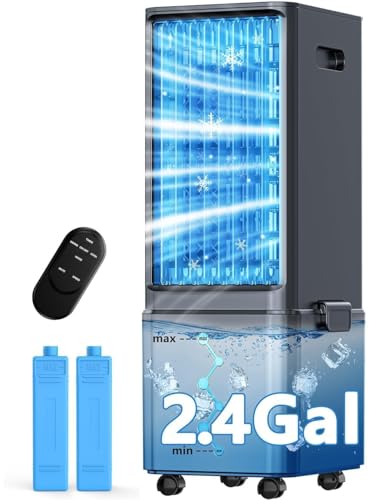
COOLECH’s windowless cooler functions as a four-mode evaporative air cooler with three speeds and a waterless alert system. It emphasizes safety with a water shortage alert and a natural wind mode when water runs low. The 20 ft remote, 20 ft airflow swing, and a long-lasting cooling effect make it appealing for tent setups, small rooms, or outdoor spaces where window access is limited. The unit targets dry climates where evaporative cooling is most effective.
Dreo Portable AC Unit (AC515S)

Note: This Dreo model is included as a reference for comparison with camping-focused units. It features a 12,000 BTU capacity, true drainage-free operation via an evaporative circuit, and a quiet noise profile around 46 dB. Its suitability for camping comes primarily from its cooling power and modern controls, but it is heavier and best suited for larger RVs or heavily shaded outdoor spaces where power is readily available.
Buying Guide: Key Considerations For Camping Cooling Solutions
- Cooling power and space: For tents and small campers, focus on units designed for 64–120 sq ft spaces or portable evaporative coolers. In larger vans or RVs, expandable or battery-enabled units like the Wave 3 may be a better fit.
- Power source and endurance: Battery-powered options offer freedom from shore power, but may have limited runtime. Consider USB-powered, car-adaptable, or solar-ready models if off-grid is the goal.
- Noise level: Camping environments benefit from quiet devices (below 50 dB). Look for models that emphasize low-noise operation, especially for nighttime use.
- Humidity considerations: Evaporative coolers add moisture to the air, which can be beneficial in dry climates but less ideal in humid environments. If moisture is undesirable, consider a cooling unit with dehumidification options.
- Water management: Water tanks, leak-proof designs, and auto-switching to natural wind modes when water runs low improve safety and convenience in tents and small cabins.
- Portability and setup: Look for compact dimensions, built-in handles, and quick-connect water or power options. A unit that’s easy to move between car, tent, and campsite will save time and effort.
- Durability and weather resistance: Camping gear should withstand outdoor conditions. Check for sturdy housings, rust-resistant components, and secure cables or hoses.
- Energy efficiency: Eco-friendly refrigerants and low energy consumption reduce battery drain and campsite impact, aligning with eco-conscious camping habits.
These considerations help balance cooling needs with portability, comfort, and practical use at campsites, in tents, or on the road. When evaluating products, match space size, climate, and available power to the unit’s capabilities. The right choice combines effective cooling with minimal noise, easy transport, and reliable operation in outdoor environments.