Answering common buyer needs, these 1/4″ OD copper tubing coils are ideal for HVACR work, refrigeration, and DIY cooling projects. The top picks prioritize flexibility, corrosion resistance, and ease of installation. Best for professional installers needing durable, compliant coils, and DIYers seeking reliable, easy-to-bend tubing for home projects.
| Product | Length | OD x ID | Best For |
|---|---|---|---|
| GOORY Copper Tubing 50 Ft | 50 ft | 1/4″ x 0.187″ | Professional HVACR installations |
| BELLA BAYS Copper Tubing 50 ft | 50 ft | 1/4″ x 0.187″ | Residential and DIY projects |
| TAUROX Copper Tubing 50 Ft | 50 ft | 1/4″ x 0.187″ | Flexible, easy bending |
| BELLA BAYS Copper Tubing 25 ft | 25 ft | 1/4″ x 0.195″ | Compact installations |
| GOORY Copper Tubing 25 Ft | 25 ft | 1/4″ x 0.195″ | Smaller projects and tight spaces |
GOORY Copper Tubing 50 Ft ACR Coil

Specification: Annealed UNS C12200, 1/4″ OD x 0.187″ ID, wall 0.031″, length 50 ft. Seamless, annealed copper that meets ASTM-B280. Weight and flexibility support simple routing in tight spaces. The nitrogen-filled production process reduces impurities and improves anti-corrosion performance.
Best for: Professional HVAC technicians and dependable DIYers who need a longer, ready-to-install coil with high thermal efficiency. This version suits refrigerant line runs in appliances, air conditioners, and refrigeration setups where long runs are required without frequent connections.
Caution: While nitrogen charging improves purity, verify compatibility with your refrigerant type and ensure correct sealing methods to avoid leaks in DIY installations.
BELLA BAYS Copper Tubing 50 Ft 1/4″ x 0.187″

Specification: UNS C12200, 1/4″ OD x 0.187″ ID, seamless coil, 0.8 mm wall, 50 ft. The nitrogen-charged treatment reduces oxidation and condensation, enhancing longevity for air conditioners and refrigerators. Flexible and corrosion-resistant with ASTM-B280 compliance.
Best for: Homeowners and small contractors seeking a reliable, longer coil for standard HVAC refrigerant runs and DIY installations. This option balances durability with ease of handling in typical residential projects.
Caution: Slightly thicker wall than some competitors; ensure your fittings accommodate the 0.8 mm wall thickness to avoid seating issues in tight joints.
TAUROX Copper Tubing 50 Ft ACR Coil

Specification: C12200 copper, 1/4″ OD x 0.187″ ID, seamless coil with 0.0 8″ wall up to 50 ft. ASTM B280 compliant, nitrogen-treated for anti-oxidation and reduced impurities. The tubing emphasizes smooth inner surfaces for better refrigerant flow.
Best for: Installers who value uniform wall thickness and easy, hand-friendly bending to configure custom refrigerant paths. Suitable for traditional HVACR systems and refrigeration projects.
Caution: Some users may prefer slightly shorter lengths for compact installations; plan layout to minimize long runs where joints are required.
BELLA BAYS Copper Tubing 25 Ft 1/4″ x 0.195″

Specification: UNS C12200, 1/4″ OD x 0.195″ ID, seamless 25 ft coil, wall 0.7 mm. Nitrogen-charged for oxidation resistance and improved lifespan of connected HVAC equipment.
Best for: Small-to-medium projects or tight spaces where a shorter coil reduces waste and makes routing easier. Ideal for compact fridges or localized condenser runs.
Caution: The slightly larger ID difference (0.195″ vs 0.187″) can affect fittings; verify compatibility with existing hardware before substitution.
GOORY Copper Tubing 25 Ft 1/4″ x 0.195″
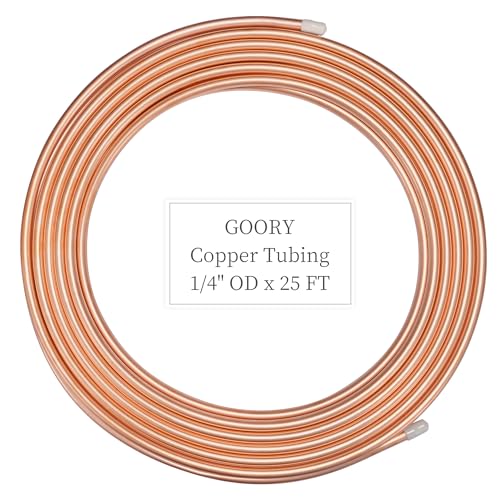
Specification: UNS C12200 seamless, 1/4″ OD x 0.195″ ID, 25 ft length. Meets ASTM-B280; designed for flexibility and long-term durability with high corrosion resistance.
Best for: DIY enthusiasts needing a shorter run for appliance repairs or small installations. The 0.195″ ID supports robust refrigerant flows in constrained spaces.
Caution: Shorter coils may require more joints; plan for reliable leak protection at each connection.
Buying Guide
What should I look for in 1/4″ copper refrigeration tubing?
Key factors include material grade (UNS C12200), adherence to ASTM-B280, wall thickness, diameter tolerance, and whether the tube is seamless. Nitrogen charging during production helps reduce impurities and oxidation, extending service life.
How do I choose the right length and ID for my project?
Measure the run length and verify the refrigerant or gas type. A larger ID improves flow but may require larger fittings. For tight spaces, shorter coils or 25 ft options can simplify routing and minimize waste.
Which features improve durability?
- Seamless construction reduces leak points.
- Nitrogen charging aids rust resistance and cleaner interiors.
- Uniform wall thickness improves resilience to bending without cracking.
Is 0.195″ ID better than 0.187″ ID?
0.195″ ID offers slightly more internal cross-section for refrigerant flow, which can benefit higher-demand systems. Check compatibility with fittings and existing system specs before choosing.
What installation considerations matter?
- Flexibility and ease of bending reduce fatigue on joints.
- Precise cutting and clean ends prevent leaks; ensure proper deburring.
- Use nitrogen-charged tubes from reputable brands to minimize oxidation and condensation.
Maintenance and safety tips
- Inspect connections for leaks, especially at joints and fittings.
- Avoid kinks during bending by using proper tube benders.
- Store coils away from moisture and corrosive environments when not in use.
Quick comparison at a glance
- Best overall: GOORY 50 Ft for length and performance in professional HVACR work.
- Best for DIY homeowners: BELLA BAYS 50 Ft for reliability and ease of handling.
- Best for tight spaces: GOORY 25 Ft or BELLA BAYS 25 Ft for compact installations.
- Best for easy bending: TAUROX 50 Ft emphasizes uniform wall thickness and hand-bendability.
Frequently asked questions
- Q: Are these tubes suitable for refrigerants other than R-134a or R-410A?
A: They are designed for typical HVAC and refrigeration applications; check compatibility with your refrigerant type before use. - Q: Do these tubes come with fittings?
A: The listings show tubes only; fittings are not included. - Q: Is nitrogen charging standard across all brands?
A: Most top brands use nitrogen during production to reduce impurities and rust risk, but confirm with the seller. - Q: Can I solder or brazed joints with these tubes?
A: Yes, they are designed for standard HVAC joining methods, but follow safety guidelines and local codes. - Q: What length should I buy for a typical residential AC line set?
A: A 25–50 ft coil often covers common runs; assess your layout and add a small buffer for extra fittings. - Q: Are there any handling tips for 0.195″ ID tubes?
A: They are slightly stiffer than smaller IDs; use proper benders and avoid sharp bends near joints.