Quick answer: the top 1/8 BSPT to 1/8 NPT adapters help connect BSPT-sourced gauges and sensors to NPT ports, with brass or stainless options depending on your environment. This guide highlights five solid choices, suitable for pressure gauges, oil and fuel systems, and turbo oil feeds. Best for: DIY enthusiasts needing a reliable fit; professionals requiring corrosion resistance in engine bays; and hobbyists seeking compact, easy-to-install fittings.
| Product | Best For | Key Benefit |
|---|---|---|
| Zeiboat 2PCS 1/8 BSPT Male to 1/8-27 NPT Female | Gauge replacement | Two-pack value with solid brass/brass-like build |
| PIHIL 1/8 BSPT Male to 1/8-27 NPT Female (Brass, 2 Pack) | High-temperature compatibility | Brass construction for durability |
| GlowShift 1/8 BSPT Male to 1/8-27 NPT Female | Sensor integration | Brass, universal sensor adapter |
| EVIL ENERGY 1/8 BSPT Oil Pressure Sensor Tee Adapter | Stainless steel option | 304 stainless steel for harsh environments |
| Senlinyu 1/8 BSPT Oil Pressure Sensor Tee Adapter | Compact fits | 304 stainless steel, compact 2.0-inch body |
Zeiboat 2PCS 1/8 BSPT Male to 1/8-27 NPT Female Thread Adapter

Product overview: The Zeiboat adapters convert 1/8 BSPT male threads to 1/8-27 NPT female ports. Each unit weighs 11.8 grams, and the package includes two metal adapters for gauge replacements or worn-out fittings. Best for: professionals replacing damaged gauge connections or DIYers stocking spare parts. A potential limitation is that two adapters share the same configuration, which may require an additional part if you need multiple port sizes.
Why it’s selected: Its straightforward brass-like construction and dual-pack format make it a practical choice for standard gauge installs where a quick swap is needed. Choose this if you want a budget-friendly, ready-for-replacement option with consistent thread engagement.
Caution: Verify compatibility with your gauge’s thread pitch and ensure proper sealing to avoid leaks in high-pressure lines. Not ideal if you require multiple sizes in one kit beyond 1/8 BSPT to 1/8-27 NPT.
PIHIL 1/8 BSPT Male to 1/8-27 NPT Female Thread Adapter, Brass
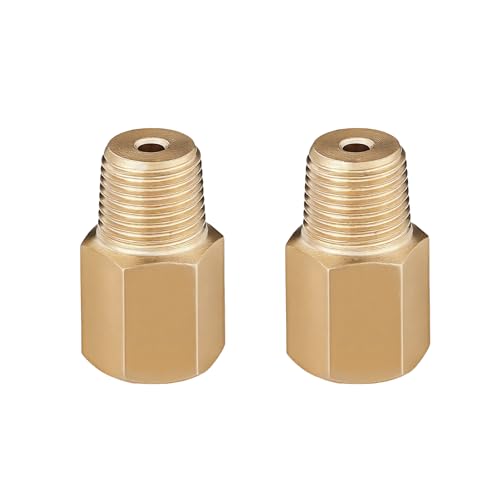
Product overview: Brass adapters with 1/8 BSPT male to 1/8-27 NPT female threads, sold in a 2-pack. Built for high-temperature and corrosion resistance to support long-term use in engine compartments. Best for: applications requiring durable brass construction and easy replacement for pressure gauges. Limitation: brass may be heavier and could be less resistant to extreme thermal cycling than stainless options.
Why it’s selected: Brass construction offers a good balance of durability and cost, making it suitable for many automotive OBD sensor and gauge installations. Choose this if you want a two-pack solution with solid resistance to heat and corrosion.
Caution: Ensure the sealing is proper; improper torque can create leaks in tight spaces. Not the best choice if stainless steel is required for extreme environments.
GlowShift 1/8 BSPT Male to 1/8-27 NPT Female Gauge Sensor Sender

Product overview: Brass-made, universal sensor thread adapter with 1/8 BSPT male to 1/8-27 NPT female. Designed to accommodate sensors that aren’t initially compatible with NPT ports, enabling seamless gauge installation. Best for: users with various sensor fittings seeking a single, universal solution. Caution: Brass can be softer than stainless; handle fittings to avoid cross-threading in tight spaces.
Why it’s selected: GlowShift’s adapter is notable for enabling flexibility when mounting a sensor that uses BSPT threads in an NPT system. Choose this if you need a general-purpose adapter that supports multiple gauge types.
EVIL ENERGY 1/8 BSPT Oil Pressure Sensor Tee Adapter

Product overview: Stainless steel 1/8 BSPT female to male adapter with a center tap 1/8-27 NPT female port. Made of 304 stainless steel, designed to resist corrosion in harsh environments such as oil pressure lines. Best for: heavy-duty installations requiring stainless steel durability and robust sealing. Limitation: Stainless steel can be more rigid, potentially complicating installation in tight spaces.
Why it’s selected: The stainless steel construction is a strong match for long-term reliability in engine bays or off-road applications where corrosion and heat are concerns. Choose this if you need an enduring solution in challenging conditions.
Larlansz 1/8 BSPT Male to 1/8 NPT Tee Oil Pressure Sensor Adapter

Product overview: Stainless steel 1/8 BSPT male to 1/8-27 NPT female center port with NPT center. Designed for engine oil systems, offering a compact tee adapter suitable for tight spaces. Best for: users needing a compact, high-quality stainless option with clear thread specifications. Limitation: May require precise torque due to fine BSPT/NPT threads to avoid leaks.
Why it’s selected: The Larlansz adapter provides durability and a compact footprint, beneficial for tight engine bays where sensor routing is constrained. Choose this if you need a stainless option with a precise center port for NPT connections.
Buying Guide
What to consider when choosing a 1/8 BSPT to 1/8 NPT adapter
- Material: Brass is affordable and corrosion-resistant for many automotive uses; stainless steel offers superior corrosion resistance in harsh environments.
- Thread compatibility: Confirm 1/8 BSPT male and 1/8-27 NPT female are the exact thread types you need for your gauge or sensor.
- Port size and center port: If you require a center NPT port for a sensor, verify the adapter’s port dimensions and seating to ensure a tight seal.
- Space and fit: Consider the overall length and elbow configuration; tight engine bays may favor compact designs.
- Leak prevention: Proper sealing and torque are essential; use appropriate thread sealant if recommended for your system.
- Corrosion and temperature: For high-temperature or corrosive environments, stainless steel may outperform brass.
Performance and compatibility considerations
Use cases vary from gauge replacements to sensor add-ons in oil and fuel systems. When selecting, align the adapter with your sensor’s thread pitch, material compatibility, and space constraints. Brass adapters are typically easier to work with for quick DIY projects, while stainless options are better for long-term installations in challenging environments.
Installation tips
- Clean threads before installation to prevent cross-threading.
- Apply thread sealant or Teflon tape only if the manufacturer recommends it for your specific threads.
- Torque to the manufacturer’s specification or use a calibrated torque wrench to avoid damaging threads.
- Check for leaks after installation by applying a brief pressure test and inspecting seals.
Common configurations to know
- 1/8 BSPT male to 1/8-27 NPT female is a common conversion for gauge sockets and sensor ports.
- Adapters may come in packs; consider whether you need multiple duplicates for spares in your toolbox.
FAQ
- Q: Are these adapters universal for all gauges? A: They fit gauges with matching BSPT to NPT thread requirements; verify your gauge’s threads before purchasing.
- Q: Is brass better than stainless for oil systems? A: Brass is versatile and easier to machine, while stainless offers superior corrosion resistance for harsher environments.
- Q: Will I need sealant with BSPT threads? A: Some installations require sealant; follow manufacturer guidance to ensure proper sealing.
- Q: Can I use these adapters in high-temperature environments? A: Yes, but check material specifications; stainless steel generally performs better under extreme heat.
- Q: Do these adapters come with multiple sizes? A: Some packs include duplicates of the same size; verify the exact package contents before use.
- Q: How do I know which adapter to choose for my sensor? A: Match the inlet and outlet thread sizes, then consider material, space, and environmental conditions.