When choosing a spring check valve, the goal is reliable backflow prevention, durability, and compatibility with your piping setup. The top options below suit different needs: residential irrigation, well pumps, or commercial piping. This guide highlights five strong candidates, explained with clear use-cases to help you pick the right one for your system. Read on to see which valve is best for your application and why.
Product comparison at a glance:
| Product | Best For | Key Benefit | Limitations |
|---|---|---|---|
| 1 inch Check Valve with Backflow Preventer (Camoo) | Residential irrigation and domestic water | Backflow prevention with a lead-free brass body | Requires standard 1″ FNPT connections |
| Boltigen 1 inch Spring Check Valve (Stainless) | Industrial and well systems | Stainless steel spring, corrosion resistance | Temp range up to 248°F |
| 1″ NPT Stainless Steel Spring Check Valve (SYWUWV) | Oil, water, gas, and general inline flow | Stainless body, wear-resistant construction | Assorted media compatibility |
| Boltigen 2PCS 1 Inch NPT Brass Check Valve | Budget installs and spare valves | Brass body, solid value | Brass, 200 psi max |
| Merrill MFG CVNL100 1″ No-Lead Brass Check Valve | Potable water and small systems | IAPMO certified, no-lead brass | Standard 1″ NPT connections |
1 inch Check Valve with Backflow Preventer for Merrill CVNL100 700 Series

This option combines a spring-loaded check valve with a backflow prevention feature. It is designed to block reverse flow in irrigation and domestic water lines. The valve uses lead-free brass construction and stainless steel components for durability, supporting potable-water use and long-term reliability in demanding environments. Best for residential irrigation systems and small-water supplies where backflow control is essential.
Best for: Home irrigation setups and small domestic water lines where backflow protection is a priority. Better for: Potable water applications requiring lead-free materials. Choose this if: You need a compact, compliant brass valve with a straightforward install in 1″ FNPT connections.
Caution: The maximum temperature rating is 190°F, so avoid high-heat fluid service beyond that limit.
Boltigen 1 inch Spring Check Valve, 304 Stainless Steel

This valve uses a stainless steel spring and a robust stainless body, offering solid corrosion resistance and durability in a range of industrial settings. It supports vertical and horizontal installations and is suitable for many well, pump, and tank systems. Best for: Environments needing stainless steel durability and reliable one-way flow. Better for: Higher-temperature or harsher conditions than basic brass valves handle. Limitations: Rated up to 200 psi and -10°C to 120°C, so select accordingly for extreme conditions.
1″ NPT Stainless Steel Spring Check Valve (SYWUWV)
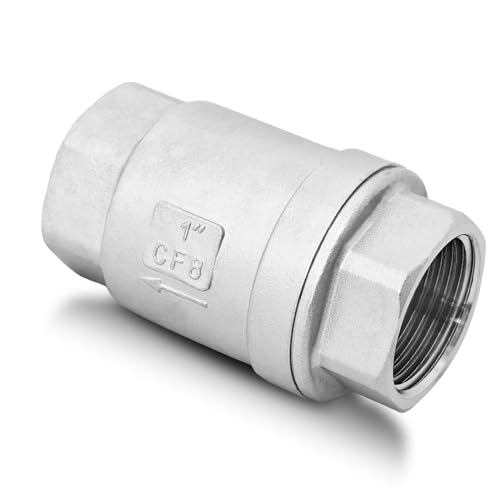
This in-line, vertical-check valve uses a stainless steel body with a polished inner surface to minimize resistance and clogging. It emphasizes explosion-proof wear resistance and high-temperature capability. Suitable for oil, water, gas, and air pipelines. Best for: Systems needing a durable, general-purpose inline check valve. Better for: Those requiring high wear resistance and a smooth internal surface. Caution: Not all media types are specified; verify compatibility for aggressive chemical services.
Boltigen 2PCS 1 Inch NPT Brass Check Valve

This product pair comprises heavy-duty brass 1″ NPT check valves with a spring mechanism for one-way flow. The brass construction provides good corrosion resistance and compatibility with water-based systems. Best for: Budget-conscious installations or stocking multiple valves for different lines. Better for: Home or small business piping where a reliable, affordable check valve is needed. Caution: Each valve is rated up to 200 psi; avoid high-pressure applications beyond that.
Merrill MFG CVNL100 1″ No-Lead Brass Check Valve

This Merrill valve is built from no-lead brass and designed for potable-water backflow prevention. It is IAPMO certified and features a 1″ female NPT connection. Best for: Residential and small commercial potable-water lines that require lead-free materials and certified performance. Better for: Applications prioritizing compliance and long-term reliability in drinking water systems. Limitation: Standard 1″ NPT fitting; verify compatibility with your piping layout.
Buying Guide: Key Purchase Considerations
What type of backflow do you need? A spring-loaded check valve prevents reverse flow, but consider whether you also need backflow prevention features in the same unit. For potable water, prioritize lead-free brass or certified materials (IAPMO or equivalent).
What is the installation orientation? Some models support vertical or horizontal layouts; others have preferred orientations. Confirm compatible orientations to avoid flow issues and ensure proper seating of the seal.
What are pressure and temperature limits? Match the valve’s maximum psi and temperature rating to your system’s operating conditions. Exceeding these limits can compromise sealing and longevity.
Material choice matters. Brass offers good corrosion resistance and is common in residential systems; stainless steel is favored in harsher or industrial environments. Consider media compatibility (water, oil, gas) when choosing.
Certification and compliance provide confidence in reliability. If potable water is involved, look for no-lead brass and third-party certifications. For non-potable or industrial uses, verify compatibility with your fluid type and operating environment.
Frequently Asked Questions
- What is a spring check valve and how does it work?
A spring check valve uses a spring-loaded disc or poppet to allow flow in one direction and quickly shut to prevent backflow when pressure reverses. - Can these valves be installed in any orientation?
Many support horizontal and vertical installations, but always verify the manufacturer’s guidance for each model. - Are these valves suitable for potable water?
Yes, some are specifically designed with lead-free brass and IAPMO compliance for drinking water systems. - What should I consider about pressure ratings?
Match PSI rating to your system’s operating pressure. Exceeding limits can damage seals and reduce effectiveness. - Do I need a backflow prevention device in addition to a check valve?
For some applications, a dedicated backflow preventer is recommended. Check local codes and system requirements. - What maintenance is required?
Routine inspection for leaks and corrosion is advisable; replace seals or springs if you notice wear or reduced performance.