Find the right 110V baseboard heater and thermostat combo to keep spaces warm with minimal noise and steady comfort. This guide highlights practical options for small-to-medium rooms and offices, focusing on models that support 110V- or dual-voltage operation and offer reliable thermostat control. The top picks are best for budget-conscious buyers, compact spaces, or those seeking easy DIY installation.
Below is a quick comparison of the most relevant products, showing who each option is best for and why it’s a solid choice for 110V setups.
| Product | Best For | Why It Stands Out |
|---|---|---|
| YeloDeer Dual Voltage Baseboard Heater Thermostat | Homes needing 110V-265V flexibility | Broad voltage range and accurate electronic thermostat for precise control |
| Mysa Smart Thermostat Lite | Smart-home users on 120V-240V baseboards | WiFi control, scheduling, and voice assistant compatibility |
| King 4K1210BW K Series Baseboard Heater | Simple 120V installations | Aluminum Ribbon Fin Element and safety features for durable comfort |
| Stelpro Brava AB61501W 1500W / 120V | Quiet, high-output rooms | Full-length thermal protection and no-end-cap design for quiet operation |
| Stelpro Brava AB03029W 300W / 240V | Smaller spaces with higher-voltage needs | Convection heating in a compact form with built-in safety options |
YeloDeer Dual Voltage Baseboard Heater Thermostat

The YeloDeer model supports 110V-265V and operates with a 4-wire setup. It provides a maximum 20A load with a high-capacity output, delivering up to 2400W at 120V and 4800W at 240V. This unit uses an electronic thermostat for higher accuracy, offering a control range from 40°F to 80°F (4.4°C to 26.7°C). It is best for homeowners who want versatile voltage compatibility and precise temperature control in spaces that may be wired for different voltages.
Best for: Regions or rooms that may require dual-voltage operation or future-proofing for voltage changes. Why selected: Versatile voltage support and accurate temperature control help maintain steady comfort across a range of installation scenarios.
Caution: Wiring must follow local electrical codes; professional installation may be advised for dual-voltage configurations.
Mysa Smart Thermostat Lite for Baseboard Heaters
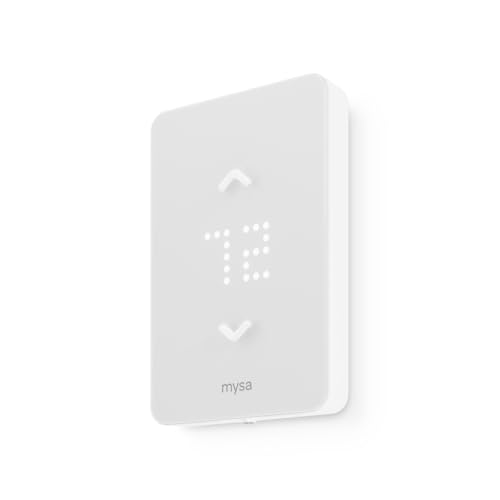
The Mysa Smart Thermostat Lite is designed for electric baseboard heaters operating on 120V-240V. It enables WiFi-based control, scheduling, and remote monitoring with a user-friendly app. It supports integrations with HomeKit, Alexa, and Google Assistant, providing voice-controlled temperature adjustments. This makes it a strong pick for tech-forward homes that want to optimize heating costs without sacrificing comfort.
Best for: Smart-home enthusiasts who want app-based scheduling and voice control. Why selected: Built-in WiFi and widely compatible ecosystems make it easier to automate and monitor electric heat across zones.
Caution: Requires a compatible baseboard heater and adequate wiring; no hub is required, but a stable WiFi connection is essential for full functionality.
King 4K1210BW K Series Baseboard Heater

The King 4K1210BW is a 120V baseboard heater featuring an aluminum ribbon fin element for efficient heat distribution and a full-length safety cutout to prevent overheating. It’s designed for straightforward installation and reliable operation in small-to-medium rooms. This option is best for buyers seeking a simple, durable baseboard heater with predictable performance in lighter-duty spaces.
Best for: Value-focused installations in standard rooms that require dependable performance. Why selected: The design emphasizes safety and steady convection, making it a solid range entry for 110V/120V circuits.
Caution: Not ideal for very large rooms where higher wattage is needed; check local code for hardwired installation requirements.
Stelpro Brava AB61501W Baseboard Heater

The Stelpro Brava AB61501W delivers high-performance convection heating with 1500W at 120V, warming spaces up to 150 sq ft efficiently and silently. It is hardwired and supports optional thermostat control, including electronic or mechanical on-unit or wall-connected configurations. Its one-piece, no-end-cap design minimizes noise and distributes heat evenly across the cabinet.
Best for: Quiet heating in mid-sized rooms where wall thermostat installation is preferred. Why selected: Strong convection output and a streamlined design reduce noise while maintaining consistent warmth.
Caution: Requires hardwiring and compatibility with the chosen thermostat kit or wall control for full room control.
Stelpro Brava AB03029W Baseboard Heater

The Stelpro AB03029W provides 300W of convection heating at 240V in a compact 22″ length. This model is suitable for small rooms or zones where a low-wattage, higher-voltage solution is appropriate. The heater’s design emphasizes silent operation and vertical heat distribution to reduce cold spots in tight spaces.
Best for: Smaller spaces or zones where 240V is available and a compact heater is needed. Why selected: High-voltage operation in a compact footprint helps maximize efficiency in tight spaces.
Caution: Total heating capacity is modest; pairing with additional units may be necessary for larger areas.
Buying Guide
Key considerations when selecting an 110V baseboard heater with thermostat:
- If wiring in your space is 110V, confirm the unit’s voltage range or dual-voltage capability. Models like YeloDeer are explicitly versatile, while others are fixed at 120V or 240V.
- Assess room size and insulation to choose appropriate wattage. Higher wattage yields quicker warming in larger or less-insulated rooms, but may require dedicated circuits.
- Consider built-in vs. wall-mounted thermostats, manual vs. electronic control, and smart capabilities. Smart thermostats can save energy through scheduling and remote control.
- Convection-based baseboard heaters are quiet; avoid models with fans if you need near-silent operation.
- Some models require hardwiring and a dedicated circuit. Verify clearance, mounting height, and space for proper air circulation.
- Look for thermal protection, automatic reset, and full-length cutouts to reduce overheating risk in enclosed spaces.
- If you want voice or app control, choose thermostats or heaters with compatible ecosystems (HomeKit, Alexa, Google Assistant).
Frequently Asked Questions
- What is the typical voltage for baseboard heaters? Baseboard heaters commonly operate at 120V or 240V. Some models support dual voltage to adapt to different wiring setups.
- Do I need a thermostat with baseboard heaters? Yes. A thermostat helps maintain consistent temperatures and can improve energy efficiency by reducing unnecessary heat output.
- Are smart thermostats compatible with baseboard heaters? Many smart thermostats work with baseboard heaters that use 120V-240V. Check compatibility with your specific model and wiring.
- Can I install baseboard heaters myself? Installation can be DIY-friendly for some models, but hardwired configurations or dual-voltage setups may require a licensed electrician.
- How do I choose the right wattage? Larger rooms or poor insulation require higher wattage. Use a rough wattage calculator or consult a professional to estimate needs.
- What are the advantages of convection baseboard heaters? They distribute warm air evenly without fan noise, making them suitable for living spaces and offices seeking quiet operation.