Answer: A 120 inch baseboard heater is ideal for large rooms or open floor plans where you need uniform heating along a wall. This guide highlights five solid options, with clear guidance on who each model suits best, and practical cautions to consider before buying. The best picks balance long length, efficient convection, and straightforward installation for different spaces.
Summary table of selected products:
| Product | Brand | Length / Output | Best for | Key note |
|---|---|---|---|---|
| TPI 2900S Series H2925-120S | TPI | 120″ length | Large living areas needing steady warmth | Durable stainless element with quick-connect options |
| Cadet F Series 36″ (2F350W) | Cadet | 36″ | Supplemental heat in mid-size rooms | Simple installation, multi-volt options |
| Cadet F Series 36″ (3F750W) | Cadet | 36″ | Stronger convection in medium rooms | Convection design for even heat distribution |
| Stelpro Brava 300W (AB03029W) | Stelpro | 22″ | Silent comfort in tight spaces | Not plug-in; high-performance convection |
| Stelpro Brava 1000W (AB41001W) | Stelpro | 48″ | Larger area insulation and quiet warmth | Hardwired installation |
TPI 2900S Series H2925-120S Baseboard Heater, 120 Inch

Features include a stainless steel heating element with aluminum fins, an over-temperature thermal limit, and junction boxes with quick-connect cable clamps. Best for spaces needing a long, uninterrupted heat strip along a wall. This model is best for buyers prioritizing durability and a low-profile, long-length unit that distributes heat evenly along 120 inches. Caution: ensure adequate clearance and hardwiring readiness; not a plug-in unit.
Cadet F Series 24″ Electric Baseboard Heater (2F350W)
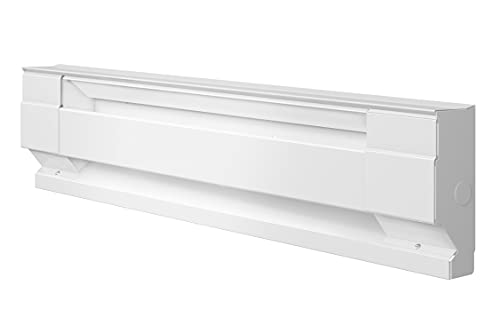
Best for small to mid-sized rooms where supplemental heat is needed and wiring is straightforward. This Cadet unit emphasizes a white steel finish and simple, reliable electric operation. It’s a solid choice when a 120-inch unit isn’t required but a compact baseboard solution is desired. Caution: it’s not a long 120-inch heater, so plan layout accordingly if pairing with other long heaters.
Cadet F Series 36″ Electric Baseboard Heater (3F750W)
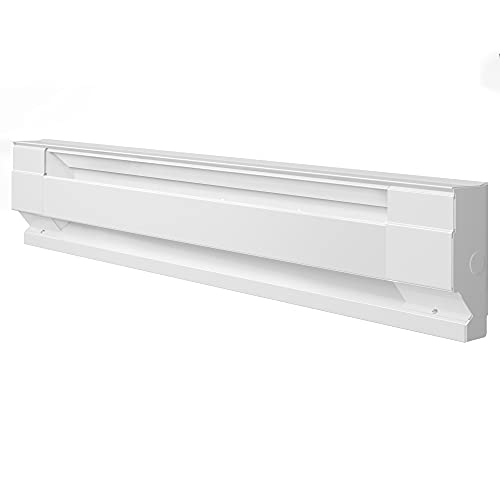
Best for improving room-wide convection with higher wattage in a mid-size footprint. It offers multi-watt capabilities (750/563 W) and 240/208 V, enabling flexible installation and effective heat distribution. This is a better option when you want robust heat without extending to a full 120 inches. Caution: not the longest length, so use in combination with other heaters for large walls.
Marley 1128/1500W 208/240V Electric Baseboard Heater

Best for rapid convection with uniform warmth across a room, especially where a blower or fan is undesired. It features a large wiring compartment, dual knockouts, and a built-in cable clamp for straightforward installation. Choose this if you prioritize fast, even hot air flow from a long, continuous baseboard run. Caution: ensure wall space and wiring capacity align with 208/240V requirements.
Stelpro Brava 300W / 240V (AB03029W)

Best for compact spaces needing quiet, high-performance convection without fans. This Stelpro model is designed for permanent hardwired installation and provides full-length thermal protection with automatic reset, contributing to dependable operation. It’s ideal when you want near-silent heating along a shorter wall segment. Caution: not plug-in; plan for thermostat integration and permanent wiring.
Stelpro Brava 1000W / 120V (AB41001W)

Best for large rooms or open layouts where long heat coverage is beneficial. This 1000W unit, designed for hardwired installation, offers strong convection and even heat distribution along a longer wall. Optimal when paired with a programmable thermostat for zone control. Caution: as a hardwired unit, verify electrical capacity and local code requirements before installation.
Buying Guide: Key Considerations For 120 Inch Baseboard Heaters
- Length vs. room size: A true 120-inch heater is best for long walls. In shorter rooms, combine multiple shorter units to cover the same area.
- Voltage and wattage: Check your electrical panel capacity. Many baseboard heaters operate at 120V or 240V; select wattage that matches room heating needs without overloading circuits.
- Installation type: Decide between plug-in (where allowed) and hardwired models. Plugs are simpler but less common for long runs; hardwired units offer permanent, cleaner installations.
- Convection vs. radiant: Convection baseboards warm air that circulates, while radiant ones transfer heat more directly. Convection models often provide more uniform room warmth.
- Thermostat compatibility: Some models require separate wall thermostats or optional on-unit thermostats. Consider compatibility with existing thermostat systems.
- Materials and durability: Stainless steel elements and aluminum fins tend to resist corrosion and maintain efficiency over time. Ensure weathering is suitable for the room environment.
- Clearance and safety: Check clearance from furniture, curtains, and walls. Look for over-temperature protection and automatic reset features for safety.
Frequently Asked Questions
- What is the advantage of a 120-inch baseboard heater?
It provides continuous heat along a long wall, reducing cold spots in large rooms. - Can I mix different brand baseboards on the same wall?
Yes, but ensure compatible voltage and thermostat control. Consider a coordinated control strategy for even heat. - Do all baseboard heaters require hardwiring?
No—some models offer plug-in options, but many 120-inch units are designed for hardwired installations for a cleaner look and reliable long-term use. - How do I choose between 208V and 240V models?
Match the heater’s voltage to your electrical supply and panel capacity; higher voltage can deliver more consistent heat in larger spaces. - What maintenance is needed for baseboard heaters?
Periodic inspection of wiring connections and ensuring vents are unobstructed helps maintain efficient operation and safety. - Is a thermostat necessary for baseboard heaters?
A thermostat improves comfort and energy efficiency; some models support integration with wall thermostats or optional internal kits.