Answering the need for strong, reliable air movement, these 1800 CFM-class exhaust fans are suited for workshops, attics, garages, and greenhouses. This selection showcases models with automatic shutters, variable speed controls, and thermostatic operation to match different spaces and climates. The top picks are best for large areas up to about 1800 square feet, or bigger spaces requiring rapid air exchange. For buyers prioritizing energy efficiency, maintenance simplicity, and mounting versatility, these options provide clear advantages.
| Product | Approx. CFM | Best For | Notes |
|---|---|---|---|
| iLiving ILG8SF18V-ST | 1736 | Large garages or shops | High airflow with thermostat and speed control |
| Ehiair 15″ Attic Fan | 1800 | Attics and greenhouses | Thermostat auto-on/off, remote, timer |
| VEVOR 16″ 3000 CFM | 3000 | Year-round attic/garage ventilation | Smart programming; high airflow |
| VEVOR 14″ 2000 CFM | 2000 | Workshops and sheds | Solid all-metal build; multiple speeds |
| iLiving 20″ 3368 CFM | 3368 | Very large spaces or extreme heat | Highest airflow in list; wide coverage |
iLiving 18″ Wall Mounted Shutter Exhaust Fan

CFM: 1736; Voltage: 115V; A fueling combination of 0.85A and 1/15 HP delivers solid airflow with a compact footprint. Shuttered design helps prevent backdrafts when not in use, and the Thermospeed Controller supports variable speeds with a 32–130°F operating range. Ideal for warehouses, garages, and greenhouses that require strong ventilation without excessive noise. Better for medium-to-large spaces compared to smaller 12″ or 16″ models.
Best for: Large garages and workshops that need robust airflow with automatic control. Caution: Noise levels can approach higher ranges in full speed mode, so allow for some room acoustics in sensitive areas.
iLiving 16″ Wall Mounted Shutter Exhaust Fan
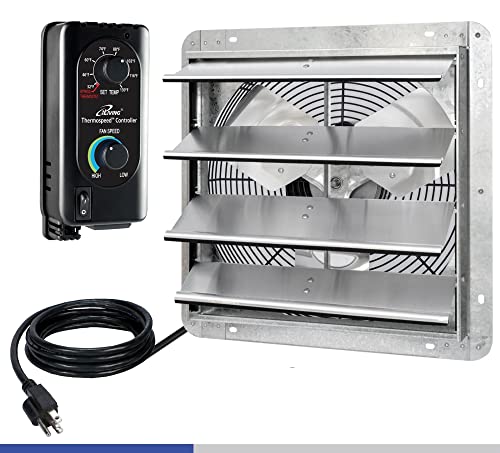
CFM: 1200; Coverage up to 1800 sq ft; Thermospeed Controller and thermostat provide temperature-regulated air exchange. Industrial-grade steel frame, aluminum shutters, and a permanently lubricated motor emphasize durability. Best for mid-size spaces like small warehouses or large workshops. Choose this if you need reliable 1200 CFM in a compact footprint.
Best for: Medium-sized workshops or garages seeking dependable ventilation with automatic shuttering. Caution: Lower throughput than larger 18″ or 20″ models.
VEVOR 14 Inch Exhaust Fan With Variable Speed

CFM: 2000; Wall-mounted with a robust 115V motor and 10-speed adjustable settings. Features automatic shutter and a durable all-metal construction. Best for sheds, garages, and small workshops that demand higher airflow without a large footprint. Better for users needing more than 1800 CFM while maintaining compact size. Caution: Higher CFM may generate more noise at top speeds.
Best for: Small-to-medium spaces needing strong exhaust without a large unit. Choose this if you want more than 1800 CFM in a compact 14″ form factor.
VEVOR 16 Inch Exhaust Fan With 3000 CFM

CFM: 3000; 1400 RPM; 98W motor with smart programming, temperature and humidity triggers, and up to 10 speed settings. The shuttered design is suitable for attic or greenhouse exhaust, and a rugged metal frame provides durability for year-round use. Best for extremely hot days or spaces with persistent heat buildup. Caution: The high airflow can lead to louder operation in high-speed modes.
Best for: Attics, greenhouses, and large workshops needing aggressive air exchange. Choose this if you require very high CFM and flexible climate-triggered control.
Ehiair 15″ Attic Fan With Thermostat

CFM: 1800; Thermostat-based auto-on/off; 3 speeds and an 18-hour timer for flexible attic control. Remote included for convenient operation in the attic. Best for homes with attics or upper-story spaces needing automatic, temperature-regulated ventilation. Caution: Remote operation requires line-of-sight and distance considerations in tall spaces.
Best for: Attics and large residential spaces needing automatic temperature control. Choose this if you want integrated remote control and a timer function for efficient cooling.
Buying Guide: Key Considerations for 1800 CFM Exhaust Fans
- Space size and airflow needs: Match CFM to room size and desired air exchanges per hour. Larger spaces may require 2000–3000 CFM, while smaller workshops can be well-served by 1200–1800 CFM.
- Shutters and backdraft prevention: Automatic shutters prevent outdoor infiltration when the fan is off. Look for PVC or aluminum shutters for durability.
- Speed controls and thermostats: Variable speed with a thermostat helps maintain comfort and energy efficiency. Thermospeed controllers are common in mid-to-large units.
- Motor and build quality: Aluminum blades and galvanized frames resist corrosion in humid environments. Permanently lubricated, UL-listed motors simplify maintenance.
- Noise considerations: Higher CFM and RPM can raise noise; check dB ratings and plan mounting or sound-dampening strategies if noise is a concern.
- Installation and mounting: Wall-mounted units save space; ensure appropriate clearances and weather resistance for external mounting. Verify electrical requirements and wiring safety for your locale.
- Extra features: Remote control, timer, humidity sensors, and multi-speed modes can enhance convenience and energy savings in variable conditions.
Frequently Asked Questions
- What does CFM mean in exhaust fans, and why does it matter?
– CFM stands for cubic feet per minute and measures how much air the fan moves. Higher CFM means faster air exchange, which is important in large spaces or areas with heat, humidity, or odors. - Is a thermostat necessary on an exhaust fan?
– A thermostat auto-controls the fan based on temperature, improving energy efficiency by running only when cooling is needed. - When should I choose a 3000 CFM fan over an 1800 CFM model?
– For very large rooms, attics with high heat buildup, or spaces requiring rapid air removal, a higher CFM provides better ventilation performance. - Do these fans require professional wiring or installation?
– Some models are designed for straightforward wall installation with standard 115V circuits. If unsure, consult a licensed electrician for wiring safety and code compliance. - How important are built-in shutters?
– Shutters prevent backdrafts and reduce energy loss when the fan is off, which is especially important in outdoor or high-dust environments. - Can I use these fans year-round?
– Yes, many models are suitable for year-round use, with thermostats and humidity controls that adapt to seasonal changes.