If you need compact, efficient warmth for a small room, a 2‑foot electric baseboard heater can be a smart choice. These compact units fit under windows, along narrow walls, or beside desks where space is at a premium. The best options deliver steady convection warmth, quiet operation, and simple installation. This guide highlights five suitable picks, showing who each heater is best for and why. Use the buying guide and FAQs to compare dimensions, wattage, voltage, and safety features to match your needs.
Product Snapshot: Quick Comparisons
- Cadet F Series 24″ Electric Baseboard Heater — Best for consistent heat with easy installation in small rooms (2F350W, 350/262W, 240/208V).
- Marley 120V 2′ Baseboard Heater — Best for quick room heating with simple wiring (2′ length, convection).
- DIMPLEX LC2005W31 20″ Base Heater — Best for compact layouts needing 500W at 240V, fast heat flow.
- Stelpro Brava 22″ Electric Baseboard Heater — Best for silent, durable comfort with full-length protection.
- King 27″ K Series 500W Baseboard — Best for slightly longer footprint with aluminum ribbon fin element.
Cadet F Series 24″ Electric Baseboard Heater
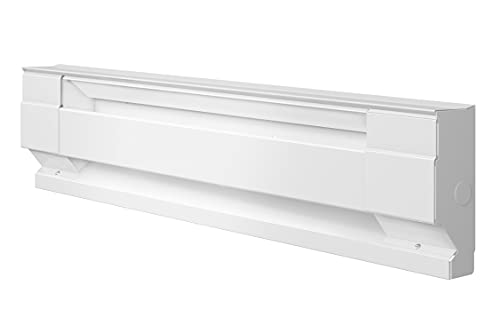
Best for small rooms where a compact, easy-to-wire heater is needed. This Cadet model operates at 350/262 watts and supports 240/208 volt wiring, offering reliable convection warmth. Its steel construction and white finish blend with most decors, and the unit is straightforward to install in standard wall cavities or along baseboard lines. Consider this option if you want a proven, low-profile heater that can be wired for multiple voltage options. A minor limitation is the fixed length; you may need a different size for larger spaces.
Marley 120V 2′ Baseboard Heater
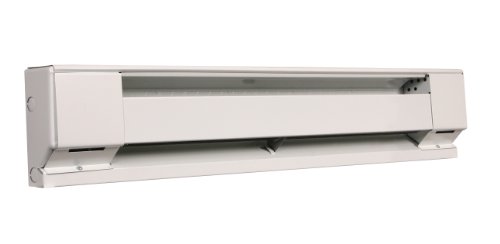
Best for rapid convection heating in small to medium rooms without a fan. This model emphasizes natural convection to distribute warm air evenly from floor to ceiling, reducing cold spots. It’s quick to wire thanks to a large wiring compartment and built-in cable clamp. Choose Marley if you prefer a slim profile that minimizes dust disturbance, but be aware that some installations may benefit from additional wall space for the long baseboard run.
DIMPLEX LC2005W31 500W 20″ Base Heater

Best for compact setups where maximum space efficiency matters. At 500W on 240V and a 20″ length, this baseboard heats quickly while maintaining a slim footprint. The shorter length is advantageous in restricted wall spaces, but ensure the 500W rating meets your room heat load. The unit’s durable construction supports steady, zone-specific warmth without reliance on a blower. If your room needs more heat, you may require a longer or higher-w wattage model instead.
Stelpro Brava Electric Baseboard Heater

Best for quiet, efficient convection with a high focus on safety and durability. The Brava model delivers 300W at 240V (225W at 208V) and features a full-length thermal protection circuit with automatic reset. It emphasizes noise-free operation and a clean, one-piece design to minimize expansion noises. It requires hardwiring and is well-suited for rooms where silent operation is a priority. If you prefer plug-in models, this is not the right pick, but it suits dedicated wall installations.
King 2K2405BW K Series Baseboard Heater

Best for a slightly longer footprint with robust heat distribution. The K Series uses an aluminum ribbon fin element and includes a full-length safety cutout with a crushproof element, offering reliable warmth for small-to-mid sized spaces. Use this when you need a durable baseboard with a slim profile and need durable heat delivery along a longer wall. A potential limitation is the need for appropriate clearance and mount points along the baseboard line.
Buying Guide: Key Considerations for 2‑Foot Baseboard Heaters
- Length and heat output: Match the unit length to your wall space and compute a room heat load to determine required watts. Longer units generally deliver more heat, but in very small rooms, a 2′ heater with 350–750W can suffice.
- Voltage options: Most compact baseboards use 120V or 240V. Verify your home’s wiring capacity and available outlet/branch circuit before selecting a model.
- Heat distribution: Convection-only designs rely on natural air movement; consider models with full-length fins or optimized cabinet design for even warming from floor to ceiling.
- Safety features: Look for thermal protection, auto shutoff after overheating, tip-over resistance for portable scenarios, and a stay-cool exterior to prevent burns on contact.
- Installation type: Decide between plug-in (simpler) and hardwired (requires electrical work). Plug-in units are easier for quick setups, while hardwired units often provide a cleaner look and better thermostat integration.
- Noise level: Most baseboards are whisper quiet, but some models may have minor fan-independent hum from heat exchange. Prioritize models advertised as quiet for bedrooms or offices.
- Thermostat compatibility: Some heaters are designed to connect to external wall-mounted or built-in thermostats. If you need precise control, confirm compatibility before purchase.
FAQ: Quick Answers to Common Buyer Questions
What size baseboard heater should I choose for a small bedroom?
For a small bedroom, a 2′ baseboard heater rated around 350–750 watts is typically sufficient, depending on insulation and climate control needs.
Do 2′ baseboard heaters require hardwiring?
Some models are plug-in, while others require hardwiring. Check the product details to confirm installation type and plan accordingly.
Is convection heating less noisy than fan-forced heat?
Yes. Baseboard convection heaters generally operate without fans, offering quiet and steady warmth with minimal moving parts.
Can I install a baseboard heater under a window?
Yes. A 2′ unit fits well under many windows, helping offset cold drafts. Ensure proper clearance as per the manufacturer’s guidelines.
How do I know if a heater is safe for a child-friendly space?
Look for stay-cool exteriors, automatic thermal protection, and tip-over or thermal sensors. Hardwired units often provide more stable thermostat control.
Notes on Selecting the Right 2 Foot Heater
When choosing, consider whether you prefer quick, plug-in warmth or a neater, built-in look with hardwired installation. For occasional guest rooms or home offices, a 120V plug-in model can be sufficient and easier to manage. For more permanent setups, a 240V option may deliver faster heat and better consistency. Always verify wall clearance, mounting options, and thermostat compatibility to ensure safe and efficient operation.