Answering the call for compact, high-efficiency inline fans, this guide highlights five 3-inch models that balance airflow, noise, and ease of installation. These fans are suitable for grow tents, small workshops, 3D printer enclosures, resin printers, or bathroom exhausts. The top picks favor models with adjustable speed controls, durable motors, and clear installation options. This overview helps buyers choose based on performance needs, noise tolerance, and installation scenarios.
| Product | Brand | Best For | Key Benefit |
|---|---|---|---|
| Hon&Guan 3 Inch Inline Blower Fan | Hon&Guan | Grow rooms, bathrooms, kitchens | Energy-efficient 120 CFM with low 20W draw |
| POLISI3D 3 Inch Inline Duct Fan | POLISI3D | Enclosures, 3D printer spaces | 200 CFM with copper motor and speed control |
| Makacces 3 Inch Inline Duct Fan | Makacces | Printer rooms, studios | 2600 RPM, 200 CFM with speed control |
| VIVOSUN 4″ Inline Exhaust Fan | VIVOSUN | Grow tents, basements, bathrooms | 130 CFM with EC motor and low noise |
| Qofioeuo 3 Inch Inline Duct Fan | Qofioeuo | Workshops, cabinets, enclosed spaces | Up to 130 CFM with quiet operation |
Hon&Guan 3 Inch Inline Blower Fan

The Hon&Guan inline blower delivers up to 120 CFM at a maximum 20W power draw. Its upgraded DC motor aims to move air quickly while maintaining low noise levels. This makes it suitable for compact ventilation tasks in grow rooms, bathrooms, kitchens, and small workshops. The unit supports both vertical and horizontal installation thanks to integrated mounting feet and durable plastic construction.
Best for: small to medium-diameter ventilation tasks where energy efficiency matters. Choose this if you need a quiet, low-power solution with straightforward mounting. Caution: plastic components may be less robust in very dusty or humid environments without proper enclosure.
POLISI3D 3 Inch Inline Duct Fan

This 3-inch duct fan uses a 1Kg copper motor to push up to 200 CFM and includes a speed controller for on-the-fly airflow adjustments. It’s well-matched for 3D printer enclosures, laser engravers, and other equipment that benefits from rapid odor and smoke removal. The high-flow capability helps maintain a clean environment in tighter spaces where exhaust must travel through restrictive ducts.
Best for: users needing stronger airflow than typical compact fans, with adjustable speeds to fine-tune performance. Caution: higher airflow can produce more noise at maximum speed; plan duct routing to minimize turbulence.
Makacces 3 Inch Inline Duct Fan
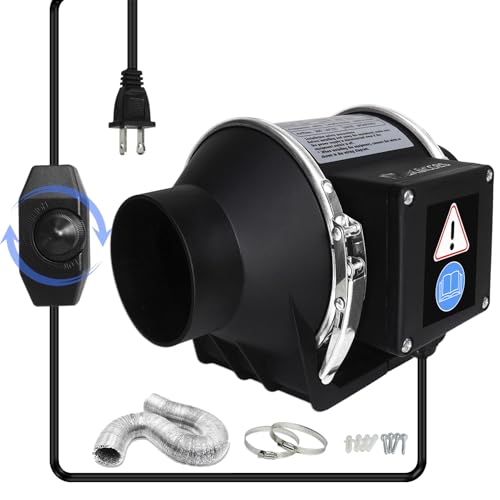
The Makacces inline fan features a 1Kg copper motor delivering up to 200 CFM at 2600 RPM. A speed controller allows precise airflow adjustments, making it suitable for diverse spaces such as 3D printer setups, resin workstations, and small grow tents. The 30 dB quiet operation helps maintain a low-noise environment in shared spaces.
Best for: environments requiring quiet but robust airflow with adjustable speed. Choose this if you want a balance of high flow and controllability. Caution: check duct compatibility and mounting orientation to ensure stable operation over time.
Attwood 1733-4 Blower Bilge 3″

This marine-grade blower is designed to exhaust vapors and stagnant air from enclosed engine compartments. The water-resistant motor is built to operate in demanding marine environments, offering reliable high-airflow performance. It’s a strong choice for tough, moisture-prone settings where robust construction matters.
Best for: harsh, moisture-heavy installations where bilge-type durability is valued. Caution: not optimized for silent operation; better suited for ventilation tasks where exposure to water and fuel vapors is common.
Qofioeuo 3 Inch Inline Duct Fan
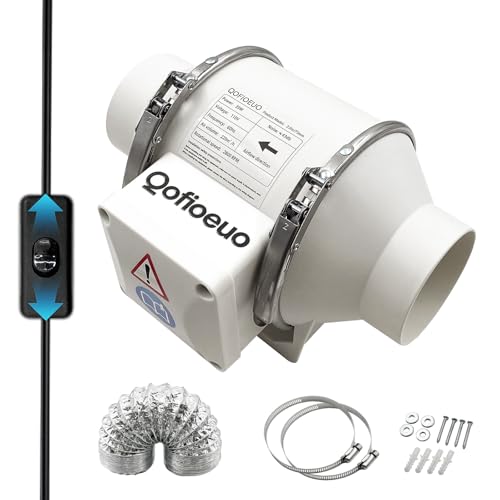
The Qofioeuo model offers up to 130 CFM with a copper motor and a built-in speed control for easy adjustments. It’s well-suited for small workshops, cabinets, and enclosed spaces where quick air changes are needed. Quiet operation helps maintain a comfortable work environment during long sessions.
Best for: compact spaces needing moderate airflow with straightforward speed control. Caution: perform duct sizing checks to prevent excessive backpressure that could reduce efficiency.
Buying Guide: How to Choose a 3-Inch Inline Fan
- Airflow requirements: Match CFM to the room size and the interval of ventilation. Higher CFM is better for faster air exchange but can increase noise if not paired with a quiet motor or vibration dampening.
- Noise level: Consider dB specifications and blade design. Quiet models at or below 30 dB are ideal for living or working spaces.
- Motor type and efficiency: Copper motors often deliver reliable performance and longevity. Look for energy-efficient models to reduce power draw over time.
- Speed control: A built-in controller or external regulator helps tailor airflow to changing needs, such as varying resin printing fumes or plant growth stages.
- Installation and durability: Check mounting options, whether the unit supports vertical and horizontal installation, and consider environments with dust, humidity, or fumes.
- Compatibility: Ensure duct size is a true 3 inches and check pipe length or elbows in your setup to avoid excessive turbulence or backpressure.
Frequently Asked Questions
- What is a good CFM for a small grow tent?
A small grow tent typically needs 100–150 CFM to exchange air effectively, depending on tent size and setup. Higher CFM models with speed control offer flexibility for growth stages.
- Do 3-inch fans tend to be loud?
Noise varies by model. Quiet designs aim for around 30 dB, but higher-speed settings can be louder. Look for balanced blades and vibration-dampening features.
- Is a speed controller necessary?
Not strictly necessary, but a speed controller lets you dial in airflow for different tasks, reducing energy use and noise when full power isn’t needed.
- What installation considerations matter most?
Ensure correct duct diameter, secure mounting, minimal bends, and compatibility with your enclosure materials to prevent leaks and excessive vibration.
- Are copper motors better than plastic ones?
Copper motors generally offer better durability and heat tolerance than plastic variants, especially in continuous or demanding applications.
- Can these fans be used for marine or wet environments?
Some models with water-resistant or rugged housing are intended for damp environments, but confirm IP rating and manufacturer guidance before use in wet areas.