Looking for a reliable 30 inch baseboard heater to warm a small-to-medium room? This guide highlights five solid options that balance heat output, installation considerations, and quiet operation. The top picks are best for different needs: compact spaces, fast warming, hardwired setups, and energy-conscious layouts. Read on to compare features, ideal use cases, and practical caveats.
| Product | Best For | Key Feature | Voltage |
|---|---|---|---|
| DIMPLEX LC3010W31 | Fast uniform heat in living areas | Top heat discharge for faster warming | 240V |
| 2F500-1W-A Mollii 30″ | Budget-friendly 500W baseboard | Moderate wattage with 1710 BTU/h | 120V |
| 2F500W-A Mollii 30″ 375/500W | Flexible wattage 208/240V | Dual wattage options | 208/240V |
| Cadet 3F750W 36″ (Not 30″ but popular) | High heat for larger spaces | 750W at 240/208V | 240/208V |
| Stelpro Brava AB0501W | Quiet convection with thermostat options | 500W convection heater, hardwired | 120V |
Notes: The table lists representative 30 inch options and related 36 inch or variant models for context. For strict 30 inch models, consider the Dimplex LC3010W31 and Mollii 2F500W-A variants, along with Stelpro Brava options that match similar dimensions and heat outputs. Always check your installation requirements, including preferred voltages and whether hardwired connections are feasible in your space.
Dimplex 30″ Linear Convector Electric Baseboard Heater

The Dimplex LC3010W31 is a 30-inch, 240V baseboard heater rated at 1000W. It features a top heat discharge design intended to speed warm air distribution toward the room’s center, which can help occupants feel warmer faster in mid-sized rooms. It uses a shark-fin blade design on a steel tubular element to improve heat transfer, with quiet operation and longer life. The unit is designed to be more discreet, being up to 42% smaller than conventional baseboards, allowing flexible placement and cleaner styling. Best for smaller living rooms or bedrooms where space is at a premium and quick warmth is desired. Caution: higher-wattage at 1000W may demand adequate electrical capacity and proper mounting clearance.
Mollifii 30″ Electric Baseboard Heater, 500W

The Mollifii 2F500-1W-A offers 500W at 120V, providing a compact, economical heating solution for small rooms or zones. Its straightforward 30-inch form factor makes it easy to fit under windows or along wall edges without crowding decor. This model is best for users prioritizing affordability and simple installation. It also provides a runtime-friendly option for zones that don’t require the full 1000W. Caution: At 500W, it may take longer to reach comfort in larger spaces.
Mollii 30″ Electric Baseboard Heater, 375/500W

This Mollii model provides dual wattage options (375W at 208V and 500W at 240V), giving flexibility for different electrical setups and room sizes. It suits spaces where a mid-range heat output is sufficient and where 208V supply is available. Pick this if you want a balance between energy usage and heating capacity. Caution: Confirm the correct voltage before installation to avoid under- or over-heating.
Cadet F Series 24″ Baseboard (Model 2F350W)
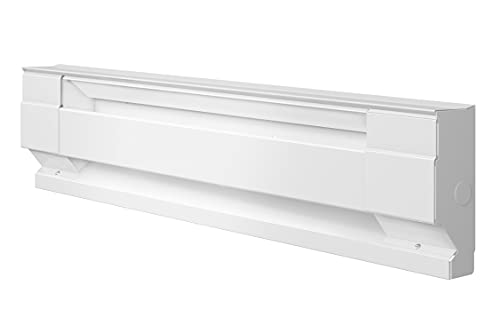
Cadet’s F Series includes the 2F350W, a 30-inch-variant family option for 240/208 Volt setups with 350/262 Watt output. This model is suitable for narrow wall spaces or as a zone heater in small rooms. It emphasizes simple installation with universal wiring and pre-punched knockouts, making it a practical choice for straightforward retrofits. Caution: This is a smaller wattage option; larger spaces may require higher output models to maintain comfort.
Stelpro Brava 500W / 120V Baseboard Heater (AB0501W)
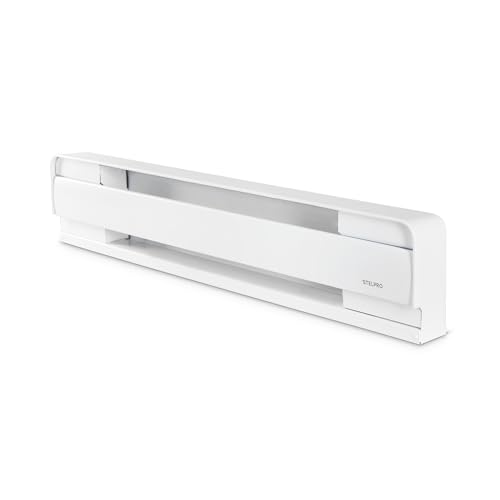
The Stelpro Brava AB0501W delivers 500W of convection heating at 120V. It is designed for silent operation without fans or moving parts, which can be ideal for bedrooms, offices, or media rooms where low noise is important. It requires hardwiring and offers control options via compatible wall thermostats or an optional on-unit thermostat kit. Best for those prioritizing quiet, diffuse heat and a clean aesthetic. Limitation: Not a plug-in unit; installation complexity depends on your electrical setup.
Buying Guide
What size and wattage should you choose? Focus on room size, insulation, and expected heat load. A 30-inch baseboard heater in the 500–1000W range is typically suited for small to medium rooms in well-insulated homes. For larger or draftier spaces, higher wattage or additional baseboard units may be necessary. Consider voltages available in your home: 120V units are common and easier to install, but 208/240V models can provide more heat with potentially better efficiency in rooms with appropriate electrical service.
Hardwired vs. plug-in. Many baseboards require hardwiring and thermostat integration for consistent control. If you want simple, wall-mounted thermostat compatibility, verify that the model supports the thermostat options you prefer. If you need plug-in flexibility, look for models explicitly designed for that configuration or consider conversion options with electrician guidance.
Installation and clearance. Check clearances from furniture, drapes, and walls to ensure safe operation. Slimmer profiles improve aesthetic integration and allow placement under windows or along baseboard lines without crowding. Noise considerations are also important; convection-based units tend to be quiet, while older or poorly installed units may produce slight hum or expansion sounds.
Controls and compatibility. If you plan to link multiple heaters for uniform room temperature, ensure control compatibility across units. Some units offer compatible built-in thermostats or external thermostat options for synchronized operation. Always confirm voltage and wiring requirements before purchasing.
Frequently Asked Questions
- What is the typical wattage for a 30 inch baseboard heater?
Answer: Most models in this size range run from about 350W to 1000W, depending on the model and voltage, to suit different room sizes. - Can I install a baseboard heater under a window?
Answer: Yes, baseboards are commonly placed under windows to offset heat loss, but ensure adequate clearance from curtains or furnishings. - Do I need a thermostat with a baseboard heater?
Answer: Many models pair with room thermostats to maintain consistent comfort; some units offer built-in thermostat options, while others require external control. - Are these baseboard heaters energy efficient?
Answer: Efficiency depends on insulation, room size, and proper wattage selection. Slower heat-up times can be offset by consistent, even heat distribution and proper zoning. - Is hardwiring required for most 30 inch baseboards?
Answer: Most higher-wattage 30 inch baseboards require hardwiring, though smaller units may be plug-in if designed for that setup.