Answering the common buyer question: which 4 inch inline fan fits your space and needs? This guide highlights five top options, each chosen for specific use cases like grow tents, bathrooms, kitchens, or hydroponics. The products below emphasize energy efficiency, noise levels, and reliable airflow, helping you pick the right model for your setup. Whether you need a compact unit for tight spaces or a high-CFM blower for larger tents, there is a best-fit choice here.
| Product | Best For | Approximate Airflow (CFM) |
|---|---|---|
| VIVOSUN 4″ Inline Exhaust Fan & Speed Controller | Grow tents, basements, bathrooms | 130 |
| VIVOSUN D4 4″ Inline Duct Ventilation Fan | Grow tents, heat transfer, rooms | 195 |
| AC Infinity CLOUDLINE PRO S4 | Hydroponics, AV racks, rooms needing quiet control | 195 |
| Hon&Guan 4 Inch Inline Booster Duct Fan | Quiet odor exhaust, small spaces | 130 |
| VIVOSUN M4 4-Inch Inline Duct Fan | HVAC, grow tents, hydroponics | 195 |
VIVOSUN 4″ Inline Exhaust Fan & Controller

Best for: small to medium grow spaces, bathrooms, or workshops needing steady airflow with energy efficiency. This model delivers up to 130 CFM and includes a speed controller, making it suitable for users who want simple, adjustable ventilation. The upgraded EC motor promises low energy use and longer service life, with a quiet operation level of about 26dB(A). This combination supports quieter spaces like home offices or quiet-living areas while maintaining effective exhaust. A potential limitation is that lower CFM may be insufficient for very large tents or high-heat rooms without additional units.
VIVOSUN D4 4 Inch 195 CFM Inline Duct Fan
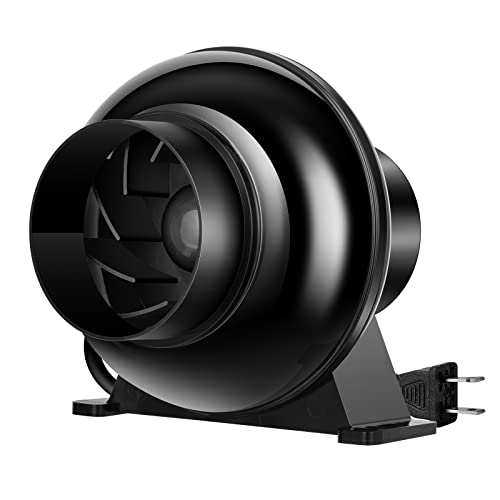
Best for: grow tents and rooms needing robust airflow with quiet operation. This fan can reach up to 195 CFM and features a flow-deflector design to reduce turbulence and noise to about 30 dB. It also includes ETL-listed motor protection and a flame-retardant junction box for safer operation. Choose this if you require higher airflow for larger tents or heat management, but be mindful that the higher output may be noticeable in very small spaces.
AC Infinity CLOUDLINE PRO S4

Best for: hydroponic setups, grow tents requiring precise control, and spaces where quiet, programmable ventilation matters. The S4 uses a PWM-controlled EC motor and a wired 10-speed controller, with compatibility for UIS controllers for advanced automation. It is designed to quietly move air while supporting variable climate needs. A consideration is that more complex installations may benefit from programmable controllers or app-based integration for advanced users, which can add setup time.
Hon&Guan 4 Inch Inline Booster Duct Fan

Best for: quiet, energy-efficient exhaust in environments like bathrooms, kitchens, or basements where odor control and space-saving installation are priorities. This model delivers up to 130 CFM with a low power draw of about 6W, using a DC motor to balance airflow with energy efficiency. It is well-suited for small-to-medium rooms, but note that very large or heavily polluted spaces might require higher-CFM units or multiple fans in parallel.
VIVOSUN M4 4-Inch Inline Duct Fan

Best for: versatile ventilation needs in HVAC, hydroponics, and grow tents that require adjustable speed and energy efficiency. The M4 runs at about 195 CFM with a PWM-controlled EC motor, offering three speed levels for precise airflow control. It features automatic reset and locked-rotor protection for safety. Use this when you need a flexible fan with reliable safety features and quiet operation. A limitation is that higher airflow models may require careful wiring and mounting to minimize vibration in sensitive spaces.
Buying Guide: What To Consider When Choosing a 4 Inch Inline Fan
Airflow needs: Calculate the space in cubic feet and multiply by the desired air changes per hour (ACH). For grow tents, 150–250 CFM is common for mid-sized tents; smaller areas can manage with 100–130 CFM. Higher CFM provides faster air replacement but may increase sound and energy use.
Noise level: Look for models with noise ratings around 25–30 dB for quiet operation in living spaces. Some units use deflectors or mixed-flow designs to reduce turbulence and sound.
Motor type and controller: EC motors and PWM speed control offer energy efficiency and smoother speed changes. Built-in speed controllers simplify installs, while external controllers enable automation with UIS or WiFi systems.
Safety and protection: Features like ETL listing, automatic reset, flame-retardant components, and protected electrical junction boxes improve safety and reliability in damp or enclosed spaces.
Installation space: Many models vary in body length and mounting configuration. Compact designs or shorter bodies fit tight closets, cabinets, or under tents where space matters.
Durability and environment: Copper windings, flame-retardant housings, and durable plastics contribute to longevity in humid environments like bathrooms or hydroponic rooms.
Use-case fit: For hydroponics or grow tents, prioritize higher CFM and stable climate control. For apartments or offices, prioritize quiet operation and energy efficiency to minimize disruption.
FAQ
- Q: What is the most important feature for a 4 inch inline fan in a grow tent? A: The right balance between CFM and noise level. Higher CFM moves air faster, but you still want low noise for a quiet grow tent.
- Q: Can I run multiple 4 inch fans in parallel? A: Yes, parallel setups can increase total airflow and provide redundancy, but wiring and controller compatibility should be considered.
- Q: Are EC motors worth it? A: EC motors offer energy efficiency and better speed control, which is beneficial for long-term use and precise climate control.
- Q: Do these fans require external controllers? A: Some models include built-in controllers; others rely on external controllers or app-based systems for automation.
- Q: Is a higher CFM always better? A: Not necessarily. If the space is small, too much airflow can cause unnecessary noise and energy use. Match CFM to space and needs.
- Q: What safety features should I look for? A: ETL listing, automatic reset, flame-retardant components, and quality wiring/J-box protection are important safety indicators.