If you’re seeking compact yet powerful 5-inch exhaust fans, you want options that move air effectively, operate quietly, and install easily in walls, ceilings, or ductwork. This guide highlights five reliable 5-inch models, clarifies who each is best for, and explains key differences to help you choose confidently. Ideal buyers include DIY homeowners, small workshops, grow tents, bathrooms, and utility spaces needing improved ventilation without heavy installation work.
| Product | Airflow (CFM) | Power | Best For |
|---|---|---|---|
| Suncourt 5-Inch Inline Booster Duct Fan (DB205C) | 75 – 130 | Low current draw | Small spaces needing boosted airflow without HVAC changes |
| ACEDUROBLA 4 inch Exhaust Fan | 117 | 20 W | Compact wall or window mounting with check valve |
| Hon&Guan 6 Inch Inline Booster Duct Fan | 345 | 19.2 W | Quietly move large air volumes in grow rooms or bathrooms |
Suncourt 5-Inch Inline Booster Duct Fan

This single-speed inline booster is designed to overcome back pressure and quietly boost airflow in systems where rooms feel uncomfortable. It is UL Listed and optimized for low noise with a range of 75 CFM to 130 CFM boosted air. Best for smaller living areas, utility spaces, or retrofits where you want to improve ventilation without major HVAC changes. A potential limitation is that it lacks multiple speed settings, so you cannot tailor airflow as precisely as multi-speed models.
ACEDUROBLA 4 Inch Exhaust Fan

This metal 4-inch exhaust fan delivers about 117 CFM at roughly 20 watts, making it a compact but capable option for bathrooms, kitchens, or small workshops. It includes a backdraft check valve and a slim design, which helps prevent odors from re-entering the space. Choose this if you want a sturdy metal unit with a built-in valve, but note the data specifies a 4-inch duct, which may require adaptation for some 5-inch projects or slightly larger installations.
Hon&Guan 6 Inch Inline Booster Duct Fan

With a 6-inch footprint and 345 CFM capacity, this unit is designed to quietly move large air volumes and is energy-efficient at 19.2 W. It’s well-suited for grow rooms, bathrooms, kitchens, or basements that require rapid ventilation. For tight spaces where 6 inches would be excessive, this may be a better pick for rooms with higher airflow needs, though it’s larger than many 5-inch options and may require duct adaptation.
HG Power 6 Inch Exhaust Fan

HG Power presents a 6-inch exhaust fan with a strong 308 CFM output at a 38W energy footprint. It features a durable metal construction and a long service life. Best for spaces that demand substantial air movement, such as garages or shops. A limitation is that it’s a larger 6-inch unit, which may not fit smaller openings without modification.
VENTS-US GK 125 MA Through-The-Wall Exhaust Fan
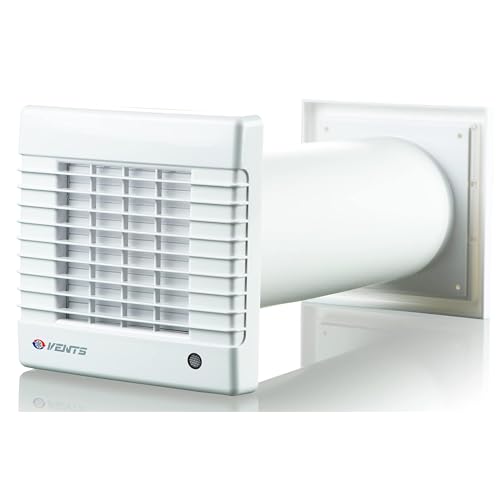
This 5-inch through-the-wall model provides 102 CFM and includes a duct and vent cover, simplifying installation and reducing backdraft risk. It’s ideal for bathrooms, basements, or garages lacking existing ventilation. It offers flexible power options via a plug-in cord or hardwire. Choose this if you want a straightforward wall-mounted solution with a built-in backdraft barrier, and avoid this if you need ultra-quiet operation at ultra-low noise levels.
Fepinc Duct Fan With Plug

Fepinc offers a 5-inch inline fan with 183 CFM, 40W power, and a 6.6-foot cord, making it a solid choice for bathrooms, kitchens, or grow tents. The unit is built with ABS plastic for durability. Best for portable or temporary installations where cord length matters, but it may be less suited for heavy-duty, long-term use compared with metal-bodied units.
Amico 6 Inch Kitchen Exhaust Fan
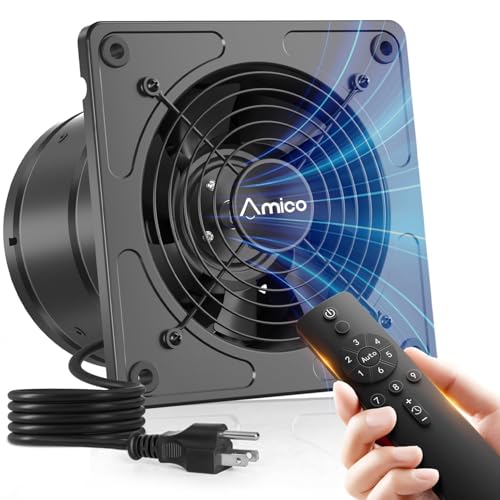
Amico’s 6-inch exhaust model uses a high-speed motor to deliver up to 358 CFM with a 10W EC motor for energy savings. It includes a remote and multiple speed settings, suitable for kitchens, garages, attics, or greenhouses where precise control matters. Best for advanced ventilation needs; consider space for the remote control and potential higher upfront cost against simpler inline boosters.
Aydomer 6 Inch Wall Mounted Exhaust Fan

This 6-inch wall-mounted unit delivers about 308 CFM with a metal construction designed for durability. It includes a backdraft damper and a detachable design for cleaning. Best for spaces needing robust exhaust and easy maintenance; however, the 6-inch size may require larger openings or ducting adjustments in tight installations.
Buying Guide
Key considerations for selecting a 5-inch exhaust fan include airflow needs, noise level, and installation constraints. Use these questions to compare models:
- What is the target space size and required CFM? For bathrooms and small rooms, 100-130 CFM may suffice; for grow tents or studios, 300+ CFM could be necessary.
- Is energy efficiency important? Look for models with low wattage and EC motors when available.
- What installation options are available? Through-the-wall, inline duct, or ceiling/wall mounting affect ducting length and mounting space.
- Do you need multiple speeds or remote control? High-control units offer flexibility for varying conditions.
- Is durability a priority? Metal housings tend to last longer in humid or dusty environments than plastic.
Quick buying tips
- For compact, quiet boosts in small rooms, choose an inline booster with moderate CFM and low noise.
- For grow tents or bathrooms with odors or humidity, prioritize higher CFM and a durable metal construction.
- If space is tight or you prefer wall-through installation, consider a through-the-wall model with a built-in damper.
FAQ
- What is a 5-inch exhaust fan best used for? It fits standard 5-inch duct work and is ideal for small rooms, bathrooms, grow tents, and compact utility spaces.
- Do 5-inch fans require professional installation? Some models are designed for DIY mounting; check your duct size, mounting location, and electrical requirements first.
- Can a 5-inch fan replace a larger one? It can, with proper airflow calculations. Larger rooms may need higher CFM or multiple units.
- Are there energy-efficient options? Yes, several models use low-power motors (including EC or DC variants) while delivering solid airflow.
- What maintenance is needed? Regular cleaning of grilles and dampers helps maintain efficiency and reduces noise.
- Do any models include dampers? Some include backdraft dampers or check valves to prevent odor backflow; verify in product features.