Find reliable 65,000 BTU propane heaters designed for RVs, off-grid camping, and small living spaces. This guide highlights five top options, shows who each product best serves, and explains why they stand out. Compare performance, installation considerations, and safety features to choose the right propane heater for your setup.
Summary table of selected products:
| Product | BTU / Capacity | Best For | Notes | |
|---|---|---|---|---|
| Feqivolt RV Tankless Water Heater 65,000 BTU | 65,000 BTU | RV users needing instant hot water with dual outlets | Dual outlets, remote control, ±2°F temperature stability | Front & rear outlets for flexibility |
| CAMPLUX CX264 65,000 BTU Tankless Water Heater | 65,000 BTU | Small living spaces needing reliable on-demand hot water | ±1°F temperature control, compact design | Indoor installation, space-saving |
| Silvbott 65,000 BTU RV Tankless Water Heater | 65,000 BTU | RV families seeking fast, on-demand hot water | Fast flow, low-noise operation | High-altitude compatibility |
| Somokg 65,000 BTU RV Tankless Water Heater | 65,000 BTU | Off-grid and RV users needing efficient propane use | Instant water, temperature stability, anti-freeze features | Replaceable standard RV cutouts |
| Gen II Ranein 65,000 BTU RV Tankless Water Heater | 65,000 BTU | Families needing simultaneous hot water for multiple points | Thermostatic mixing chamber, 12V powered | High-altitude ready |
Feqivolt RV Tankless Water Heater 65,000 BTU

The Feqivolt unit provides 65,000 BTU of heating power with staged combustion to optimize propane use and prevent overheating. It features a smart remote control for operation from up to 6.2 feet away and a rapid on-demand hot water capability. The design supports dual outlets (front and rear), making it suitable for families who need simultaneous access to hot water while traveling. Best for RV owners who want flexible hot-water delivery with a remote control. Caution: verify fit for your RV’s 15×15 inch door opening and ensure proper venting and clearance during installation.
CAMPLUX CX264 65k BTU Tankless Water Heater

The CAMPLUX CX264 delivers 65,000 BTU with a compact, space-saving design ideal for tiny houses, RVs, or apartments. It offers precise temperature control with ±1°F fluctuations to ensure comfortable showers even when water flow changes. Best for small spaces where maintaining consistent water temperature is a priority. Choose this if you need reliable indoor installation with a focus on temperature stability and space savings.
Silvbott 65,000 BTU RV Tankless Water Heater

Silvbott emphasizes fast on-demand hot water with a flow up to 2.3 GPM and low-noise operation. It is designed for high altitude compatibility and can support continuous use for showers and dishes. Best for RV households needing quick hot water without frequent re-fills. Limitation: proper installation requires a compatible RV setup with venting and a stable 12V power supply.
Somokg RV Tankless Water Heater 12V 65k BTU

Somokg offers instant hot water with precise ±1°F temperature control and a robust copper heat exchanger designed to resist freezing temperatures. It supports quick ignition and automatic flame adjustment to conserve propane. Best for off-grid campers who want reliable heat with low gas waste. Caution: exterior door is not included in some kits; check included components and replacement door options if needed.
Gen II Ranein RV Tankless Water Heater 65k BTU
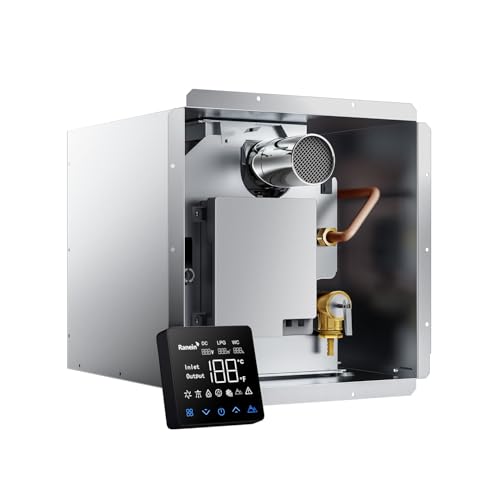
Ranein’s Gen II model includes a thermostatic mixing chamber to stabilize water temperature and a 12V power system for off-grid versatility. It’s designed for simultaneous use, balancing heat output to maintain comfortable shower temperatures even with multiple outlets. Best for families needing consistent hot water across several fixtures. It is high-altitude ready, but ensure your vehicle’s electrical setup matches the 12V requirements.
Buying Guide
- Hot water needs: For single or multiple fixtures, prefer units with higher GPM ratings and thermostatic mixing to maintain stable temperatures under varying demand.
- Installation space: Compact designs suit tight RVs and small homes. Check cabinet or exterior wall cutouts and door sizes to ensure fit.
- Power and venting: Most RV heaters require 12V power; verify your RV’s electrical system and propane supply. Proper venting and clearance are essential for safety.
- Altitude and climate: If you camp at higher elevations or in cold environments, choose models advertised as high-altitude ready with reliable ignition and anti-freeze features.
- Temperature control: Look for ±1°F to ±2°F stability or thermostatic chambers to minimize temperature swings during showers.
- Safety features: Automatic flame adjustment, leak detection, and shutoff mechanisms help reduce propane waste and prevent accidents.
- Replacement parts and service: Consider availability of replacement parts (gas nozzles, valves, doors) and ease of replacement for longevity.
Frequently Asked Questions
- What does 65,000 BTU mean for an RV heater?
It indicates the maximum heat output the burner can produce. Higher BTU can provide faster hot water heating and better performance in cold weather, but it also uses propane more quickly. - Can these heaters work off-grid?
Many models are designed for off-grid use with 12V power supplies, but installation and venting requirements vary. Always confirm compatibility with your RV electrical and propane setup. - Is dual-outlet hot water possible with these units?
Some models offer front and rear outlets for flexible hot-water distribution, which can be advantageous for simultaneous use in different RV zones. - What maintenance is required?
Regular inspection of seals, connections, and vent paths; periodic checks of propane lines; and ensuring the heat exchanger remains free of corrosion help maintain performance. - Are these heaters easy to replace in an existing RV?
Most RV tankless units are designed to replace standard cutouts, but verify opening sizes and mounting points. Some models require optional doors or trim kits. - Do these heaters work at high altitude?
Several models advertise high-altitude compatibility, which helps maintain performance where air pressure and temperatures vary.