Answering the main buyer intent, this guide helps you pick a 90 degree duct elbow that fits your space, reduces leakage, and preserves airflow. The top picks below are suited for different needs: space-saving close-turns, adjustable angles, and reliable metal construction for HVAC or dryer vent setups. Whether you’re finishing a compact laundry corner or upgrading an RV, these elbows offer secure connections and durable materials. Use the quick comparison table to identify the best fit for your environment and installation style.
| Product | Best For | Key Benefit |
|---|---|---|
| Whirlpool 4396006RW | Dryer vent installs in tight spaces | Close-turn 90-degree design with snap-lock |
| Mitchell Metal 4″/6″ Elbow | Rugged HVAC systems | Galvanized steel, adjustable angle |
| Hicarer 4 Inch 90 Degree | Budget-friendly dryer venting | Galvanized, adjustable |
| LIRAST 5 Inch | General ducting and vents | Plastic construction, standard 5-inch fit |
| A-KARCK 4 Inch | Leak-proof ducting joints | Sealed welds and sealant for tightness |
Whirlpool 4396006RW Genuine OEM Dryer Vent Elbow

Best for space-constrained dryer setups. This Whirlpool vent elbow is an OEM part designed for compatibility with Whirlpool and other compatible dryers. Its 90-degree close-turn helps you position the dryer closer to the wall without crimping or kinking the vent. The snap-lock collars enable quick, tool-free installation and a secure fit. This option is ideal for apartments, laundry closets, and rooms with limited clearance where a standard elbow would cause a bend too sharp or a bulky profile.
Caution: Verify model compatibility before purchase to ensure a proper fit with your dryer vent system.
Mitchell Metal 4″/6″ Adjustable Duct Elbow
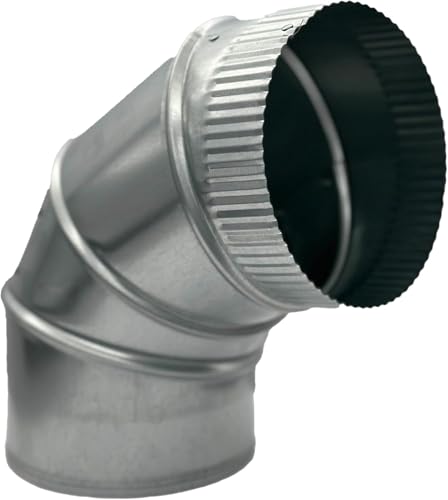
Best for robust HVAC installations. This galvanized steel elbow is designed for durability in both 4-inch and 6-inch ducts, making it suitable for a wide range of residential HVAC tasks. The adjustable 0°–90° angle helps you navigate tight corners and complex layouts while maintaining optimal airflow. It’s a solid choice for durable ductwork where longevity matters, such as long-term home upgrades or renovations.
Caution: Galvanized steel can be heavier than plastic options, which may require more secure mounting in some spaces.
Hicarer 4 Inch 90 Degree Galvanized Dryer Elbow

Best for quick, flexible dryer venting. This galvanized elbow is designed for a 4-inch system with an adjustable 90-degree angle. It features a sturdy construction and a slightly adjustable angle if the fit isn’t perfect, helping to align the vent with minimal effort. The durable galvanized finish resists wear in high-heat, high-dust environments commonly found in laundry areas.
Caution: While the angle is adjustable, excessive bending may reduce airflow; aim for smooth transitions where possible.
5 Inch 90 Degree Round Duct Elbow (Plastic)

Best for lightweight, cost-conscious projects. This 5-inch plastic elbow is designed for general HVAC ducting with a straightforward 90-degree bend. It’s corrosion-resistant and lighter than metal alternatives, which makes it easier to handle during installation. Suitable for general vent routing where metal isn’t required, such as hobbyist projects or budget-conscious retrofits.
Limitation: Plastic construction may be less durable in extreme heat or high-traffic environments compared with metal elbows.
GREENSEAM 90 Degree Elbow, 12″ Duct Size

Best for larger duct runs or refrigeration contexts. The GREENSEAM 12″ elbow supports broader ducting needs and is built for HVAC and refrigeration applications. This product is designed to bridge longer spans and encourage smooth air movement around corners. It’s a practical pick when the line of sight requires a longer, continuous elbow to maintain steady airflow through a larger duct system.
A-KARCK 4 Inch Duct Elbow with Rubber Sealing

Best for tight, leak-proof joints in metal-to-metal connections. This 4-inch elbow includes a sealing approach with internal and external gaps bonded to reduce leakage. The precision welded galvanized steel construction provides a seamless connection that helps maintain duct efficiency and minimize air loss, making it a solid option for critical ventilation paths or high-pressure systems.
Buying Guide: Key Purchase Considerations
Material choice matters. Galvanized steel elbows offer durability and better heat resistance, while high-quality plastics are lighter and easier to install for simple tasks. For dryer vents, metal options generally provide longer life in warm, humid environments.
Size and fit. Confirm the duct diameter (commonly 4″, 5″, or 12″) and the intended use (HVAC vs. dryer vent). An accurate match prevents leaks and reduces airflow resistance.
Angle range and adjustability. Some elbows are fixed at 90 degrees, while others are adjustable from 0° to 90°. Choose based on your space and the need to navigate corners without sharp crimping.
Sealing and leakage control. Look for built-in sealants or tight welds if leakage is a concern. Rubber seals or snap-fit designs can also improve airtightness in dry environments.
Installation effort. snap-lock and tool-free options speed up installation in tight spaces, whereas metal elbows may require mounting brackets or duct clamps.
FAQ
- What is the standard duct size for most 90 degree elbows? Common sizes include 4-inch and 5-inch ducts, with 12-inch variants available for larger runs.
- Are plastic elbows suitable for dryer vents? Plastic elbows are budget-friendly for dry venting in low-heat areas, but metal is usually preferred for durability and safety in dryer applications.
- Can I install a 90-degree elbow without tools? Some models offer snap-lock installation, which reduces tool use and speeds up the process.
- Should I choose an adjustable elbow? Adjustable elbows help accommodate tight spaces and nonstandard layouts, minimizing the risk of kinks.
- How do I prevent air leaks at joints? Look for sealed welds, rubber gaskets, or sealant options when shopping, and ensure proper clamping during installation.
- Is a longer elbow better for airflow? Longer elbows can introduce more bends and potential resistance; choose the shortest path that achieves a smooth transition.