Answering the search intent for a reliable 60 gallon air compressor tank, this guide highlights several top options suited for garages, workshops, and light industrial spaces. Each model below is chosen for durability, storage capacity, and steady airflow. Best for: contractors needing long run times, hobbyists with larger tools, and small shops seeking reduced refill cycles.
Quick comparison at a glance:
- Ingersoll Rand SS3L3: Durable cast iron, 60 gal vertical tank, high‑pressure up to 135 psi.
- Campbell Hausfeld 60 Gallon: Oil‑lubricated two‑stage pump, high capacity tank, up to 175 psi.
- VEVOR 60 Gallons Heavy‑Duty (Oil‑Lubricated): 4 HP, 10 SCFM @ 90 psi, max 125 psi.
- DEWALT 60 Gallon Vertical: 3.7 HP, 155 psi, space‑saving vertical design.
- Quincy 60 Gallon: 3.5 HP, 12.4 CFM @ 100 psi, high endurance vertical tank.
Ingersoll Rand SS3L3 60 Gallon Receiver Tank

Reference features: Cast iron construction supports long life with an endurance that can extend pump life beyond 5,000 hours. Maximum air delivery is 10.3 CFM at 90 psi, with a 60 gallon vertical ASME receiver providing strong pulse for demanding tasks. The unit offers auto start/stop control, is fully assembled and pre-wired, and allows easy maintenance via accessible filter, oil sight gauge, and fill port.
Best for: professionals who need robust, continuous duty capability and easier maintenance. Choose this if your workflow includes high‑demand tools and you value long‑term durability. Limitation: heavier unit due to cast‑iron components, which may affect mobility in tight spaces.
Campbell Hausfeld 60 Gallon Vertical Compressor
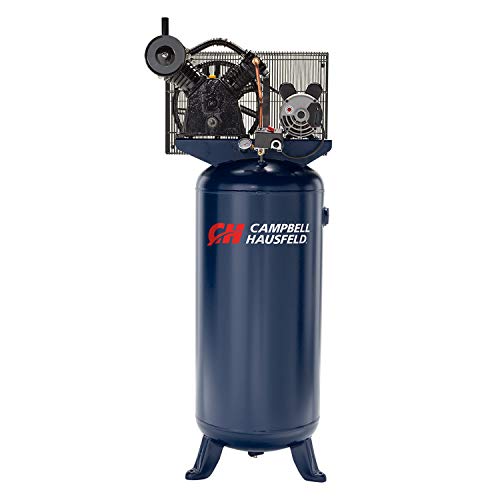
Reference features: Oil‑lubricated two‑stage pump designed for long service life and continuous operation. Large vertical tank provides ample storage, ideal for automotive, workshop, and professional shop use. Capable of up to 175 PSI max pressure to support high‑demand air tools and reduce cycle times.
Best for: automotive shops or garages that require sustained air flow and longer runtime between fills. Better for: users who prioritize higher max pressure and a two‑stage pumping system. Caution: oil management is required for optimal performance and longevity.
VEVOR 60 Gallons Heavy‑Duty Oil‑Lubricated Compressor
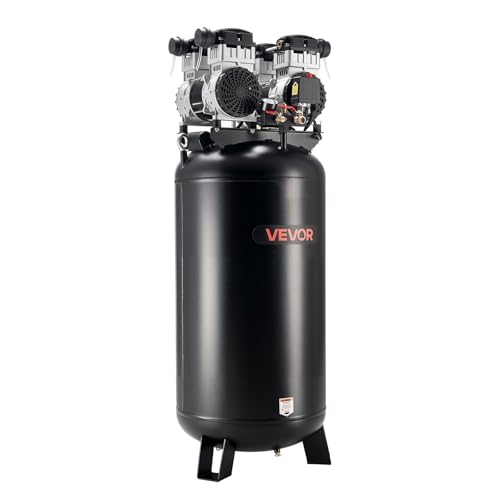
Reference features: 4 HP motor delivers 10 SCFM at 90 PSI, with a maximum pressure of 125 PSI. Oil‑lubricated design provides durable operation. A 60‑gallon tank supports extended air supply, suitable for industrial manufacturing and large workshops.
Best for: settings needing higher airflow with oil lubrication for durability. Choose this if you want steady performance with lower maintenance compared to some oil‑free models. Caution: bore wear and lubrication requirements mean regular oil checks are essential.
DEWALT 60 Gallon Vertical Air Compressor

Reference features: 3.7 HP electric design, 155 max PSI, and oil‑lubricated pump for reliable output. The vertical design saves floor space, making it suitable for compact workshops and garages while still delivering strong air pressure for heavy tools.
Best for: DIY enthusiasts and pros with limited floor area who still need reliable high‑pressure output. Better for: spaces where a compact footprint matters. Limitation: oil lubrication requires regular maintenance to sustain performance.
Quincy Single‑Stage 60 Gallon Compressor

Reference features: 3.5 HP, 12.4 CFM at 100 PSI, and a 60 gallon vertical tank. Operates at 230 V single phase with a maximum of 145 PSI, designed for robust, long‑lasting performance in professional shops.
Best for: users who want a balance of moderate airflow with substantial storage capacity. Choose this if you prefer a classic single‑stage setup and a proven vertical design. Caution: not the quietest option and may require more space for service access.
Buying Guide: Key Considerations
- What is your air demand? Match CFM at your typical tool pressure to avoid frequent cycling. Higher CFM at delivery pressure generally means faster tool performance.
- Tank size versus space. A 60‑gallon tank is substantial; ensure your workspace has room for vertical or horizontal layout and appropriate clearance for maintenance access.
- Pump type and lubrication. Oil‑lubricated pumps tend to be durable in busy shops, while oil‑free designs reduce maintenance but can be noisier or less robust under heavy use.
- Pressure rating. Applications vary; 135–175 PSI tops a lot of consumer and professional tools. Higher max PSI supports tools with higher pressure requirements but may draw more power and generate more heat.
- Duty cycle and noise. Consider duty cycle (how long the compressor can run before needing a rest) and noise level, especially in home garages or noise‑sensitive environments.
- Space and footprint. Vertical tanks save floor space but may extend height; ensure ceiling clearance and wall anchoring as needed.
- Maintenance needs. Oil level monitoring, filter access, and oil changes are part of routine upkeep for many 60‑gallon models. Oil‑free models simplify maintenance but may require more attention for air purity.
- Electrical requirements. Check voltage (230V is common for these units) and dedicated circuit needs to handle startup surges safely.
FAQ
- What is the advantage of a 60 gallon tank?
A 60 gallon tank provides longer runtime between fills, reducing cycling and enabling more consistent tool performance for extended tasks. - Should I choose oil‑lubricated or oil‑free?
Oil‑lubricated pumps tend to be more durable under heavy use; oil‑free models are easier to maintain but may require more attention to air purity and pump life under demanding cycles. - Is a vertical tank better than a horizontal one?
Vertical tanks save floor space and are common in limited rooms, while horizontal tanks can be more stable in certain layouts and easier to move on casters. - What PSI do I actually need for common tools?
Most shop tools perform well around 90–125 PSI. Higher‑pressure tools may benefit from models with 150 PSI or more, but ensure your tools require it before selecting. - Do these units require special foundations or mounting?
Some models are free‑standing, while others are designed for wall mounting or bolting to a base. Follow the manufacturer’s installation guidance for safety and longevity. - How do I maintain an oil‑lubricated 60‑gal compressor?
Regularly check oil level, change oil per manufacturer intervals, clean filters, and inspect belts and gauges for accurate readings.
| Model | Tank | Max PSI | Notable Strength | Best For |
|---|---|---|---|---|
| Ingersoll Rand SS3L3 | 60 gal | 135 | Long pump life, auto start/stop | Heavy-duty, continuous use |
| Campbell Hausfeld 60 Gal | 60 gal | 175 | Two‑stage pump | High‑demand automotive/workshop |
| VEVOR 60 Gal Oil‑Lubricated | 60 gal | 125 | Oil‑lubricated durability | Industrial manufacturing |
| DEWALT 60 Gal Vertical | 60 gal | 155 | Space‑saving vertical design | Compact workshop |
| Quincy 60 Gal | 60 gal | 145 | Reliable single‑stage | Professional shop |