Chilled water fan coils are a staple for efficient, centralized cooling in commercial, industrial, and some residential settings. This guide highlights five relevant products, explaining who they’re best for and how they compare. Ideal buyers include building engineers, HVAC installers, IT cooling managers, and DIY enthusiasts seeking reliable water-cooled options. The table below summarizes key picks to help you compare at a glance.
| Product | Brand | Best For | Why It Stands Out |
|---|---|---|---|
| First Company 6HBC3RH Chilled Hydronic Fan Coil Right Drain | First | Small to mid-size chilled water systems | Compact, right-drain configuration suited for tight spaces |
| Clyxgs Water Cooling Radiator, 12 Pipe Aluminum Heat Exchanger Radiator | Clyxgs | PC water-cooling or small cooling loops | Multiple pipes, aluminum fins for efficient heat transfer |
| BACOENG 3/8″ x 50Ft 304 Wort Chiller Coil | BACOENG | Homebrewing or DIY wort chilling | Large surface area for rapid cooling with stainless tubing |
| DIYhz Water Cooling Computer Radiator, 12 Pipe Aluminum Heat Exchanger | DIYhz | Custom liquid cooling for PCs | Balanced size and 12-tube configuration for heat dissipation |
| Clyxgs Water Cooling Radiator, 12 Pipe Aluminum Heat Exchanger Radiator | Clyxgs | PC CPU cooling and DIY liquid loops | Winged fins and black oxide paint for efficiency |
First Company 6HBC3RH Chilled Hydronic Fan Coil Right Drain

The First Company 6HBC3RH is a chilled hydronic fan coil designed for compact, right-drain installations. It suits small commercial spaces or retrofit projects where drainage and space constraints matter. Best for system designers prioritizing a straightforward integration into existing chilled water loops.
Why selected: It aligns with tight installations and standard hydronic circuits, offering predictable performance in compact footprints. Limitation: Specifics on capacity are not listed here, so verify compatibility with your loop pressure and flow requirements.
Best for: Small to mid-size buildings or retrofit projects needing a right-drain fan coil with reliable hydronic cooling.
Clyxgs Water Cooling Radiator, 12 Pipe Aluminum Heat Exchanger
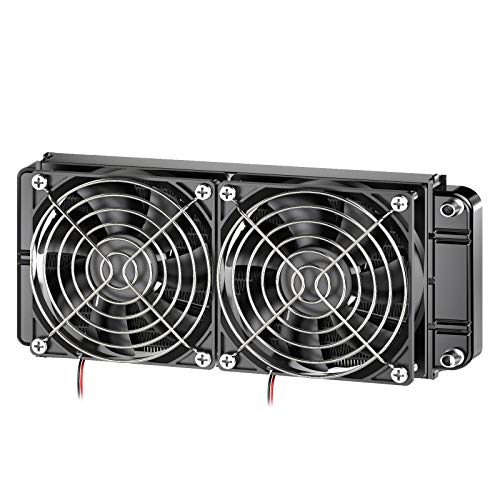
Best for PC enthusiasts or compact cooling loops needing multiple channels. The 12-pipe aluminum heat exchanger offers enhanced surface area for heat transfer and is paired with a black oxidation finish to improve thermal efficiency.
Why selected: Strong heat transfer potential in a compact form, suitable for custom PC liquid cooling or light industrial cooling. Caution: As a radiator, ensure your pump headroom matches the total loop pressure drop.
BACOENG 3/8″ x 50Ft Wort Chiller Coil

This stainless steel wort chiller coil maximizes surface area for rapid chilling of wort. It’s ideal for homebrewers and DIY setups that require quick thermal transfer with moderate water flow.
Why selected: Notable for fast chilling compared with traditional ice baths, and easy to clean due to stainless construction. Limitation: Intended primarily for beverage cooling rather than broader HVAC use.
DIYhz Water Cooling Computer Radiator, 12 Pipe

Best for PC builders seeking a balanced radiator with medium dimensions and 12-tube design. The 155 x 120 x 27 mm enclosure is compatible with standard 120 mm fans and DC12V operation.
Why selected: Good compromise between size and cooling capacity, suitable for mid-range builds. Caution: Ensure your case clearance and fan mounting align with the radiator’s footprint.
Clyxgs Water Cooling Radiator, 12 Pipe Aluminum Heat Exchanger Radiator with Tube

Another Clyxgs option, this 12-pipe radiator emphasizes aluminum fins and black oxidation to boost thermal efficiency. It’s well-suited for PC cooling loops that require multi-channel heat dissipation.
Why selected: Efficient heat transfer with a robust build for demanding computational tasks. Limitation: Data does not specify exact wattage capacity; verify against your CPU/GPU thermal load before purchase.
Clyxgs 8 Pipe Aluminum Radiator for PC Cooling

Best for compact PC builds needing multiple channels within a tight footprint. The 8-pipe configuration supports efficient heat transfer for smaller loops.
Why selected: Good fit for tighter builds where space is at a premium. Caution: Smaller piping may limit maximum flow rates in very high-performance systems.
Buying Guide: Chilled Water Fan Coils And Related Radiators
What should you consider when choosing a chilled water fan coil or radiator?
- System compatibility: Confirm coil or radiator dimensions, connector sizes, and flow requirements with your existing chilled-water loop.
- Heat transfer performance: Look for surface area (pipes, fins) and material (aluminum is common) to estimate cooling capability.
- Drainage and orientation: Right-drain versus left-drain configurations affect installation in constrained spaces.
- Maintenance: Stainless steel coils and easy-to-clean surfaces help keep performance over time.
- Power and controls: Ensure compatibility with your building’s controls, pumps, and 12V or low-voltage requirements if applicable.
- Application fit: HVAC-for-building cooling, PC liquid cooling, or beverage chilling each has different design priorities; match the product to the use case.
Frequently Asked Questions
- What is a chilled water fan coil used for?
Answer: It is a component in a centralized cooling system that transfers heat from indoor air to chilled water circulated in a loop. - What should I verify before buying a radiator for PC cooling?
Answer: Check size, tube count, material, compatibility with your water block and pump, and space inside the case. - Are aluminum radiators better for heat transfer?
Answer: Aluminum radiators are common for their balance of weight, cost, and thermal conductivity, but verify fin density and compatibility with your coolant. - Do I need a drain on a chilled coil?
Answer: Drain configuration depends on installation; some setups require a near-drain option for maintenance and condensate management. - How do I know which coil size fits my space?
Answer: Measure available clearance, inlet/outlet spacing, and matching pipe diameters to prevent fit issues. - Is a higher pipe count always better for cooling?
Answer: More pipes can increase heat transfer area, but it also increases resistance; balance with pump flow and loop design.