Direct path to finding the right commercial air handler unit starts here. This guide highlights five sturdy, reliable options for commercial or multi-use spaces, ranging from heavy-duty air handler stands to complete central air systems. The selections are best for facility managers, small business owners, and contractors seeking durable, corrosion-resistant components or complete inverter-driven systems. A quick buyer’s table follows the introduction for fast comparisons.
Buying table (summary)
| Product | Type | Best For | Key Benefit |
|---|---|---|---|
| F&L Heavy-Duty Aluminum Air Handler Stand – 18″ Tall | Stand | Small to mid-sized setups | Adjustable width; corrosion-resistant aluminum |
| F&L Heavy-Duty Aluminum Air Handler Stand – 36″ Tall | Stand | Medium to large configurations | Higher clearance; durable, 400 lb support |
| Senville 48,000 BTU Central AC & Heat Pump System | Whole-system | Large spaces | High capacity; energy-conscious operation |
| COSTWAY 36,000 BTU Ducted Central AC | Inverter ducted system | Balanced performance | Inverter with modern refrigerant; 19 SEER2 |
| Senville 60,000 BTU Central AC & Heat Pump System | Whole-system | Large, high-demand spaces | Maximum capacity; strong airflow |
F&L Heavy-Duty Aluminum Air Handler Stand – 18″ Tall

Features: Heavy-Duty & Lightweight Options – Available in multiple sizes with adjustable width for maximum compatibility. Premium Aluminum Construction – Corrosion-resistant, rust-proof, and designed for long-term durability. Its Support 400 lbs.
Best for: small to mid-sized commercial or residential projects needing a sturdy, corrosion-resistant stand that can support typical air handler weights. This option is ideal for retrofit installs in tight spaces where height clearance isn’t excessive. Limitation: Lower height means less vertical clearance for components if your setup requires substantial under-unit space.
F&L Heavy-Duty Aluminum Air Handler Stand – 36″ Tall
Features: Heavy-Duty & Lightweight Options – Available in multiple sizes with adjustable width for maximum compatibility. Premium Aluminum Construction – Corrosion-resistant and designed for long-term durability. Its Support 400 lbs.
Best for: installations requiring greater vertical clearance or heavier components. It’s a solid choice for medium to large systems with higher space constraints. Limitation: Taller stands may require more floor space and careful weight distribution planning.
Senville 48,000 BTU Central AC & Heat Pump System

Features: High Capacity Output – 48,000 BTU designed for large residential or light commercial spaces. Efficient Operation – Up to 17.6 SEER2 for energy-conscious performance. Strong Airflow Delivery – Provides up to 1690 CFM for full-area coverage.
Best for: larger spaces needing a complete central air solution with reliable heating and cooling performance. Choose this if you require robust airflow and efficient operation for sustained use. Limitation: A higher capacity unit may be more than needed for very small spaces.
COSTWAY 3 Ton Ducted Central Air Conditioner Heat Pump System
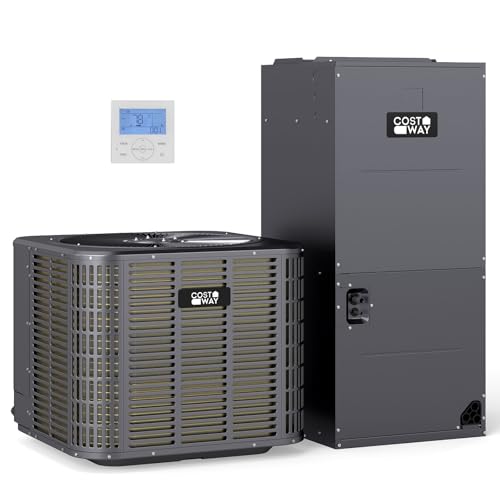
Features: Powerful Performance – 36000 BTU central air conditioner ensures fast cooling and heating with low noise. Inverter Technology – Green R454B refrigerant supports efficient operation. Energy Efficiency – SEER2 19 rating and HSPF2 9 rating. Compatible with RS485 or 24V communication.
Best for: spaces that require a ducted system with inverter efficiency and flexible communication options. This is a solid choice when upgrading to a modern, energy-conscious central system. Limitation: Ducted installations can require more complex layout and professional planning.
Senville 60,000 BTU Central AC & Heat Pump System
Features: Maximum Capacity Performance – 60,000 BTU for large spaces and high-demand applications. Reliable Efficiency – Up to 17.1 SEER2 for balanced performance and energy savings. High Airflow Output – Delivers up to 1740 CFM for wide coverage.
Best for: large commercial spaces or multi-zone environments needing substantial cooling and heating capacity. Choose this for maximum throughput and consistent climate control in demanding settings. Limitation: Higher capacity systems may entail greater upfront and installation considerations.
Buying Guide
What type of air handler solution do you need?
Decide between air handler stands for equipment support and complete central air systems. Stands are best when you already own a separate outdoor unit or need to elevate and organize indoor components. Central air systems are more comprehensive and suitable for larger spaces requiring integrated cooling and heating.
How to size for a space?
Choose BTU ratings and CFM figures based on space size, insulation, occupancy, and heat-generating equipment. Higher BTU units or airflow figures deliver faster cooling and more uniform distribution, but they come with higher energy use and installation considerations.
Energy efficiency and refrigerants
Look for SEER2 and HSPF ratings to gauge ongoing energy costs. Modern refrigerants like R454B offer environmental and efficiency benefits. Inverter-driven systems adjust capacity to demand, reducing consumption during lighter loads.
Installation considerations
Central ducted systems require ductwork layout planning, electrical readiness, and sometimes building modifications. Stand-alone stands are easier to install where space is tight or when retrofitting an existing indoor unit.
Cost vs. performance
Higher-capacity or feature-rich systems deliver better long-term climate control, but require higher upfront investment and installation complexity. Assess total cost of ownership, including energy usage, maintenance, and space requirements.
How to choose between the five options?
- Best for small spaces: 18″ or 24″ stands with corrosion-resistant aluminum, if you only need support for a compact air handler.
- Best for mid-sized spaces: 36″ stands for greater clearance and heavier components.
- Best for large spaces needing whole-system cooling: Senville 48,000 BTU or 60,000 BTU central systems.
- Balanced efficiency with ductwork: COSTWAY 36,000 BTU ducted system with inverter technology.
Maintenance considerations
Regular inspection of stands and ducted connections helps prevent alignment issues and airflow restrictions. Indoor units and ductwork should be cleaned and serviced per local guidelines to maintain efficiency and air quality.
FAQ
- What is a central air system’s typical use? It provides integrated cooling and heating across large spaces with a single outdoor and indoor unit pair and ductwork.
- Is an inverter system worth it? Yes for energy savings and smoother operation, especially in variable load scenarios.
- Do stands affect performance? Stands mainly affect installation convenience, clearance, and weight support, not cooling capacity.
- What refrigerant should I expect? Modern systems may use R32 or R454B refrigerants; check local compatibility and environmental guidelines.
- How do I choose the right BTU? Base decisions on space size, insulation, occupancy, and heat sources; larger spaces benefit from higher BTU units for even cooling.
- Do these units require professional installation? Ducted systems generally require professional installation, while some stands and standalone units may be more straightforward, depending on existing infrastructure.