If you’re shopping for a compact air conditioning unit, you’re likely balancing space, cooling power, and ease of use. This guide highlights five compact models well-suited for small bedrooms, dorms, offices, and studios. Each entry explains who benefits most, why it was selected, and a practical caveat to consider before you buy. The top picks include a mix of portable units and small window units to fit different window configurations and room layouts.
| Product | Type | Best For |
|---|---|---|
| Garvee 3-in-1 Portable Air Conditioner | Portable | Small to mid-size rooms up to 350 sq ft; those who want cooling, dehumidifying, and fan in one unit |
| GE Window Air Conditioner 5,000 BTU | Window | Very small rooms (up to 150 sq ft); quick install without ducting |
| GarveeLife 8000 BTU Portable Air Conditioner | Portable | Bedrooms or offices up to 350 sq ft; 3-in-1 cooling, dehumidifying, and fan |
| MEPTY 8000BTU Portable Air Conditioner | Portable | Single rooms up to 350 sq ft; self-evaporation and timer features |
| BSUIAK 4-in-1 Evaporative Portable AC | Portable | Small spaces needing cooling plus humidification and a compact footprint |
Garvee 3-in-1 Portable Air Conditioner

The Garvee 3-in-1 unit delivers cooling, dehumidification, and fan modes in a compact package. It cools to 61°F-88°F, handles spaces up to 350 sq ft, and includes a remote control, sleep mode, and a 24-hour timer. This model is best for renters or small-room dwellers who want flexible climate control without a built-in AC unit. A key caveat is the need for a window kit and exhaust hose alignment, which can require a few setup minutes to seal properly.
GE Window Air Conditioner 5,000 BTU

GE’s 5,000 BTU window unit is a solid choice for very small rooms up to 150 sq ft. It features mechanical controls for simple operation and two cooling modes with two fan speeds for basic customization. The unit is especially suitable when a quick, no-frills installation is needed and you don’t require smart features. A limitation is that it relies on a window installation and doesn’t offer app control or Wi-Fi features.
GarveeLife 8000 BTU Portable Air Conditioner

The GarveeLife model provides 8000 BTU cooling for spaces up to 350 sq ft, aimed at bedrooms, offices, and dorm rooms. It combines cooling, dehumidification, and a fan, with a remote for easy daily use. It’s notably portable with casters and a built-in handle. A potential limitation is that airflow can be best optimized with doors and windows closed, which may affect multi-space cooling plans.
MEPTY 8000BTU Portable Air Conditioner
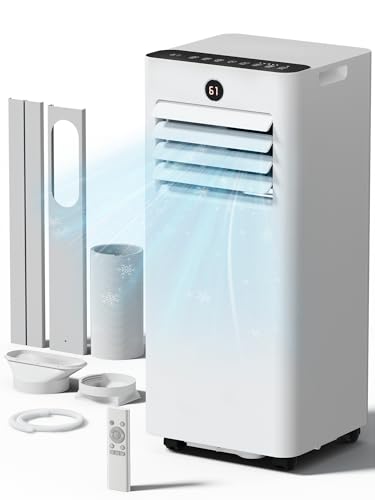
MEPTY’s 8000 BTU portable unit targets single rooms up to 350 sq ft with cooling, dehumidification, and fan modes plus a sleep timer and remote control. It features a self-evaporation system to recycle condensate and reduce manual draining in typical use. Best for users who want a compact unit with energy-saving timer features. Note that manual drainage may still be required if the water-full alarm triggers in humid, high-moisture environments.
BSUIAK 4-in-1 Evaporative Portable AC
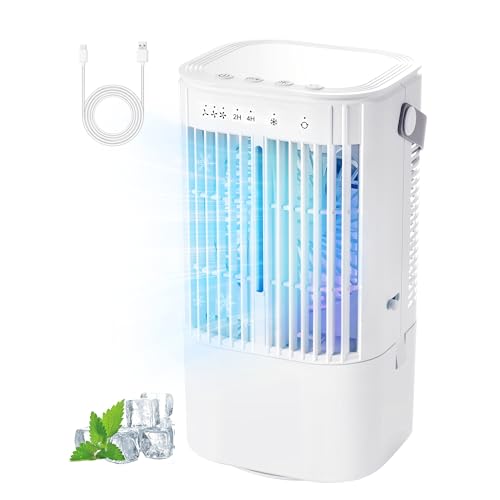
BSUIAK’s compact unit blends evaporative cooling, humidification, a fan, and an LED light into a single device. It’s ideal for small rooms where you want a budget-friendly, space-saving solution that also improves air moisture. The device operates quietly and is well-suited for night use. On the downside, evaporative cooling is less effective in very humid environments, which can limit overall cooling performance in those conditions.
Buying Guide: Key Considerations For Compact AC Units
- Room size and BTU needs: Match BTU to the room size. For up to 350 sq ft, models in the 8000 BTU range are common; smaller rooms may be comfortable with 5000 BTU units.
- Portability vs. window install: Portable units offer placement flexibility but require an exhaust path. Window units are more permanent-coolers with simpler venting but require a window-compatible space.
- 3-in-1 vs single-function: If humidity control matters, a 3-in-1 or 4-in-1 can be advantageous. For basic cooling, a single-function unit may suffice and be lighter.
- Noise levels: Look for “sleep mode” or low-dB operation for bedrooms and nurseries. Portable models typically run louder than many window units.
- Self-evaporation and drainage: Self-evaporating designs reduce manual drainage, but some models still require occasional drainage in high-humidity climates.
- Remote control and timers: Remote operation, digital controls, and 24-hour timers add convenience for all-day or overnight use.
- Energy efficiency: Consider energy-saving modes and energy star-rated options to minimize energy consumption during extended use.
Frequently Asked Questions
What size compact AC is best for a small bedroom?
Most small bedrooms benefit from a unit in the 5000–8000 BTU range, depending on window size, ceiling height, and insulation.
Are portable air conditioners as effective as window units?
Portable units can be as effective for the targeted space but require a venting path and may need more space for airflow around the unit.
Do I need to drain a portable AC with a self-evaporation system?
Self-evaporation reduces drainage needs, but manual drainage may still be required in high-humidity environments or if the condensate tank fills.
Is a smart feature worth it for a compact AC?
Smart features enable remote control and scheduling, which can improve comfort and energy savings, especially when you’re away from the room.
Can I use a compact AC in a living room with high ceilings?
Compact units perform best in standard to slightly above-average ceiling heights. Extremely tall spaces may require higher BTU or multiple smaller units.