Answering the search intent for efficient, space-saving hot water systems, condensing gas tankless water heaters deliver on-demand heat with high energy efficiency. This guide highlights top options ideal for households seeking continuous hot water, reduced energy bills, and compact installation. Best for homes with multiple bathrooms, large households, or spaces where running a traditional tank is impractical. Read on to compare five models and use the Buying Guide to select the right fit.
| Product | Best For | Key Benefit |
|---|---|---|
| ThermoMate CZ480NG 5.28GPM Condensing Tankless Water Heater | Busy households needing simultaneous showers | Dual heat exchangers for high efficiency |
| NEW Rinnai RX199iN Condensing Smart Sense | Indoor/outdoor versatility with high flow | Up to 11.1 GPM, WiFi-ready control options |
| NEW Rinnai RX130iN Condensing Smart Sense | Compact, versatile installs | Up to 7.1 GPM, indoor/outdoor capable |
| Rheem RTG-84XLN-3 | Outdoor setups with robust flow | 8.4 GPM, reliable for larger loads |
| Westinghouse Smart Tankless Water Heater | Whole-home non-condensing option | 7.9 GPM, WiFi app control |
ThermoMate CZ480NG Condensing Tankless: 5.28 GPM

Best for: medium-to-large households needing reliable hot water on demand with good efficiency. The ThermoMate CZ480NG uses a dual heat exchanger setup to boost heat recovery and overall energy efficiency, delivering up to 5.28 GPM at 105°F taps for simultaneous use. It features an 0.86 UEF rating and a responsive heating system that adjusts power up to 20,000 times per second to minimize temperature swings.
Why selected: This model emphasizes energy savings and heat reuse, making it a strong condensing option for homes aiming to lower operating costs. Its corrosion-resistant stainless steel condensing heat exchanger plus oxygen-free copper exchanger work together to capture waste heat that conventional units lose.
Who it’s best for: households that want strong efficiency with consistent hot water for two showers, especially where daily demand is steady. It is suited for indoor installation, where space is available, and where users prioritize energy savings over the largest possible flow.
Caution or limitation: While efficient, its maximum flow is around 5.28 GPM, which may be tight for very large households during peak simultaneous hot-water demands. Plan for quieter operation in living spaces as with most condensing units.
Rinnai RX199iN Condensing Smart Sense

Best for: homes needing high water capacity and flexible installation options. The RX199iN supports indoor or outdoor placement via Versa Vent and runs on natural gas or propane through a Smart Sense gas control system, designed to deliver up to 11.1 GPM with compact dimensions.
Why selected: It combines condensing efficiency with a sleek interface and Quick Flush for easier maintenance, plus the potential for remote monitoring via Controlr modules (WiFi control depends on specific kit). It’s a robust choice for households that expect high simultaneous demand without sacrificing efficiency.
Who it’s best for: larger families or homes with multiple simultaneous hot-water uses, such as several bathrooms and a laundry load, where the larger GPM rating ensures steady supply.
Caution or limitation: Outdoor installation may require additional venting considerations and a compatible control module for WiFi features. Verify space for Versa Vent compatibility before purchase.
Rinnai RX130iN Condensing Smart Sense

Best for: compact, versatile installations where indoor or outdoor placement is needed. The RX130iN provides up to 7.1 GPM and uses Smart Sense gas control for propane or natural gas with Versa Vent compatibility, making it flexible for different home layouts.
Why selected: It balances space efficiency with solid flow, suitable for typical 2–3 bathroom homes. Its modern design includes Quick Flush and a high-efficiency factor (UEF) for cost-conscious buyers who still want dependable performance.
Who it’s best for: purchasers seeking a mid-range option that travels well across indoor or outdoor settings and doesn’t require the largest household capacity.
Caution or limitation: While compact, the RX130iN’s GPM ceiling may limit simultaneous heavy-use scenarios in larger households. Confirm peak demand needs before installation.
Rheem RTG-84XLN-3 Outdoor Tankless
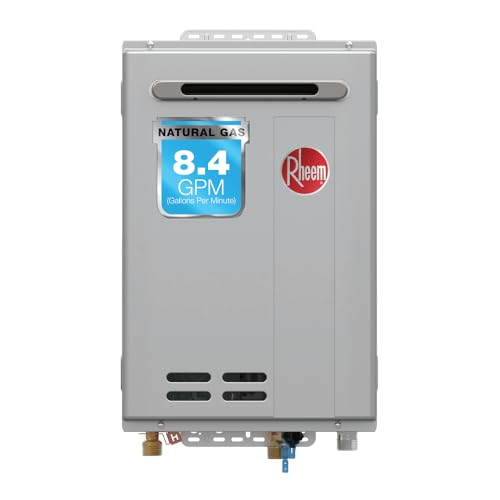
Best for: outdoor installations needing solid hot-water capacity with straightforward setup. The RTG-84XLN-3 delivers up to 8.4 GPM and 180,000 BTUs, designed for reliable performance in moderate to large homes.
Why selected: It’s a reliable non-condensing option for outdoor use with a durable exterior and clear installation approach, suitable for spaces where indoor venting isn’t available or desired.
Who it’s best for: homes with outdoor-only install plans or where a rugged outdoor unit is preferred, particularly when higher GPM is needed for simultaneous uses.
Caution or limitation: Being non-condensing, it may be less energy-efficient than condensing models and could incur higher long-term operating costs in climates with high hot-water usage.
Westinghouse Smart Tankless Water Heater

Best for: whole-home applications with WiFi control and precise temperature stability. The Westinghouse model offers up to 7.9 GPM and 180,000 BTU, focusing on consistent water temperature and app-based management.
Why selected: It provides Smart WiFi app control and precise ±1°F temperature stability, which helps households manage hot water more predictably across fixtures.
Who it’s best for: homeowners who want modern digital controls and reliable performance across multiple fixtures without needing condensing heat-exchanger complexity.
Caution or limitation: As a non-condensing unit, it may not achieve the same energy efficiency as condensing types, which can affect long-term energy costs.
Buying Guide: How to Choose a Condensing Gas Tankless Water Heater
- Flow rate needs: Calculate the required GPM by adding expected usage per fixture (shower, sink, laundry). Condensing models often pair high efficiency with solid GPM, but match to peak demand.
- Ventilation and location: Indoor installs require proper venting; outdoor models may simplify venting but need weather considerations. Versa Vent compatibility matters for some Rinnai units.
- Fuel type and compatibility: Most condensing gas tankless heaters support natural gas or propane. Confirm your fuel type and ensure the control system matches your installation.
- Efficiency and operating cost: Condensing units typically offer higher efficiency (UEF around 0.97–0.98) due to heat recovery. This lowers energy use but may involve higher upfront costs.
- Controls and monitoring: WiFi-enabled controls and Quick Flush features simplify maintenance and monitoring. Check compatibility with existing smart-home setups if desired.
- Durability and protections: Look for protections such as freeze, flame-out, overheating, and boiler-specific safety features. Stainless steel heat exchangers enhance longevity in condensing units.
- Installation type: Decide between indoor vs. outdoor installation and whether you need compact units for tighter spaces.
Frequently Asked Questions
- What is a condensing tankless water heater?
A condensing tankless water heater uses a secondary heat exchanger to reclaim heat from exhaust gases, increasing efficiency and reducing energy use compared to non-condensing units.
- Which is better for a two-bath home: condensing or non-condensing?
Generally, condensing models provide higher efficiency and useful heat recovery, which benefits homes with multiple simultaneous demands. However, match GPM to peak needs for accurate sizing.
- Can these heaters be installed indoors?
Many models listed are designed for indoor or outdoor installation. Check the product specs and venting requirements to confirm suitable placement.
- Do high-efficiency units require more maintenance?
Condensing units may require periodic flushing and maintenance, but modern designs include features to simplify care and prolong life.
- How do I choose the right GPM?
Estimate the combined water demand of your household’s showers, sinks, and appliances. Choose a unit with a higher GPM than your peak requirement to avoid cold-water shocks.
- What safety protections matter?
Look for boil-dry protection, freeze protection, overheating safeguards, flame-out protection, and pressure-related safeguards in modern condensing gas tankless heaters.