Answering common buyer questions, these copper coil tubings are chosen for HVAC, refrigeration, and DIY heat-exchange applications. The list focuses on flexible, seamless T2 copper coils that deliver excellent thermal conductivity and durability. Best for professional installers needing reliable refrigeration tubing, and DIY enthusiasts seeking easy installation and good sealing. The top five products below offer clear advantages in terms of size, flexibility, and compatibility with standard HVAC components.
| Product | Size / Type | Best For |
|---|---|---|
| GOORY Copper Tubing | 3/4″ OD x 0.687″ ID, 50 ft | General refrigeration, DIY HVAC |
| ELECTRAPICK Copper Tubing | 5/8″ OD x 9/16″ ID, 50 ft | Air conditioning and refrigeration systems |
| TAUROX 25 Ft Copper Tube | 1/4″ OD x 1/4″ ID, 25 ft | Compact cooling loops and tight bends |
| MECCANIXITY T2 Copper Tubing | 0.04″ ID x 3/32″ OD, 5 ft | Precision cooling loops, quick installations |
| MECCANIXITY T2 Copper Tubing | 0.04″ ID x 3/32″ OD, 3.28 ft | Same high quality, short runs |
GOORY Copper Tubing 3/4″ OD x 0.687″ ID

Product features: Annealed UNS C12200 seamless copper, 3/4″ OD x 0.687″ ID, wall 0.031″, 50 ft length. It’s ASTM B280 compliant and designed for refrigeration use. Production nitrogen filling reduces impurities, enhancing anti-rust and anti-corrosion performance. Best for heavy-duty HVAC runs where long lengths and high flexibility are needed. Caution: ensure proper handling to avoid kinks during installation.
ELECTRAPICK Copper Tubing 5/8″ OD x 9/16″ ID

Product features: 5/8″ OD x 35/64″ ID, 50 ft length. Made from high-quality C12200 copper with no seams, excellent corrosion resistance, and strong heat transfer. Durable for both hot and cold pressures, and suitable for maximizing refrigeration efficiency. Best for projects requiring smooth surface and uniform wall thickness. Limitation: slightly smaller diameter than some mainline coils, so match to your system’s fittings.
Water to Air Heat Exchanger (AB)

Product features: 18×18 inch, 1″ copper ports, 120,000 BTU capacity, up to 360,000 BTU per hour with 12 fins and 3 rows of 3/8″ seamless copper tubes. Fin design enhances contact areas for better heat transfer. Best for outdoor wood-fired or hybrid heating setups that use water-to-air exchange. Caution: installation requires appropriate plenum access and space for airflow considerations.
ICS Industries Refrigeration ACR Tubing (7/8R50)

Product features: Good quality copper tubing for refrigeration, ASTM B-280, MADE IN USA. Suitable for standard refrigeration lines where robust copper is preferred. Best for contractors who require US-made tubing with straightforward compatibility. Limitation: may be less flexible at very tight bends compared to some softer coils.
TAUROX 25Ft Copper Tube 1/4 OD

Product features: 25 ft of 1/4″ OD x 1/4″ ID copper tube, 0.7 mm wall. Premium C12200 copper, seamless, compliant with ASTM B280. Smooth surface supports good sealing and leak resistance. Flexible enough for professional bends while maintaining structural integrity. Best for compact installations where space and maneuverability matter. Caution: shorter run length than some 50 ft coils; plan for additional pieces if needed.
MECCANIXITY T2 Copper Tubing 0.04″ ID x 3/32″ OD (3.28 Ft)
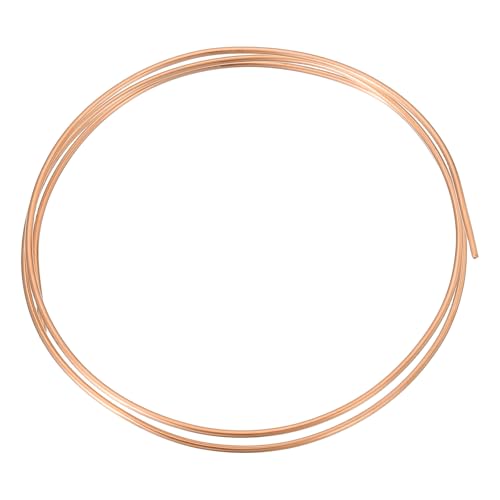
Product features: 0.04″ ID x 3/32″ OD, 3.28 ft per piece. T2 copper material, seamless tube with smooth surface for easy cut-to-length sizing. Good plasticity for hot and cold processing and strong heat transfer. Best for precise, short-run segments and where exact lengths are required. Caution: verify compatibility for your specific system length and connector sizes.
Buying Guide: Key Considerations For Copper Coil Tubing Use
- Material grade and standard compliance: Look for UNS C12200 copper and ASTM B280 compliance for reliability in refrigeration and HVAC applications.
- Tube dimensions: Match outer diameter (OD), inner diameter (ID), and wall thickness to your system’s fittings and expected refrigerant pressure.
- Length and flexibility: Longer coils offer fewer joints but can be less flexible; shorter coils provide easier routing in tight spaces.
- Seams and surface finish: Seamless tubes reduce leak points; smooth finishes improve sealing and ease of bending.
- Durability and corrosion resistance: Nitrogen-filled production and anti-corrosion features extend service life in humid environments.
- Installation practicality: Consider ease of cutting, bending by hand, and compatibility with standard fittings and connectors.
- Application fit: Choose based on intended use—refrigeration lines, air conditioning loops, water-to-air heat exchangers, or DIY projects.
FAQ
- What is the difference between OD and ID in copper tubing? The outer diameter (OD) is the pipe’s external width, while the inner diameter (ID) is the hollow interior width. Both dimensions affect fittings, pressure handling, and flow rate.
- Is seamless copper tubing better for HVAC? Yes, seamless copper tubes have fewer leak points and higher reliability under refrigeration pressures compared with welded or seam-only tubes.
- Which size should I choose for air conditioning lines? Common choices include 1/4″ to 5/8″ OD, depending on system capacity and compressor requirements. Always match to your compressor outlets and condenser connections.
- Can copper tubing be bent by hand? Some tubes are designed with good plasticity to allow manual bending, but use proper bending tools to avoid kinking.
- What precautions improve longevity? Use tubes with anti-oxidation treatments, ensure proper sealing, and avoid over-torquing fittings to prevent leaks.
- Are these coils suitable for DIY projects? Yes, several listed products are marketed for DIY, provided you follow standard safety and installation guidelines for refrigerant systems.