Answer: These 12V DC RV air conditioners are designed to run off RV batteries with minimal power draw, ideal for off‑grid travel, boondocking, and family trips. They suit RVers who want reliable cooling without a generator, those who prioritize low noise, and campers seeking long battery life. Below are five top options chosen for efficiency, battery compatibility, and quiet operation. A quick buying table is provided to compare key attributes at a glance.

| Product | BTU / Capacity | Best For | Approx. Power Need | Special Note |
|---|---|---|---|---|
| Countrymod 12V DC 10000 BTU | 10,000 | RVers needing rapid cooling | ~300–900 W | Low noise, APP remote |
| Gidrox 10000 BTU 12V DC | 10,000 | Quiet nights on battery | ~350 W | 3 modes: Turbo, ECO, Sleep |
| Gidrox 12000 BTU 12V DC w/ Heat Pump | 12,000 (cooling) / 9,000 heating | All‑season comfort | ~350 W | Heat pump option |
| Xenjum 11,000 BTU 12V DC | 11,000 | Off‑grid, off‑camping | Low energy, 35 dB | Soft start for battery life |
| OutEquip 10,000 BTU 12V DC | 10,000 | Rugged, durable installs | 8–10 h at 12V | Weather‑resistant |
Countrymod 10000 BTU 12V DC RV AC Unit
The Countrymod 10000 BTU 12V DC RV air conditioner uses inverter design to deliver rapid cooling with 10,000 BTU output. It adjusts compressor speed to match cooling demand and maintains a comfortable interior temperature. Best for campers who want strong performance with energy efficiency and APP remote control for convenient operation. A potential limitation is that performance depends on battery capacity and ambient conditions, so ensure your system can sustain the load overnight.
Best for: RV travelers who want fast cooling and app control, with moderate power use.
Gidrox 10000 BTU 12V DC RV Air Conditioner

This Gidrox model delivers up to 10,000 BTU cooling powered directly by the RV battery, with no inverter needed. It emphasizes ultra‑quiet operation (around 40 dB in Sleep mode) and three modes—Turbo, ECO, and Sleep—for tailored comfort and energy efficiency. It’s best for nocturnal use and travelers who prioritize quiet environments. Caution: long nighttime operation should align with available battery capacity and solar support for all‑night cooling.
Best for: Quiet, battery‑friendly cooling with flexible mode choices.
Gidrox 12000 BTU 12V DC RV AC With Heat Pump
This model combines 12,000 BTU cooling with a built‑in heat pump delivering about 9,000 BTU heating. It operates on 12V DC with similar battery efficiency, making it suitable for year‑round comfort. Ultra‑quiet operation (40 dB in Sleep mode) and a tri‑mode setup (Turbo, ECO, Sleep) support variable comfort needs. Choose this if you want both cooling and heating from a single rooftop unit. Limitation: heat pump effectiveness can depend on external temperatures and battery support for extended heating periods.
Best for: All‑season RV comfort with year‑round climate control.
Gidrox 10000 BTU 12V DC RV AC With Heater
This unit provides 3‑minute comfort with instant heating via advanced PTC technology, alongside rapid cooling. It runs on 12V DC with no inverter needed and shares a low‑noise profile (about 40 dB Sleep mode). It’s ideal for travelers who need reliable heating and cooling with quick response. Caution: heater performance is dependent on battery and ambient conditions, so plan battery capacity accordingly.
Best for: Off‑grid travelers needing quick switching between heat and cool.
Countrymod 10000 BTU 12V DC RV AC Unit – Black Variant
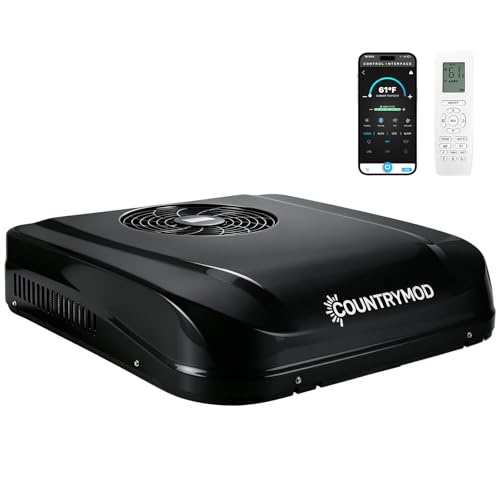
The Black variant features 11,000 BTU cooling with 0.3 kWh per hour energy use. It emphasizes a 5× energy efficiency advantage over standard AC units and battery life up to 10 hours. The design includes a variable‑frequency compressor that adapts to cooling demand while distributing cold air evenly to reduce direct blasts. Best for: RVers who want robust cooling with extended battery life and a distinct aesthetic. Limitation: data shows minor inconsistencies in text; verify exact specifications before purchase.
Best for: Enhanced efficiency and longer runtime with a low direct‑blow airflow design.
Xenjum 12V RV Air Conditioner 11,000 BTU

With 11,000 BTU cooling, Xenjum delivers quick temperature reduction, reaching setpoints in about 3 minutes. It uses a soft start to reduce startup power surge, preserving battery life. It’s designed for off‑grid camping and is compatible with solar setups. It operates at a library‑quiet 35 dB and offers improved energy efficiency compared to older models. Best for: Off‑grid campers who value rapid cooling, start‑up safety, and solar compatibility. Caution: installation space and weight limits should be considered on smaller RVs.
Best for: Quick response off‑grid cooling with minimal power surge.
Buying Guide
What to consider when choosing a 12V RV air conditioner:
- Battery compatibility: Confirm your RV battery capacity (Ah) and whether you have solar charging to support all‑night operation.
- BTU and size: Higher BTU means faster cooling but higher power draw. Match BTU to your RV square footage and insulation.
- Power efficiency: Look for inverter technology, low startup current, and modes (Turbo, ECO, Sleep) to extend battery life.
- Noise level: A quieter unit improves comfort in bedrooms and living areas; target 35–45 dB in Sleep mode if possible.
- Heating option: If you expect cold seasons, consider models with a heat pump or built‑in heater and verify performance in low temperatures.
- Durability and weather resistance: Outdoor and rooftop units should withstand temperature fluctuations and moisture exposure.
- Installation fit: Check roof clearance, mounting brackets, ducting needs (if any), and compatibility with your RV’s electrical system.
Frequently Asked Questions
- Do these units run directly on a vehicle battery? Yes. Most listed units are designed to operate on 12V DC RV batteries, with different efficiency and duration depending on battery capacity and ambient conditions.
- Can I run these without a generator? Yes, if your battery bank and possibly solar setup provide sufficient power for the intended duration.
- What is the typical noise level? Many models aim for 35–55 dB in Sleep or eco modes, with some models around 40 dB during quiet operation.
- Is heating available in these units? Some models include a heat pump or built‑in heater; verify specific BTU ratings for heating performance and climate suitability.
- How should I size BTU for my RV? A general rule is to match BTU to the interior space and insulation; larger RVs or those with poor insulation require higher BTU ratings for effective cooling.
- Are these units compatible with solar power? Several models can be paired with solar setups; confirm compatibility with your solar array and battery configuration.