Direct vent water heaters deliver hot water while venting exhaust outdoors, making them ideal for homes that require reliable indoor installation with safe, sealed venting. This guide highlights five strong choices for American households, showing who each model is best for and why. Use the quick comparison table to narrow down your pick, then review detailed product sections to confirm fit for your home and family’s hot-water needs.
| Product | Best For | ||
|---|---|---|---|
| MIZUDO 199k BTU Tankless | Large families needing high flow | Up to 10.3 | WiFi control and multiple safety features |
| Rheem RTGH-95DVLN-3 | 2–3 bathroom homes, reliable indoor installation | Up to 9.5 | Indoor efficiency with 199,900 BTU input |
| A. O. Smith ATI-310CX3 | Smaller homes needing robust on-demand supply | Up to 8 | X3 scale prevention for longer life |
| Noritz NRC71DVNG | Compact spaces with high efficiency | Up to 7.1 | Direct vent, compact design |
| Rheem RTG-95DVELN-3 | Indoor installations needing high efficiency | Up to 9.5 | WiFi-enabled with durable construction |
MIZUDO 199k BTU Tankless Water Heater

Features: 199k BTU tankless unit with 10.3 GPM flow, designed for large households with 5-7 fixtures simultaneously. Supports hot water on demand to save energy. Includes smart WiFi connectivity for remote management and control via an app. Safety features include 16+ protections, freeze protection to -13°F, anti-dry firing, flame failure detection, exhaust blockage monitoring, and automatic shutdown.
Best for: Large households or homes with high simultaneous hot-water needs who want remote monitoring and strong safety safeguards. Caution: WiFi features require app setup and stable network access; ensure ventilation and gas line compatibility for indoor installation.
Rheem RTGH-95DVLN-3 Tankless Water Heater
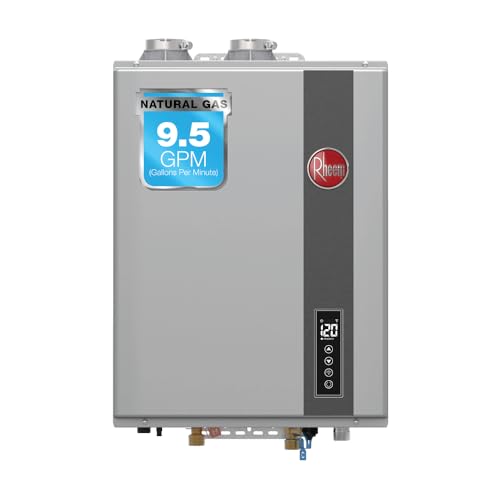
Features: Provides a flow range of 0.4–9.5 GPM and temperature controls from 100–140°F, with a default of 120°F. Electric ignition included for reliable startup.
Best for: Smaller to mid-size homes needing dependable on-demand hot water with straightforward operation. Caution: Ensure proper venting and electrical requirements are met during installation.
A. O. Smith On-Demand Gas Water Heater

Features: Delivers up to 8.0 GPM with X3 Scale Prevention Technology to reduce scale buildup and maintain performance. High efficiency with up to .81 Uniform Energy Factor (UEF); integrated temperature controls and diagnostics. Includes a 15-year limited warranty on the heat exchanger for residential use.
Best for: Homes seeking high reliability with reduced maintenance, especially where mineral buildup is a concern. Caution: Higher initial cost may be offset by long-term efficiency and less descaling.
3×5 Direct Vent Kit for Tankless Water Heaters

Features: Universal compatibility for most 3″ x 5″ gas tankless heaters. Complete venting kit with elbow, straight pipe, clamp, trim rings; total length 32 inches. Constructed from 304 stainless steel for durability.
Best for: DIY or professional installers needing a reliable venting solution. Caution: Verify compatibility with your specific model before purchase.
Rheem ProTech Vent Hood Replacement

Features: Draft hood connection to the vent system for proper exhaust management. Assists in updraft movement of combustion gases and supports venting compatibility with 3″ or 4″ venting systems.
Best for: Ensures safe venting for existing direct vent installations. Caution: Replacement part should match the original venting configuration to avoid fit issues.
Rheem RTG-95DVELN-3 High Efficiency Indoor Tankless

Features: Indoor installation design with 9.5 GPM capability and 199,900 BTU input. WiFi connectivity enables remote monitoring and control for convenient operation.
Best for: Homes that want the combination of high flow and smart features in a compact indoor unit. Caution: Ensure adequate indoor venting and professional installation for gas lines.
Buying Guide
What to consider when choosing a direct vent water heater
Flow rate and climate: Match GPM capacity to your peak simultaneous hot-water needs. Review your home’s shower, faucet, and appliance usage to determine if a higher GPM unit is necessary.
Venting requirements: Direct vent models require outdoor venting for exhaust. Confirm vent size, placement, and clearances with local codes and professional installation.
Gas type and efficiency: Most options use natural gas. Look for units with high efficiency and stable UEF ratings to minimize operating costs over time.
Installation context: Indoor installation options differ in size, mounting, and electrical/ignition needs. Some models include WiFi for remote management, which can add convenience but relies on network access.
Maintenance and durability: Features like scale prevention and robust heat exchangers extend service life. Consider warranty terms on critical components like the heat exchanger.
Installation and safety considerations
- Professional installation is recommended for gas tankless systems to ensure proper venting and gas line connections.
- Proper vent hood and draft hood components help ensure safe operation and compliance with venting requirements.
- In climates with freezing temperatures, choose models with freeze protection or insulation to prevent cold-weather issues.
FAQ
- What is a direct vent water heater?
A direct vent water heater exhausts combustion gases directly outside through a dedicated vent, keeping indoor air safe and reducing the risk of backdrafts.
- Which size of direct vent heater do I need?
Choose based on peak GPM needs and the number of bathrooms or hot-water fixtures in your home.
- Are WiFi-enabled tankless heaters worth it?
They offer remote monitoring and scheduling, which can save energy and provide convenience, but require a stable network and some setup.
- Can I install a direct vent heater indoors?
Yes, many models are designed for indoor installation with proper venting to the outdoors. Professional installation is advised.
- What maintenance is needed for tankless heaters?
Regular descaling (depending on water hardness), periodic safety inspections, and checking venting connections are common maintenance tasks.
- Do all of these units require electricity?
Most models use electricity for ignition or controls; some use gas ignition and may still require electrical power for certain features.