If you need reliable warmth on a job site, these electric heaters offer portable, plug-and-go heat suitable for construction sites, garages, and workshops. This guide highlights five options, showing who each heater is best for and why you might choose one over another. Perfect for contractors, electricians, carpenters, and do-it-yourself enthusiasts working in unheated spaces.
| Product | Best For | Key Benefit |
|---|---|---|
| DEWALT F340635 1.65 kW | Small to medium job sites | Compact, 120V operation |
| NewAir 10,000W Garage Heater | Large spaces | High output with thermostat control |
| TURBRO GH15K Smart 15,000W | Very large areas | WiFi control and timer |
| Comfort Zone 1,500W Utility Heater | Budget-conscious spaces | Three heat settings and fan option |
| GASLAND Flame Jet 125,000 BTU Propane | Outdoor or gas-ready spaces | Very high heat output (gas) |
DEWALT 1.65 kW Electric Portable Heater
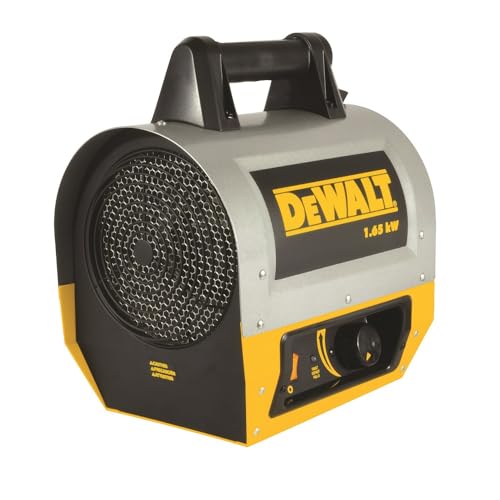
Type: Heavy-duty, portable electric heater. Heat output: 5,630 BTUs or 1.65 kW. Power: 1,500 watts on a standard 120-volt outlet. Best for smaller job sites, garages, or indoor spaces where a compact, corded heater is sufficient. Chosen for its rugged build and straightforward operation. Caution: Requires a standard 120V circuit; avoid overloading circuits on large spaces.
NewAir 10,000W Garage Heater

Type: High-output, fan-forced electric heater rated at up to 10,000 watts. Coverage: Large spaces up to 1,605 sq ft. Features: Dual power settings with a digital thermostat; ceiling or wall mounting options. Best for large garages, workshops, or industrial spaces that need fast, uniform heating. Choose this if you need precise temperature control and flexible mounting. Caution: Requires wiring to a 240V circuit and professional installation for hardwiring.
TURBRO 15kW Smart Electric Garage Heater

Type: 15,000 W/51,194 BTU fan-forced heater designed for large areas (1,600–2,500 sq ft). Mounts on ceiling or wall; includes remote and thermostat with WiFi. Best for expansive shops or warehouses that require rapid, even heating and remote management. Caution: Professional installation required; power cord not included and must be hardwired to a 240 V supply by a licensed electrician.
Comfort Zone 1,500W Utility Space Heater

Type: Electric, portable heater with adjustable thermostat. Power: 1,500W. Settings: Three heat modes plus a fan-only option. Best for budget-conscious spaces such as small garages or workshops. The design supports targeted heating with energy-efficient operation. Caution: Best used in well-ventilated areas; may not be sufficient for very large spaces.
GASLAND Flame Jet 125,000 BTU Propane Heater

Type: Propane-fired, portable heater. Heat output: 75,000–125,000 BTU, suitable for large spaces up to 3,100 sq ft. Best for outdoor work areas or spaces without access to electric power when gas fuel is available. Caution: Not electric; requires propane supply and proper ventilation. Consider for outdoor job sites or when electric options are not feasible.
Buying Guide
What size heater do I need?
Evaluate space size, ceiling height, and insulation. Larger spaces require higher wattage or BTU outputs to maintain comfort, especially in unheated environments. For enclosed garages under 1,000 sq ft, 1,500–3,000 watts is often adequate. Larger shops may need 6,000–15,000 watts or more, or multiple units.
Do I need a portable or hardwired heater?
Portable heaters plug into standard outlets and are easier to deploy but can strain electrical circuits in larger spaces. Hardwired 240V units deliver more consistent heat for big areas and industrial settings but require professional installation.
What safety features matter?
Look for tip-over switches, overheat protection, and CSA/UL-listed certifications. For gas or propane units, ensure proper ventilation and outdoor-friendly usage when appropriate. Always follow local electrical codes and manufacturer guidelines.
Which features improve convenience?
Thermostats, remote controls, timers, and WiFi-enabled controls help maintain steady temperatures and reduce energy use. Ceiling or wall mounting can save floor space in dense work environments.
What are the main trade-offs?
Electric heaters tend to be cleaner and safer indoors but require sufficient electrical capacity. Propane or gas heaters provide high heat output and can operate where electricity isn’t available, but require ventilation and safety checks. Choose based on space, power availability, and safety considerations.
Summary of key considerations
- Space size and insulation determine required heat output.
- Electrical system capacity guides portable vs. hardwired options.
- Safety features and installation requirements influence long-term use.
- Control features affect energy efficiency and comfort levels.
Frequently Asked Questions
- What type of heater is best for a small garage? A compact 1,500–3,000 watt electric heater is usually sufficient for small spaces, with a thermostat for steady comfort.
- Can I install a 240V heater myself? Some units require professional hardwiring. Always follow local codes and use a licensed electrician when needed.
- Is it safer to use electric or propane on a job site? Electric heaters are generally safer indoors and easier to manage, while propane heaters are useful where electricity is unavailable but require ventilation.
- Do electric heaters need special outlets? Most portable electric heaters use standard 120V outlets, but high-output models use 240V circuits and may need professional wiring.
- Can I mount an electric heater on the ceiling? Yes, several models offer ceiling or wall mounting to save floor space, especially in garages and shops.
- Are these heaters energy efficient? Efficiency depends on space, insulation, and usage. Thermostats and timers help optimize energy consumption.