Answering buyers seeking efficient, energy-saving cooling, this guide highlights five window air conditioners that emphasize Eco or Energy Saver features, quiet operation, and simple controls. The selections are well-suited for bedrooms, home offices, and small-to-medium living spaces. Each product section notes who it’s best for and why it’s a solid energy-conscious choice. A quick summary table follows to compare key points at a glance.
| Product | Room Size (approx.) | Energy-Saving Feature | Best For |
|---|---|---|---|
| Frigidaire 6,000 BTU Window AC | Up to 250 sq. ft. | Eco Mode, Sleep Mode | Living rooms and home offices needing mid-size cooling |
| Midea 5,000 BTU Window AC | Up to 150 sq. ft. | Dehumidifier mode, Energy-conscious settings | Bedrooms and small rooms |
| Frigidaire 8,000 BTU Window AC | Up to 350 sq. ft. | Eco Mode, Auto Restart, Sleep Mode | Medium living spaces and small apartments |
| hykolity WiFi Enabled 6,000 BTU | Up to 250 sq. ft. | Smart remote, Energy Saving mode | Tech-friendly spaces and remote-control users |
| Tackview 6,000 BTU Window AC | Up to 250 sq. ft. | Energy Saver mode, 6-in-1 modes | Users who want versatile operation and energy savings |
Frigidaire 6,000 BTU Window Air Conditioner

Best for mid-sized rooms up to 250 sq. ft., this Frigidaire model emphasizes energy efficiency with Eco Mode and Sleep Mode. It offers 6-way directional airflow and three fan speeds for refined comfort. The remote control enables easy adjustments, and a Clean Filter alert helps with maintenance. Choose this if you want reliable cooling with predictable energy usage in living rooms or home offices. Caution: Like all window units, installation feasibility depends on window frame compatibility and clearance.
Midea 5,000 BTU Window Air Conditioner

Best for small bedrooms or home offices, this Midea model cools up to 150 sq. ft. with a low noise level and multiple modes, including a dehumidifier setting. It includes a remote and a washable filter for ongoing maintenance. Choose this if you prioritize quiet operation and simple, remote-controlled adjustments. Limitation: Installation may require basic tools; the frame must suit a 5,000 BTU unit.
Amazon Basics 5000-BTU Window AC

Best for small rooms up to 150 sq. ft., this Amazon Basics model provides two-in-one functionality with cooling and fan modes, plus a washable filter for easy upkeep. It offers 7 precise temperature settings and two cooling/two fan modes for personalized comfort. Choose this if you want a straightforward, budget-conscious option with dependable cooling for compact spaces. Caution: Performance is optimized in smaller rooms; do not exceed recommended square footage for best efficiency.
Frigidaire 5,000 BTU Window AC With Remote

Best for small living spaces up to 150 sq. ft., this Frigidaire unit emphasizes Eco Mode and Sleep Mode alongside 6-way airflow and three fan speeds for customizable comfort. It’s a solid pick for bedrooms or study areas where quiet operation matters. Keep in mind: If your space is near a heat source or direct sun, consider supplemental shading to maximize efficiency.
Frigidaire 8,000 BTU Window AC
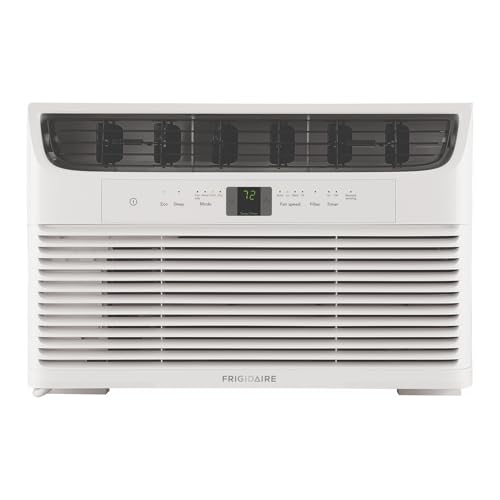
Best for larger small-to-mid-sized rooms up to 350 sq. ft., this Frigidaire model includes Eco Mode and Sleep Mode to save energy during overnight cooling. It also features three fan speeds and auto restart to resume when power returns. Choose this if you need stronger cooling without sacrificing energy efficiency in a medium space. Limitation: Higher BTU units can be less efficient in very small rooms if not properly matched to space.
Buying Guide: Energy-Saving Window ACs
Why choose energy-saving window air conditioners? They reduce electricity use while maintaining comfort, which can lower monthly utility bills and lessen environmental impact. When selecting, consider capacity, noise, control options, and maintenance needs. The following questions help clarify buying priorities.
- What room size should I target? At least 20 BTU per square foot is a common rule. For rooms up to 150 sq. ft., a 5,000 BTU unit is typical; for 250–350 sq. ft., 6,000–8,000 BTUs is common.
- How important is noise level? Look for decibel ratings around 50–60 dB for bedrooms and 50 dB or lower for quiet spaces, especially in Sleep Mode.
- Which energy-saving features matter most? Eco or Energy Saver modes, Sleep Mode, programmable timers, and 24-hour control via remote or app can meaningfully cut energy use.
- Is maintenance easy? Washable or reusable filters simplify upkeep and maintain efficiency. A Clean Filter alert helps prevent performance decline.
- Do I want smart capabilities? WiFi-enabled units offer remote control and scheduling, which can optimize daily energy usage.
Why these models were chosen
- Selection favors units with explicit energy-saving features (Eco or Energy Saver modes) and sleep functions for night-time efficiency.
- Each model provides clear, programmable controls and simple maintenance to encourage continued energy-conscious use.
- All five units cover a range of room sizes, from small bedrooms to living areas, helping buyers match capacity to space without overspending on energy.
FAQ
- What is the best energy-saving mode for night cooling? Sleep Mode gradually raises temperature to save energy while maintaining comfort.
- Is a higher BTU always better for energy efficiency? Not necessarily. An undersized unit runs constantly, using more energy; an oversized unit cycles on and off, which can be inefficient and uncomfortable.
- Do I need smart features? Smart control helps optimize energy use by programming cooling patterns around your schedule, especially in rooms that don’t need continuous cooling.
- How important is the washable filter? A washable filter reduces maintenance costs and keeps airflow efficient, which supports lower energy consumption.
- What about window compatibility? Check your window’s dimensions and frame type before purchase to ensure proper installation and sealing for energy efficiency.
- Are all window AC units equally easy to install? Installation complexity varies with window type and mounting hardware; some units include all mounting accessories, while others require a screwdriver or basic tools.