Answering the typical buyer question: which evaporator coil leak sealants are best for sealing leaks, preventing future issues, and simplifying maintenance across residential and small commercial HVAC systems? This guide focuses on trusted, widely available products that work with a range of refrigerants and system sizes. It highlights who each product is best for, plus cautions to consider before use. The following five products are selected for clarity, compatibility, and practical application across common evaporator coil setups.
| Product | Best For | Key Benefit |
|---|---|---|
| Leak Saver Direct Inject Ultimate 3-in-1 | Homes and small businesses needing sealant, moisture removal, and dye in one kit | All-in-one treatment with UV dye for leak locating |
| Extreme Ultra A/C Leak Stop Direct Easy Inject | Up to 6-ton systems needing a reusable, patent-pending solution | Non-polymer formula with reusable cartridge |
| Leak Saver Direct Inject AC Leak Sealer Small System | Small systems up to 1 ton or mini-splits | Straightforward injection into the system |
| Nu-Calgon 4050-11 EasySeal Direct Inject-UV Dye | Mid-size to larger homes needing UV dye tracking | Clear tube injection and UV dye for leak detection |
| Leak Saver Direct Inject AC Leak Sealer 3-Pack | Multiple units or service technicians performing several jobs | Three-pack for extended maintenance or multi-system use |
Leak Saver Direct Inject Ultimate 3-in-1
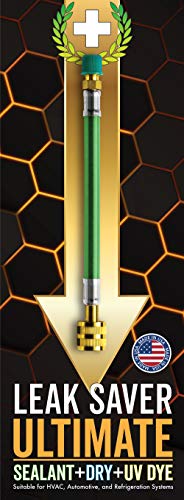
Best for: General HVAC systems that can benefit from an all-in-one sealant, moisture remover, and UV dye. This 3-in-1 package is designed to address leaks, moisture, and leak detection in one application. The sealant reacts with air and moisture at the leak site to create a permanent seal when the complete refrigerant charge is intact within seven days. It is compatible with most refrigerants and oils, making it suitable for central ACs, mini-splits, and heat pumps. Caution: verify compatibility with ammonia-free systems and ensure proper installation procedures.
Extreme Ultra A/C Leak Stop Direct Easy Inject

Best for: Systems up to 6 tons and users who want a reusable, refillable cartridge system. It claims a polymer-free formula to protect moisture-sensitive components, and it is designed to stop small leaks with a quick 5-minute vacuum test. Caution: the data notes it is not for automotive use; verify compatibility with your refrigerant before use.
Leak Saver Direct Inject AC Leak Sealer Small System

Best for: Small HVAC systems up to 1 ton, including ductless mini-splits and compact central ACs. This option emphasizes straightforward injection with broad refrigerant compatibility. It seals leaks permanently where the full refrigerant charge isn’t lost within seven days. Limitation: installation complexity may vary with smaller or uniquely configured systems; follow the injection guidelines precisely.
Nu-Calgon 4050-11 EasySeal Direct Inject-UV Dye

Best for: Medium to larger systems where UV dye tracking is beneficial for ongoing maintenance and leak detection. The concentrate reduces material in the system and uses a visible dye pathway to aid service technicians. It is designed for R-410A and other common refrigerants with clear viewing tubes to monitor injection. Caution: ensure no disruption to ongoing refrigerant charge or other sealants in the system.
Leak Saver Direct Inject AC Leak Sealer 3-Pack

Best for: Technicians or homeowners who need multiple units of sealant for ongoing maintenance or multi-system management. The 3-pack provides extra coverage and convenience for repeated use across different HVAC setups. It shares broad compatibility with many refrigerants and oils. Caution: confirm that multiple applications won’t over-saturate a single system; follow recommended dosing per system size.
Buying Guide
What to consider when choosing an evaporator coil leak sealant
- System size and type: Choose a product rated for your tonnage and whether you have a central system, ductless mini-split, or a commercial setup.
- Leak severity and location: Some products target small leaks, while others are designed for more persistent issues. UV dye helps locate leaks during service.
- Refrigerant compatibility: Ensure the sealant works with your refrigerant (R410A, R22, R134A, etc.) and oils used in your system.
- Moisture management: Moisture can affect sealant performance. Consider products with moisture-removal features if your system has moisture exposure risks.
- Ease of use: Some sealants are direct-inject, while others require syringes or special kits. Choose based on your comfort with installation.
- Reusability and waste: Refillable cartridges reduce waste and can lower long-term costs; evaluate cartridge design and storage.
How to apply a leak sealant safely
Before applying any sealant, power down the HVAC system as per standard safety practices. Confirm the leak source and address it with the sealant according to the product’s instructions. Use appropriate injection points and verify that the system can hold the refrigerant charge after sealing. Test the system for leaks and performance after treatment.
When to avoid sealants
Avoid sealants if there is a major, continuous leak or if the system shows signs of compressor damage, contaminated refrigerant, or ongoing refrigerant loss beyond sealant capabilities. For large or complex leaks, professional service is recommended.
Maintenance and next steps
Keep a record of which sealants were used and when. Use sealants as part of a broader maintenance plan, including regular refrigerant charge checks, coil cleaning, and system performance tests. Consider UV dye for ongoing leak detection in systems where leakage is suspected but not easily diagnosed.
FAQ
- Can these sealants fix large or ongoing leaks? Most are designed for small leaks or preventative maintenance. Large leaks may require professional repairs or refrigerant replacement.
- Are sealants safe for all refrigerants? Products typically advertise compatibility with common refrigerants and oils, but always verify for your specific system and refrigerant type.
- Is UV dye necessary? UV dye helps locate leaks during service, but may not be required for all treatments depending on the product.
- Do these sealants void warranties? Some warranties may have restrictions on sealant use; check your equipment warranty terms before applying.
- How long do sealants take to work? Performance varies; some products seal leaks quickly, while others require circulation and testing over a period of days.
- Can I use sealants on automotive systems? Many products specify non-automotive use; always follow the product label for vehicle applicability.