Answer: This guide highlights top roof vent extractors ideal for bathrooms, attics, garages, and sheds. It helps buyers choose models based on fan size, durability, and weather resistance. The top picks balance reliable build quality, effective airflow, and practical installation. Suitable for homeowners upgrading ventilation or replacing a worn-out vent cap or exhaust fan.
- Product 1: Broan-NuTone 636 Steel Roof Vent Cap
- Product 2: Voltset 8-Inch Kitchen Exhaust Fan
- Product 3: BINGLUX 55W Solar Attic Fan
- Product 4: Kakalote 12V RV Roof Vent
- Product 5: USDGTKN 10 Inch Roof Exhaust Attic Fan
Summary Table
| Product | Best For | Key Benefit | Best For Installation |
|---|---|---|---|
| Broan-NuTone 636 | Bathrooms and small ducts | Built-in backdraft damper and bird screen | Ridge or low-slope roofs |
| Voltset 8-Inch | Garages and workshops | 535 CFM with durable all-metal build | Wall or exterior mounting |
| BINGLUX Solar Attic | Energy-efficient attic cooling | Hybrid solar with thermostat | Roof or attic mounting |
| Kakalote 12V RV | Mobile homes and caravans | ABS frame with copper motor | RV roof hatches |
| USDGTKN 10 Inch | Large spaces like sheds | High airflow up to 2500 CFM | Wall or roof mounting |
Broan-NuTone 636 Steel Roof Vent Cap

Best for bathroom ventilation where compact roof caps are needed. This steel roof cap fits 3″ and 4″ round ducts and enhances air and sound performance. The built-in backdraft damper prevents reverse airflow, while the bird screen minimizes pest entry. The steel construction with a black powder coat ensures long-lasting durability.
Who it’s for: homeowners replacing a damp or noisy vent cap in bathrooms or small utility rooms. Choose this if you need a sturdy, low-profile roof cap with a damper and screen. Limitation: not a fan or motor, it only serves as a vent cap for duct exhausts.
Voltset 8-Inch Kitchen Exhaust Fan

Best for garages, workshops, and basements needing high airflow. It delivers 535 CFM with a copper motor and an all-metal, corrosion-resistant body. Designed for wall mounting, it’s suitable for rapid heat, smoke, and odor removal in demanding spaces.
Who it’s for: builders or DIYers measuring space for a robust, wall-mounted exhaust. Best if you need strong ventilation with a durable, industrial-grade build. Limitation: primarily designed for wall mounting; ceiling or roof mounting may require additional hardware.
BINGLUX 55W Solar Attic Fan

Best for energy-efficient attic cooling with solar power. This 12″ solar attic fan uses a 55W solar panel to move up to 1300 CFM. It includes a thermostat to switch on at higher temperatures and auto-off as temperatures drop, reducing energy usage.
Who it’s for: homeowners seeking off-grid or low-energy attic ventilation. Choose this if you want solar-assisted cooling with thermostat control. Limitation: performance depends on sunlight; cloudy days may reduce airflow unless the hybrid option engages AC power.
Kakalote 12V RV Roof Vent

Best for motorhomes, caravans, and RV roofs requiring a compact ceiling exhaust. It uses an ABS frame and blade with a copper motor and thermal protection for continuous operation. Quiet performance suits mobile living spaces.
Who it’s for: RV owners needing a reliable 12V vent for on-road ventilation. Choose this if you want a compact, quiet exhaust for a vehicle. Limitation: designed for 12V operation; isn’t suited for fixed home-installations without appropriate mounting.
USDGTKN 10 Inch Roof Exhaust Attic Fan
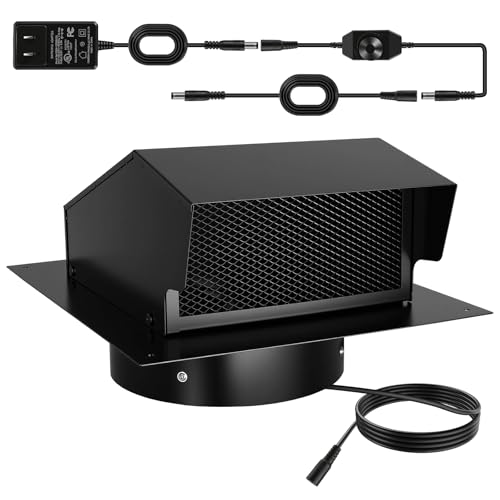
Best for large spaces like barns, sheds, or workshops needing high airflow. It delivers up to 2500 CFM with a 12W brushless DC motor and 110V compatibility. The unit aims for robust, continuous operation and wide coverage.
Who it’s for: property owners with big ventilation needs or those replacing older attic fans. Choose this if you require substantial air movement in a single unit. Limitation: larger footprint may require more space and structural consideration for roof mounting.
Buying Guide
What to consider when choosing a roof vent extractor:
- Airflow needs: Measure the space and target CFM. Larger areas require higher CFM or multiple units.
- Mounting type: Roof caps, wall-mounted fans, and RV-specific vents each suit different installations. Choose based on mounting availability and clearance.
- Durability and weather resistance: Steel, aluminum, or stainless steel with protective coatings perform better in harsh climates. Look for backdraft dampers and bird screens when applicable.
- Power source: Solar, AC, or 12V DC options exist. Hybrid solar/AC models suit variable sun exposure and temperature control.
- Noise level: Attic and living spaces benefit from lower decibel performance for comfortable operation.
- Special features: Thermostats, check valves, and quiet designs add value for different environments.
FAQ
- What is the advantage of a backdraft damper? — It prevents outside air from blowing back into the space when the fan is off, improving energy efficiency.
- Is solar-powered attic ventilation effective year-round? — Solar fans work best with ample sun, but many models include AC backup or hybrid systems for continuous performance.
- When should I choose a 10-inch vs. 8-inch or 12-inch fan? — Larger diameters move more air but require more mounting space and may need higher energy. Match diameter to the target CFM and installation space.
- Can these be installed on existing roofs? — Most roof vent caps and attic fans are designed for retrofit on standard roofs with proper ducting and weatherproof sealing.
- Are any models suitable for RVs or mobile homes? — Yes, 12V RV roof vents are designed specifically for mobile living spaces with compact form factors and low power use.
- What maintenance is needed for roof vents? — Regular cleaning of screens, checking dampers, and inspecting seals help maintain airflow and prevent leaks.