If you need fans that stay quiet while cooling a bedroom, living room, or home office, this guide highlights five top options. These are best for light sleepers, home offices, or anyone who works near fans and wants minimal disruption. Each pick emphasizes low noise, reliable airflow, and practical features like remote control or adjustable height. The buyer will find clear reasons to choose each product and a concise quick-comparison table below.
| Product | Best For | Why It Stands Out |
|---|---|---|
| Lasko Oscillating Pedestal Fan | Light sleepers, dorm rooms | Three quiet speeds; adjustable height; easy setup |
| DREO Tower Fan (42″ | Quiet living rooms and offices | DC motor; 28 ft/s; 20 dB; multiple modes |
| DREO Tower Fan (40″ | Night-friendly bedrooms | TurboSilent tech; 28 dB; 90° osc; timer |
| LEVOIT Standing Fan | Balanced airflow with whisper-quiet | DC motor; 20 dB; 90° oscillation; remote |
| Uthfy Tower Fan | Quiet bedroom or office setup | Remote + 120° oscillation; Sleep/Normal/Natural modes |
Lasko Oscillating Pedestal Fan — Quiet, Adjustable Height

Best for light sleepers who need a simple, quiet pedestal option. The Lasko fan offers three quiet speeds and widespread oscillation to cool a room evenly. The fully adjustable stand extends up to 47 inches, and a tilt-back head directs airflow where it matters most. Easy, tool-free setup and a light 8.7-pound frame make it ideal for dorm rooms or temporary setups. A potential limitation is that the design is not bladeless, which some buyers prefer for perceived safety or cleaning.
DREO Tower Fan — Quiet, Ultra-Silent Operation

Best for living rooms or home offices that require near-silent cooling. This model uses a low-noise DC motor that delivers up to 28 ft/s airflow with 1473 CFM, while keeping noise near 20 dB. It features 9 speeds and 4 modes, plus a 12-hour timer and a 30-second display dimming for sleep environments. Choose this if you want strong airflow with minimal sound, but note the larger footprint compared to compact desks fans.
DREO Tower Fan — Quiet 40″ Model with Timed Sleep
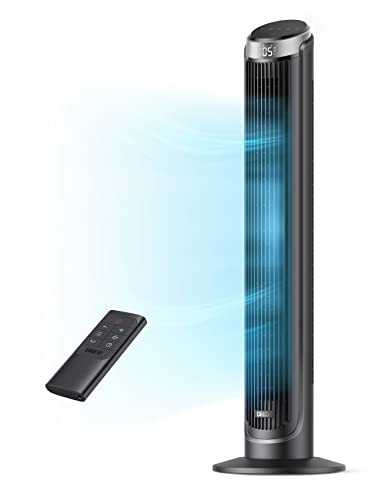
Best for bedrooms seeking long-running quiet cooling. This model uses TurboSilent technology and produces about 28 dB of noise. It combines a 40-inch tower form with 5 speeds and 4 modes plus a 12-hour timer. The 90° oscillation helps distribute air evenly. A potential limitation is that larger rooms may benefit from even stronger airflow; ensure your space fits the tower’s footprint.
Uthfy Tower Fan — Quiet, 120° Oscillation

Best for versatile control in bedrooms or offices. The Uthfy fan provides three speeds and three modes (Normal, Natural, Sleep) with a 120° wide-angle oscillation and dual control (remote and top panel). It runs quietly, with sleep-friendly operation and a 7.5-hour timer. Choose this if you want flexible modes and easy remote operation; avoid if you need a bladeless design for cleaning ease.
LEVOIT Standing Fan — Whisper-Quiet, High Airflow

Best for overall quiet, high-capacity cooling. The LEVOIT uses a DC motor to reach up to 1024 CFM with airflow speeds up to 22 ft/s. It operates at just 20 dB on the lowest setting, making it suitable for bedrooms and nurseries. The 90° oscillation and remote control add convenience. A potential caveat is that the higher airflow models may require more space for optimal distribution.
DR.PREPARE Tower Fan — Quiet DC Blade-Director

Best for compact spaces requiring quiet, directional cooling. This model uses a 12W DC motor with up to 23 ft/s wind speed and 8 speeds. It emphasizes near-silent performance (as low as 25 dB) and includes a touchscreen and remote. A caution: the compact size may limit air distribution in very large rooms; ideal for bedrooms or small offices.
Buying Guide: Quiet Fan Purchase Considerations
- Noise level: Look for models advertising decibels (dB) and DC motors for lower noise compared with AC motors.
- Airflow and coverage: Consider CFMs and blade design to ensure adequate cooling for room size.
- Oscillation and direction: Horizontal and vertical adjustments help distribute air evenly.
- Control options: Remote, touch panels, and timer features improve usability without getting up.
- Size and footprint: Taller pedestal fans and wide towers cover larger rooms; compact desk fans fit small spaces.
- Energy use: DC motors typically use less power while delivering strong airflow.
- Maintenance: Bladeless or easy-clean designs reduce cleaning hassle; bladeless models often have a premium feel.
FAQ
- What makes a fan quiet enough for sleep?
Fans described as 20 dB to 25 dB on their quietest settings are typically suitable for sleep, as they produce minimal background noise compared to traditional models.
- Are tower fans quieter than pedestal fans?
Often, yes. Tower fans with DC motors and bladeless or advanced blade designs tend to operate more quietly while keeping strong airflow and compact form factors.
- Is oscillation necessary for quiet cooling?
Not strictly. Oscillation helps distribute air, but if you need focused cooling, a direct airflow option with a tilt or directional control can suffice.
- Can I run a quiet fan overnight with a timer?
Yes. Many models include 1–12 hour timers that automatically shut off, preventing overnight energy use or unsettling fan noise after you fall asleep.
- Should I prioritize remote control for a quiet fan?
Remote control improves convenience and helps you avoid disrupting sleep while adjusting settings from bed or desk.