Answering the needs of indoor growers, this guide highlights top AC units designed to manage temperature, humidity, and airflow in grow rooms or tents. Each option is chosen for specific environments—compact tents, mid-size grow rooms, or shared spaces—so you can pick the best fit based on space, control features, and ease of use. The following table summarizes the five featured products, who they’re best for, and why they stand out in grow-room climate management.
| Product | Best For | Why It Stands Out |
|---|---|---|
| AC Infinity TERRAFORM 8 | Mid-to-large grow tents | All-in-one climate control with AI self-regulation and single-duct operation |
| Garvee 3-in-1 Portable AC | Small-to-medium rooms with flexible cooling | Three modes in one unit and quiet operation for bedrooms or offices |
| MEPTY 8000BTU Portable AC | General bedrooms and offices needing versatile modes | Self-evaporation system and dual drainage support |
| GarveeLife 8000 BTU Portable AC | Small rooms and dorms | 3-in-1 cooling, dehumidifier, and fan with remote control |
| MONRIKON Portable 8,000 BTU | Bedrooms and small living areas | 4-in-1 modes with Wi-Fi/app control for smart rooms |
AC Infinity TERRAFORM 8 Climate Controller

This all-in-one air conditioner delivers complete climate control through a single duct, using dynamic AI to self-regulate the grow environment. It enables cooling, heating, and air exchange, taking the guesswork out of maintaining stable conditions. Best for growers who want hands-off accuracy and integrated VPD management. A limitation is that drying requires manual two-duct adjustments, so plan for setup flexibility in drying cycles.
Garvee 3-in-1 Portable AC Unit

Best for small-to-medium rooms, this unit combines cooling, dehumidification, and fan modes in one compact package. It’s ideal for spaces like bedrooms or small grow areas where quiet operation (under 50dB) matters. The included window kit and exhaust hose simplify installation. Choose this if you want a balance of cost, portability, and multi-function cooling, but be aware that window sizing may require trimming for smaller windows.
MEPTY 8000BTU Portable AC with Self-Evaporation
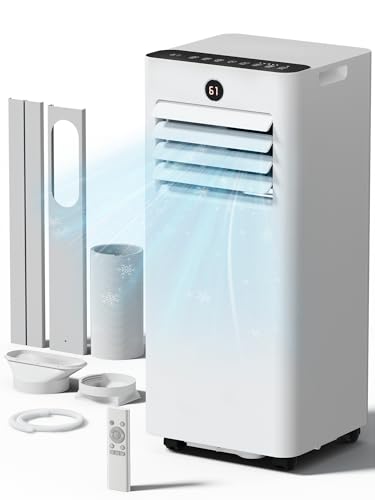
Best for rooms up to 350 sq. ft., this portable unit offers three modes (cool, dehumidify, fan) with precise temperature control and a self-evaporation system. It’s well-suited for bedrooms or studios where moisture removal and flexible cooling are priorities. A potential drawback is manual drainage when a full-water condition triggers the alarm, so plan for occasional maintenance in high-humidity settings.
GarveeLife 8000 BTU Portable AC

Best for bedrooms, offices, or dorms, this 8000 BTU unit combines cooling, dehumidifying, and a fan with a remote control. It’s compact enough for tight spaces and includes a window kit for straightforward installation. Avoid this if your space requires continuous, long-running cooling with heavy moisture loads, as it may need periodic emptying in damp environments.
MONRIKON 4-Mode Portable AC System

Best for multi-room flexibility, this MONRIKON unit provides four modes with Wi-Fi/app control for smart room management. It’s suitable for users who want remote access to temperature and mode settings, allowing better planning for grow schedules. A caution is that app connectivity can depend on network reliability, which may affect real-time control in some setups.
Buying Guide
Key considerations when choosing a grow-room AC unit:
- Room size and airflow: Match BTU capacity to the space; larger rooms need higher cooling power with efficient dehumidification.
- Control features: AI-based climate control, VPD targeting, and app-based remote access help maintain stable conditions and reduce manual adjustments.
- Installation and setup: In-tent deployments, single-duct versus dual-duct configurations, and window kit compatibility affect ease of use.
- Sound and commute: Quiet operation matters in sleep areas or shared spaces.
- Moisture handling: Self-evaporation systems reduce maintenance, but some units require manual drainage in high-humidity environments.
- Portability vs. permanence: Portable units offer flexibility but may be less efficient than fixed, integrated systems for large tents.
FAQ
- What is VPD and why does it matter for grow rooms? VPD stands for Vapor Pressure Deficit; managing VPD helps optimize plant transpiration and growth by correlating temperature and humidity.
- Can I use a regular household AC for a grow tent? Not ideal. Grow rooms benefit from units with precise humidity control, self-regulating mechanisms, and ducting designed for tents.
- Is a single-duct or dual-duct setup better? Single-duct can be simpler for small tents; dual-duct is often necessary for controlled exhaust and intake in larger tents or rooms.
- Do portable units work year-round? Yes, but efficiency and moisture management vary by model; some have self-evaporation or dehumidification modes suitable for summer use.
- How important is remote control for grow rooms? Remote control and app access improve scheduling, automation, and consistency across day and night cycles.
- What should I consider about installation space? Ensure clearance for air intake and exhaust, along with stable mounting or placement that avoids obstruction of vents.