Answering the need for reliable, quiet, and energy-efficient exhaust fans tailored to grow rooms, this guide profiles five strong options. Best for different spaces and setups, these picks help maintain optimal temperatures, humidity, and air quality. Ideal buyers include hobbyist growers, home basement setups, and small-scale hydroponics operators seeking quiet operation and easy control.
Summary at a glance: the table below compares key specs to help you pick quickly.
| Product | Airflow (CFM) | Best For | Note |
|---|---|---|---|
| VIVOSUN 4″ Inline Exhaust Fan | 130 | Small grow tents or compact rooms | Low-noise EC motor |
| VIVOSUN 6″ Inline Exhaust Fan | 345 | Medium growth tents and multi-room setups | Balanced power and noise |
| AC Infinity CLOUDLINE PRO T6 | 6″ (varies with install) | Advanced climate control with smart options | WiFi app and programmable controls |
| AC Infinity CLOUDLINE A6 | 6″ (varies with install) | Value-focused grow rooms needing quiet operation | Includes wired speed controller |
| VEVOR Inline Duct Fan 6″ | 400 | Large tents and high-heat environments | Low noise; energy-efficient motor |
VIVOSUN 4″ Inline Exhaust Fan & Controller

Best for compact grow tents or small rooms, this 4″ unit delivers up to 130 CFM. It uses an upgraded EC motor for energy efficiency and reduced maintenance. Quiet operation at about 26dB(A) keeps disturbances minimal. Choose this if you’re optimizing a tight space and need a simple, low-cost solution for basic exhaust needs.
Who it’s for: hobbyists with small grow spaces, apartments, or basements needing dependable air exchange without high noise. Limitation: lower airflow than larger models, so less suited for very hot or expansive rooms.
VIVOSUN 6″ Inline Exhaust Fan & Controller

Better for medium grow tents or multi-plant setups, this 6″ model provides up to 345 CFM. It balances solid airflow with lower noise (around 32dB(A)) and energy efficiency via an EC motor. Best for users who need stronger venting without a big noise footprint.
Who it’s for: growers upgrading from a 4″ system or expanding tent space. Limitation: larger ducting may require more space and more thorough installation planning.
AC Infinity CLOUDLINE PRO T6
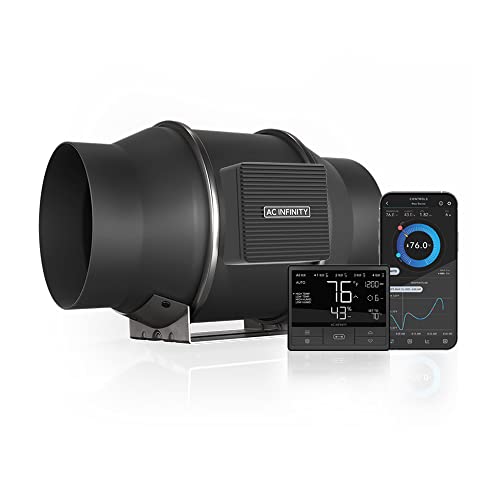
Designed for hydroponic grow rooms and odor control, the CLOUDLINE PRO T6 offers dynamic temperature and humidity programming with timers and grow cycles. It supports remote operation via WiFi, enabling climate data review and automation. This unit suits enthusiasts seeking advanced climate management and remote control.
Who it’s for: serious growers needing precise control over temperature, humidity, and scheduling. Limitation: higher initial setup complexity and price compared with basic models.
AC Infinity CLOUDLINE A6

The CLOUDLINE A6 provides quiet, reliable ventilation with a 6″ diameter and an included speed controller. It mirrors CLOUDLINE build quality in a value package, making it a strong pick for budget-conscious setups. It’s best for users who want a straightforward, controllable fan without smart apps.
Who it’s for: grow room operators seeking a solid, quieter 6″ option with immediate speed control. Limitation: lacks built-in WiFi smart features found in PRO models.
VEVOR Inline Duct Fan 6”

Offering a robust 400 CFM, this model is suited for larger tents or rooms with higher heat loads. It combines strong airflow with a quiet motor and energy savings of about 30% compared with older designs. Choose this for substantial air exchange needs and larger installations.
Who it’s for: larger grow spaces or operations needing high airflow to manage heat and humidity. Limitation: higher airflow may require more complex ducting and mounting space.
Buying Guide: Key Considerations For Grow Room Exhaust Fans
What size fan do I need? Start by calculating your room volume (length × width × height) in cubic feet. A common rule is to exchange the air every 1–3 minutes, depending on heat and humidity. For example, a 4′ × 4′ × 6′ room (~384 ft³) may require 128 CFM to achieve a 3-minute air exchange.
How important is noise level? If you operate near living spaces or recording areas, prioritize fans with dB ratings around 26–34 dB(A). EC motors tend to run cooler and quieter, improving long-term reliability.
Which control features matter? Simple on/off or speed controllers suit basic needs. For advanced setups, consider models with PWM control, remote apps, or smart controllers for automation, scheduling, and climate monitoring.
Energy efficiency and maintenance: Look for EC or brushless DC motors for lower energy use and longer service life. Fewer moving parts typically mean lower maintenance needs and quieter performance over time.
Installation considerations: Assess duct size compatibility (4″, 6″, or 8″ options), straight duct length, and noise pathways. Longer runs and more elbows increase resistance, potentially reducing effective airflow.
FAQ
- What is the best fan size for a 4′ x 4′ grow tent? A 4″ to 6″ fan is common, delivering 100–200 CFM depending on heat load. For hotter environments, a 6″ option with higher CFM is often preferred.
- Is a powered speed controller necessary? A speed controller helps regulate airflow, reduce noise, and save energy. It’s useful for adapting to different growth stages or day/night cycles.
- Do I need WiFi control? WiFi control is optional. It’s beneficial for automated climate management but not essential for all setups. Basic manual control suffices for simple rooms.
- Which brand is most reliable for grow tents? AC Infinity and VIVOSUN offer widely used options with consistent part availability and support, particularly for hydroponics and tent setups.
- Can I run these fans continuously? Yes, most inline duct fans are designed for continuous operation, especially models with EC motors that emphasize energy efficiency and quiet performance.
- How do I choose between 4″ and 6″ fans? Choose 4″ for small, tight spaces; 6″ for larger tents or higher heat loads. Airflow needs and duct length drive the decision more than room size alone.