Answering the common buyer question, these heat pump air filter choices are selected for reliability, allergen control, and compatibility with most standard 1-inch filters. They’re best for homeowners seeking improved indoor air quality, allergy relief, and steady HVAC performance. The top picks come from trusted brands and emphasize easy installation, strong particle capture, and durable filtration. Use the quick comparison table below to narrow your choice by size, filtration level, and replacement cadence.
| Product | Size (Actual) | Filtration | Best For | Replacement (approx.) |
|---|---|---|---|---|
| Aerostar 20x20x1 | 19.75 x 19.75 x 0.75 in | MERV 8 | Homes with pets and pollen sensitivity | ~90 days |
| Filtrete 20x20x1 | 19.68 x 19.68 x 0.81 in | MERV 11 | Allergen-heavy households | ~90 days |
| Simply 20x20x1 | 19.75 x 19.75 x 0.75 in | MERV 8 | Budget-friendly dust and dander control | ~90 days |
| Filterbuy 16x25x1 | 15.50 x 24.50 x 0.75 in | MERV 8 | Medium-sized HVAC systems or heat pumps | ~90 days |
| Filtrete 20x25x1 | 19.69 x 24.69 x 0.81 in | MERV 5 | Budget basic filtration | ~90 days |
Aerostar 20x20x1 MERV 8 Air Filter

Best For: Homes needing solid dust and pollen control without a high price. This 20x20x1 filter has a 19.75 x 19.75 x 0.75 actual size and is commonly compatible with many heat pump systems using a standard 1-inch frame.
- Universal compatibility with standard HVAC systems.
- Captures up to 90% of airborne particles, including dust, pollen, and mold spores.
- Electrostatically charged pleated media enhances particle capture while maintaining airflow.
Limitations: While effective for everyday allergens, this filter uses a MERV 8 rating, which may be less effective for very high allergen loads compared to higher MERV/ MPR options.
Filtrete 20x25x1 Air Filter MERV 5 (2-Pack)

Best For: Budget-conscious buyers who need a basic filtration boost for older HVAC systems or spaces with modest air quality concerns.
- Designed for standard 20x25x1 HVAC setups.
- Includes six-pack options for longer-term maintenance planning.
- Lower MERV rating (MERV 5) means higher air flow but less microscopic particle capture than higher-rated models.
Limitations: Not ideal for households with heavy pollen, mold, or pet dander loads; consider a higher MERV or MPR rating if these are primary concerns.
Simply 16x25x1 Air Filter

Best For: Larger spaces or heat pumps that require 16×25 filter frames with strong all-around dust and dander control.
- Industrial-grade pleated design with higher pleat count for better coverage.
- 90% capture of airborne particles including pet dander and pollen.
- Actual size 15.75″ x 24.75″ x 0.75″ to fit many 16×25 frames.
Limitations: Like other MERV 8 options, extreme indoor air quality concerns may require a higher-rated filter for maximum filtration.
Filterbuy 16x25x1 Air Filter MERV 8 (6-Pack)

Best For: Homeowners seeking a balance of price, performance, and replacement cadence for medium-to-large spaces using heat pumps.
- Electrostatically charged media with 14 pleats per foot for deeper filtration.
- Comparable to MPR 700 / FPR 5 in filtration efficiency.
- Actual size 15.50″ x 24.50″ x 0.75″ fits 16×25 frames well.
Limitations: While effective for everyday particulates, it may not be the best choice for heavy smoke or ultra-fine particulates.
Filtrete 20x20x1 Air Filter MERV 11
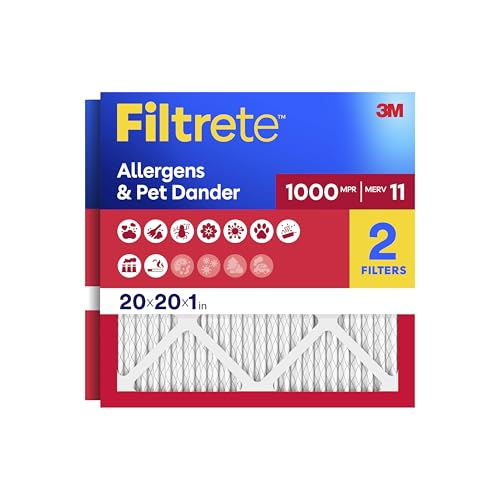
Best For: Homes with high allergen loads seeking strong filtration without sacrificing airflow.
- Filtrete 3-in-1 technology targets a broad range of microparticles.
- Higher MERV 11 rating provides robust allergen and dust capture.
- Actual size 19.69″ x 24.69″ x 0.81″ for some 20x20x1 configurations in this lineup.
Limitations: Higher filtration efficiency can slightly reduce airflow to very old or underpowered HVAC systems; ensure compatibility before purchase.
Buying Guide: Key Considerations For Heat Pump Air Filters
- Size and fit: Always verify the actual dimensions against your heat pump or furnace filter slot. The “nominal size” can differ slightly from the actual size, so measure before buying.
- Filtration level: Higher MERV or MPR ratings capture smaller particles but may reduce airflow in undersized systems. If you notice reduced airflow, consider a lower rating or a system with adequate capacity.
- Allergen focus: If allergic to pollen, pet dander, or mold, prioritize higher MERV/MPR ratings or filters designed for those particle sizes.
- Material and construction: Pleated filters offer greater surface area and particle capture than fiberglass. Electrostatically charged media can improve efficiency without dramatically increasing pressure drop.
- Replacement cadence: Most filters for residential heat pumps are recommended every 90 days, though homes with pets or heavy usage may require more frequent changes. Track changes to maintain air quality and HVAC efficiency.
- Cost vs. value: A higher upfront cost may translate into longer filter life and better indoor air quality. Balance cost with replacement frequency and system compatibility.
- System impact: Regularly changing filters helps reduce strain on the blower, supports energy efficiency, and prolongs equipment life. Avoid running filters too long past their recommended interval.
Frequently Asked Questions
- What is the difference between MERV and MPR ratings? A: MERV is a standardized rating (Higher means finer filtration). MPR is a Filtrete-specific rating scale measuring particle capture efficiency. Both indicate how much of the air is filtered.
- How often should I replace a heat pump air filter? A: Most homes replace every 90 days, but households with pets, smokers, or allergy sufferers may need every 30-60 days.
- Will a higher MERV filter restrict airflow in a heat pump? A: It can, especially in older or underpowered systems. If you notice reduced airflow or cold spots, consider a lower MERV/MPR filter or consult an HVAC professional.
- Are electrostatically charged filters better for single-family homes? A: They can trap more particles without a drastic pressure drop, but effectiveness depends on particle size and system design.
- Is it okay to mix filter brands? A: It’s best to match size, frame type, and filtration level to avoid fit issues and maintain HVAC efficiency.
- Can I use a higher-rated filter in a heat pump? A: Yes, if the system supports it, but ensure proper airflow and fit to prevent strain on the blower.