When selecting an HVAC air flow measurement instrument, you want accuracy, reliability, and features that fit your workflow. This guide highlights five top picks suited for professionals and serious DIYers who measure air velocity, temperature, and CFM in ducts, vents, and in open-air applications. Best for professionals balancing complex systems, contractors needing data logging, and hobbyists measuring duct flow, these instruments offer clear readouts, durable construction, and practical connectivity. The summary table below helps you compare core capabilities at a glance.
| Product | Best For | Key Features |
|---|---|---|
| Testo 405i Anemometer | In-duct airflow with flexible reach | Telescopic shaft, Bluetooth app, accurate wind velocity and in-duct airflow |
| Fieldpiece STA2 In-Duct Anemometer | Professional air balancing | 38″ telescoping probe, direct in-duct CFM and air velocity |
| Elitech ANE-200W | Bluetooth-ready data and reporting | Wind velocity, airflow in CFM/CFM, temp, real-time data |
| BTMETER BT-100 | Portable, versatile field use | Wind speed, wind temp, CFM calculation, tripod mount |
| HoldPeak 866B | Versatile handheld with backlight | Wind speed, wind temp, max/min/avg, tripod hole, backlit display |
BTMETER BT-100 Handheld Anemometer

The BTMETER BT-100 measures wind speed and wind temperature with a backlit LCD and low battery indicator. It offers multiple units (m/s, km/h, ft/min, knots, mph) and provides CFM calculations using duct cross-sectional area. The device includes two temperature sensors and eight vanes, making it sensitive enough for low airflow in HVAC installations and duct vents. Best for field technicians who need a portable tool with quick CFM estimates and drone-friendly operation.
Best for: field technicians and drone operators who need an adaptable, portable airflow meter with quick CFM calculations. Caution: data is user-driven; ensure duct dimensions are accurate for CFM calculations.
HoldPeak 866B Digital Anemometer

The HoldPeak 866B provides highly accurate wind speed readings (0.67–67.1 mph) with ±2% accuracy, plus wind temperature in °C/°F. It supports multiple units, max/min/average wind speed, backlight, and a tripod mount. Best for professionals who need a robust, multifaceted handheld tool with data retention features. Caution: may require calibration for extreme low airflow readings.
Testo 405i Anemometer

The Testo 405i is an in-duct capable wind speed and temperature meter with a telescopic shaft up to 15 inches, enabling measurements in tight ducts. It can calculate CFM when duct dimensions are provided and is widely used for HVAC inspections. Best for technicians performing duct traverses and in-duct airflow assessments where reach and precision are essential. Caution: in-duct measurements require careful duct dimension input for accurate CFM calculation.
AP-856A Pro HVAC Anemometer
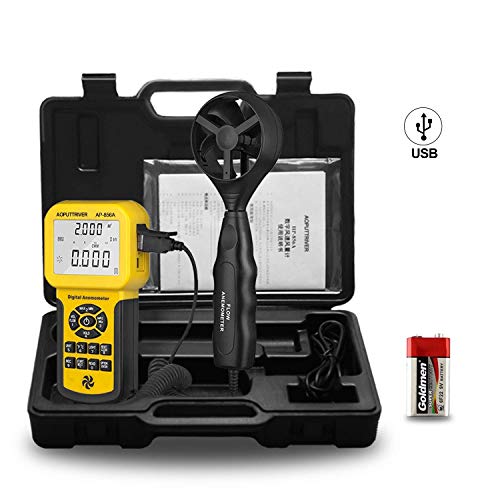
The AP-856A provides high-precision wind speed and temperature with USB data export and a data log capacity of up to 600 records. It supports CFM measurements via the velocity and duct area formula, with a backlit display and max/min/avg tracking. Best for professionals who need PC-friendly data export and long measurement sessions. Caution: USB data handling requires compatible software and setup.
Buying Guide: Key Purchase Considerations
- Measurement range and precision: Look for devices with at least +/- 2% accuracy for wind speed and a temperature range that covers your typical HVAC environments.
- In-duct capabilities: If you measure inside ducts, prioritize telescoping shafts, flexible probes, or long probe options for deep duct access.
- CFM calculation: Ensure the instrument can compute CFM or CMM directly or with simple input of duct cross-sectional area.
- Data logging and connectivity: For professional reporting, consider USB data export, Bluetooth, or mobile apps for trends and charts.
- Durability and usability: Backlit displays, tripod compatibility, and rugged housings improve field performance and readability in varied lighting.
- Power and battery life: Long battery life and indicators help avoid downtime on site.
FAQ
- What is CFM and why is it important in HVAC?
– CFM (cubic feet per minute) measures airflow volume. It helps verify that ducts and vents deliver the intended air distribution for comfort and system efficiency. - Do I need a telescoping probe for HVAC work?
– Yes, a telescoping or long probe allows measurement deep inside ducts, improving accuracy for in-duct airflow. - Is Bluetooth connectivity necessary?
– Bluetooth is helpful for real-time monitoring and easy data transfer to apps, but not strictly required for basic readings. - Can I use any anemometer for duct work?
– Some are designed specifically for duct traverses; others are general handheld models. For ducts, pick one with in-duct readiness or a long probe.