Hydronic baseboard heaters use heated liquid in a sealed loop to gently and evenly warm living and working spaces. They’re known for quiet operation, reliable performance, and simple installation. This guide highlights five well-regarded options that suit American homes and light commercial use, focusing on efficiency, safety features, and ease of installation.
Summary of chosen products:
| Brand | ||||
|---|---|---|---|---|
| Dayton | Hydronic Electric Baseboard Heater (B07CGLFJHV) | 1706/1280 | 208/240V | Commercial-grade, conventional housing |
| Marley | Qmark HBB2004 | Unknown (2000W) | 240V | Liquid-filled, fanless, safety features |
| Cadet | F Series 72″ (6F1500W) | 5120/3840 BTU | 240/208V | All-metal, powder-coated |
| Cadet | F Series 48″ (4F1000W) | 3415/2560 BTU | 240/208V | Easy universal wiring |
| KING | 4K1210BW | 1000W | 120V | Hard-wired, aluminum ribbon fin |
These selections aim to cover a range of room sizes, installation scenarios, and power availability. Each option emphasizes steady heat, minimal noise, and safety features that align with typical American homes and small commercial settings.
Dayton Hydronic Electric Baseboard Heater (B07CGLFJHV)

The Dayton model provides a reliable hydronic electric baseboard solution suitable for commercial use. With a conventional housing and a 208/240V configuration, it delivers 1706/1280 BTU depending on voltage. This unit prioritizes straightforward installation in rooms that require steady, unobtrusive heat without complex controls or fans, making it a solid pick for offices or small commercial spaces that demand dependable warmth.
Qmark HBB2004 Liquid Filled Electric Hydronic Baseboard Heater

This Marley Qmark model uses a liquid-immersed heating element to reduce temperature swings and maintains warmth even after power is interrupted. Its fanless design supports quiet operation, while safety features help prevent overheating. If you want smooth, uniform heat distribution in a living or working area, this option offers a balanced approach to comfort and efficiency.
Cadet F Series 72″ Electric Baseboard Heater (6F1500W)

Cadet’s 72-inch F Series combines robust heating capability with durable construction. It runs on 240/208V and delivers 1500W/1125W, totaling 5120/3840 BTU. Features include a 25-gauge steel body, a grounded junction box, and an all-metal, powder-coated finish. Universal wiring and easy mounting options make this heater suitable for larger rooms or reconstruction projects where consistent warmth is essential.
Cadet F Series 30″ Electric Baseboard Heater (2F500W)
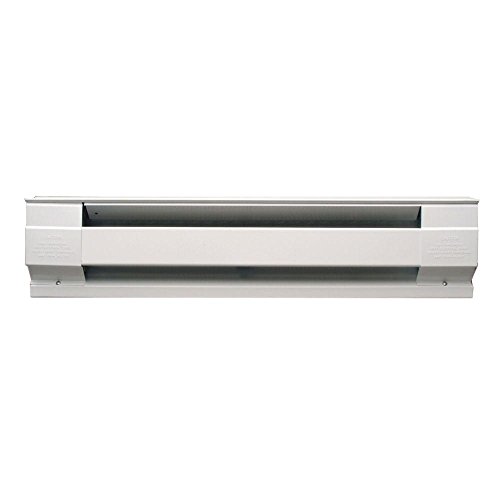
Cadet’s 30-inch F Series provides a compact but capable heating solution for small rooms. With multi-watt options (500/375W) at 240/208V, it delivers 1710/1280 BTU and features universal wiring with pre-punched knockouts for easy installation. The convection design helps move warm air through the space, contributing to a comfortable atmosphere without noisy components.
KING 4K1210BW K Series Baseboard Heater

The KING 4K1210BW is a 1000W 120V baseboard heater designed for hard-wired installation, not a plug-in model. Aluminum ribbon fin elements enhance heat transfer, while a full-length safety cutout adds a layer of protection. It suits rooms where 120V service is standard and a discreet, unobtrusive heating solution is desired, particularly in retrofit projects or spaces with limited a/c options.
Cadet F Series 48″ Electric Baseboard Heater (4F1000W)
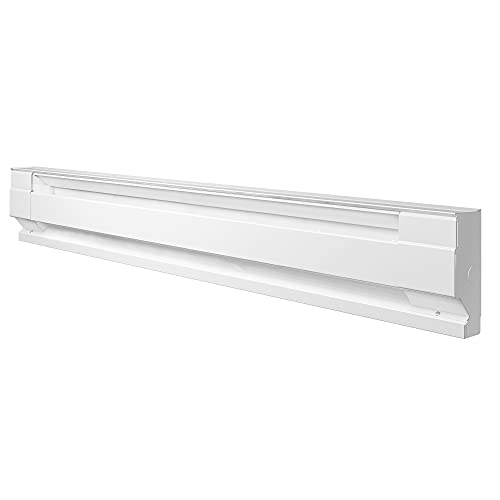
This Cadet option delivers 1000/750W at 240/208V, totaling 3415/2560 BTU. It combines straightforward universal wiring with pre-punched knockouts for cost-effective installation. The heater uses convection to distribute warm air, helping maintain a steady temperature across the room while keeping operation quiet and simple.
Buying Guide: Key Considerations For Hydronic Baseboard Heaters
Selecting the right hydronic baseboard heater depends on room size, power availability, and installation constraints. Consider these perspectives when evaluating models:
- Heat output and voltage: Match BTU ratings to room size and ensure the unit’s voltage aligns with available circuits (120V, 208V, or 240V). Larger rooms often require higher BTU ratings and multiple units.
- Thermal behavior: Liquid-filled elements tend to reduce temperature swings and retain heat longer, which can improve comfort in fluctuating climates.
- Noise and airflow: Hydronic baseboards are typically fanless, offering quiet operation. If noise is a concern, prioritize models advertised as fanless or with natural convection.
- Safety features: Look for thermal cutoffs, short-circuit protection, and sturdy enclosures. For homes with children or pets, safety shutoffs are particularly valuable.
- Installation and wiring: Universal wiring capabilities and pre-punched knockouts simplify installation. Consider whether the unit is designed for surface mounting or concealment within existing wall cavities.
- Durability and finish: Powder-coated finishes and all-metal housings improve longevity in high-traffic areas and improve resistance to wear.
- Maintenance and service: Some models offer easier access for cleaning and service. Consider availability of replacement parts and warranty coverage when evaluating long-term costs.
In evaluating these options, consider how each model’s features align with your space’s heat needs, the existing electrical setup, and long-term reliability. For offices or small commercial rooms, a higher BTU output with straightforward wiring may be preferable. For living spaces, quiet operation and predictable heat can be more valuable than peak wattage alone.