Need steadier water pressure across faucets, showers, and outdoor hoses? This guide highlights five in line water pressure boosters that are well-suited for homes, apartments, and small properties. Each product section explains who it’s best for, why it was selected, and a practical limitation to consider. The top picks cover a range of power, efficiency, and control options—from smart, constant-pressure models to robust diaphragm pumps. A quick summary table follows to help you compare key details at a glance.
| Product | Best For | Key Benefit |
|---|---|---|
| Aquastrong Smart 45 | Whole-house boosting with smart control | Automatic constant pressure with high head |
| ECO-WORTHY 33-Series | RV, garden, irrigation on a budget | Diaphragm pump with simple pressure switch |
| GWANZI 1.2HP | Large homes or villas needing higher head | High head and OTA upgrade capability |
| TDRFORCE 540E | Boats, RVs, gardens needing flexible on/off | On-demand 5.5 GPM with 75 PSI |
| konzition 0.8HP | Quiet indoor boosting with digital display | Energy-saving, stable pressure |
Aquastrong Smart 45 Whole House Booster Pump

The Aquastrong Smart 45 is a fully integrated, intelligent water pump designed for domestic boosting. It automatically monitors demand and adjusts performance to maintain constant pressure across all taps, with a maximum flow of 1500 GPH and a head up to 150 ft. The adjustable pressure range runs from 22 to 80 PSI, with a preset around 44 PSI. Best for homeowners seeking automatic, maintenance-free pressure without manual adjustments.
Best for: Homes needing true constant pressure with minimal manual setup. Why selected: smart control and durable stainless steel components support reliable daily use. Limitation: may require wall or cabinet space for housing the integrated design.
ECO-WORTHY 33-Series 110V Diaphragm Water Pump
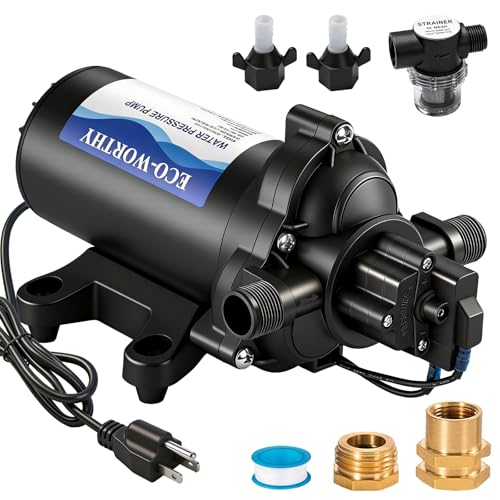
This 33-Series diaphragm pump provides a straightforward 4.0 GPM at a nominal 50 PSI, ideal for RVs, small gardens, and irrigation setups. It uses a smart pressure switch to start and stop on demand, with a safe self-priming capability. Best for: budget-conscious users who want a simple, reliable inline booster without advanced smart controls. Limitation: range is limited to about 50–70 PSI depending on setup, so higher pressure needs may require a different model.
GWANZI 1.2HP Whole House Booster

The GWANZI booster features a 900W motor with a maximum head of 170 ft and an adjustable range of 15–90 PSI. It delivers up to 1500 GPH for complete whole-house boosting. Best for: larger homes or villas where higher pressure is needed across multiple fixtures. Limitation: data notes an OTA upgrade path, which implies software should be kept updated for best performance.
TDRFORCE Fresh Water Booster 540E

The TDRFORCE 540E is an inline 110V pump that increases water pressure up to 5.5 GPM and 75 PSI, with self-priming capability for versatile use in boats, RVs, and gardens. Best for: users needing a compact, reliable on-demand booster that can be installed in mobile or stationary setups. Limitation: power draw and flow depend on supply conditions; ensure wiring and outlets meet local requirements.
Tdrsuper Water Pressure Booster Pump

The Tdrsuper pump is a 110V diaphragm model delivering roughly 5.0 GPM with a 70 PSI factory setting and self-priming capability. It’s designed for homes and RVs, with auto start/stop based on faucet use. Best for: users who want a dependable diode-free diaphragm pump with easy installation. Limitation: the supplied default pressure can be adjusted but may require fine-tuning for hot water systems or long pipe runs.
konzition 0.8HP Smart Booster

The konzition booster uses a 600W permanent magnet motor and intelligent frequency control to save energy while delivering consistent pressure. It offers a 70 PSI target with a maximum 21 GPM and quiet operation at about 50 dB. Best for: indoor installations where quiet operation and energy efficiency are priorities. Limitation: advertised features rely on a smart control system and may require compatible electrical and piping configurations.
Buying Guide: Key Purchase Considerations
- Pressure needs: Determine whether you require a fixed output (constant pressure) or variable pressure adapting to demand. Constant-pressure models keep all fixtures at a steady level, while variable models react to usage.
- Head and flow: Match the head (feet of lift) and GPM to your home’s water layout. Higher head suits multi-story homes; higher GPM benefits busy households with simultaneous fixtures.
- Control type: Smart/inverter models adjust speed automatically for efficiency, while diaphragm and standard pumps rely on pressure switches or presets. Consider ease of use and maintenance expectations.
- Energy use and noise: Permanent magnet motors and inverter control typically reduce energy use and noise. Check dB ratings and placement considerations for indoor use.
- Installation and compatibility: Look for models with standard fittings (DN25, 3/4″ to 1″ pipes) and clear wiring requirements. Self-priming capability helps with shallow wells or tanked water.
- Materials and durability: Stainless steel components and rust-resistant housings improve longevity and water quality. Consider pumps designed for hot water up to the rated temperature if applicable.
- Maintenance and serviceability: Integrated designs may simplify setup but can complicate replacement parts. Verify ease of access to seals, impellers, and fans if relevant.
Frequently Asked Questions
- What is a booster pump with constant pressure good for?
It maintains a steady pressure across all taps, which is beneficial in homes with multiple bathrooms or long pipe runs where pressure fluctuates.
- Do these pumps work with shallow wells?
Yes, many models have self-priming features and can handle shallow wells, but verify maximum lift and priming height in the product specs.
- Can I install these myself?
Most inline boosters are designed for DIY installation, but some configurations may require professional wiring or plumbing adjustments. Always follow the manufacturer’s instructions.
- What affects the noise level of a booster pump?
Motor type, mounting method, and the presence of rubber feet or vibration dampening affect sound. Inverter-driven models are often quieter.
- How do I choose between 50 PSI and 70 PSI presets?
Lower PSI suits smaller homes or older pipes prone to leaks; higher PSI can improve shower and faucet performance but may stress fixtures. Start with the manufacturer’s default and adjust carefully.
- Is a larger head always better?
Not always. A head that exceeds your pipe’s practical lift won’t improve performance and can waste energy. Choose based on your home’s height and longest run.