Looking for an in-wall tankless water heater that fits tight spaces and delivers instant hot water? This guide highlights five compact options well-suited for under-sink or small-utility installations. Each product is evaluated for ease of install, reliability, and what type of user will benefit most—from apartment dwellers to small homes needing point-of-use hot water. The table below compares key features to help you decide at a glance.
| Product | Best For | Output | Notes |
|---|---|---|---|
| Rheem 8kW 240V | Single sink, small apartment | Up to 1.95 GPM | Self-modulating power; easy dial control |
| xwdzswgs 110V 3000W | Under-sink kitchen/bathroom | ~0.3–0.5 GPM depending on temp | LED display; compact; not for showers |
| Mini Tankless 3kW Under Sink | Compact spaces with limited flow | Low-flow only (not for showers) | LED display; safety protections |
| Orbek 14kW 240V | Two to three points of use | Up to 3.38 GPM | Higher capacity; requires robust electrical |
| B0FTCMVRY3 110V 3000W | Kitchen/bathroom with tight space | ~0.3–0.5 GPM depending on flow | LED display; IPX4; wall-mounted |
Rheem 8kW 240V Tankless Electric Water Heater
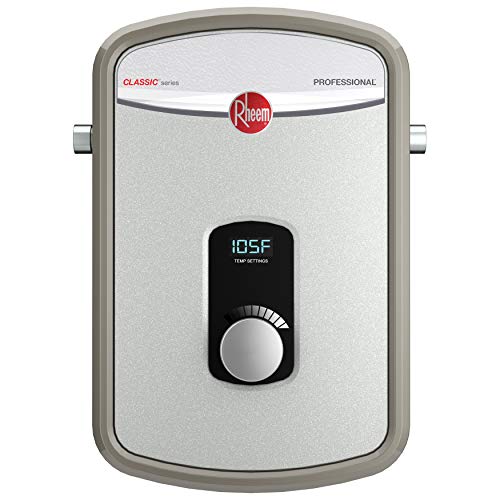
The Rheem 8kW unit uses an ON/OFF dial with an adjustable digital temperature display and self-modulating power control. It is designed for low-to-moderate flow needs, delivering up to 1.95 GPM. Best for a single sink in a compact living space where 80–120°F hot water is sufficient for a quick wash or small tasks. This model is a straightforward install for electricians familiar with 240V circuits.
Who this is for: individuals with a single outlet hot water demand or small apartments needing reliable on-demand hot water at a single location. Why selected: balance of simple controls, energy efficiency via self-modulation, and compact 8kW output. Limitation: higher flow requirements at multiple taps will reduce temperature rise.
Tankless Water Heater Electric 110V, 3000W By xwdzswgs

This under-sink model is compact with a digital LED display. It can raise supply water by about 82°F to 131°F at low flow, depending on inlet water temperature and flow rate, making it suitable for quick, localized hot water near a sink. Best for small kitchens or bathrooms where space is at a premium. Caution: not suitable for showers due to low flow ceiling.
Mini Tankless Under Sink Instant Water Heater 120V 3kW

Note that this 3kW 110V mini heater is designed primarily for low-flow use. It is best for tasks like warm water at a single faucet and not for showers or multiple taps. It features a simple control knob and LED display, with multiple safety protections. Choose this if you need a small, easy-to-install point-of-use heater and only light-duty hot water needs.
Orbek 14kW 240V Tankless Water Heater

The Orbek 14kW model provides up to 3.38 GPM, suitable for 2–3 points of use such as bathroom and kitchen simultaneously. It requires a robust electrical setup (240V, 60A breaker, 6 AWG wires) and at least a 150-amp service capacity. Best for homes needing more hot water at multiple fixtures. Limitation: installation demands a dedicated high-capacity circuit.
110V Tankless Water Heater Electric, 3000W

This 110V model operates at 3000W with a 82°F to 131°F rise depending on flow, similar to other 3kW units. It includes a digital display and IPX4 waterproofing for safety at the point of use. Best for spaces where 110V wiring is already available and you need quick hot water at a sink or compact area. Limitation: moderate flow may limit performance for showers.
Buying Guide
Where will you install?
In-wall or under-sink tankless heaters save space, but installation location affects required electrical capacity. A single-sink setup with 8kW or 3kW units is simpler, while multiple-use systems (like Orbek) need higher amperage service and dedicated breakers.
What is your required flow?
GPM matters. Many compact units top out around 0.3–0.5 GPM at higher temperatures or up to about 1.95 GPM for larger 8kW models. If you want hot water at multiple taps, aim for higher wattage and confirm the home’s electrical capacity.
Electrical compatibility and safety
Most wall-mounted options use 110V or 240V. 240V units typically require dedicated double-pole breakers and thicker conductors (like 6 AWG) for 14kW- or 24kW-class models. Ensure electrical panel space and wiring meet the unit’s requirements.
Protection features
Look for IPX-rated water resistance, dry-heating and overheat protections, and automatic power-off when inactive. These protections improve longevity in damp conditions and reduce risk of damage in busy kitchens and bathrooms.
Installation considerations
Consider mounting location, access to cold water supply, and ventless design advantages. For point-of-use options, ensure the chosen model aligns with your faucet’s expected flow and water temperature requirements.
Maintenance and longevity
Tankless models typically require minimal ongoing maintenance beyond checking for mineral buildup. Units with self-modulating controls tend to be more energy-efficient and responsive to changing flow demands.
FAQ
- What size tankless heater should I choose for one sink? Choose an 8kW unit or a 3kW model if your demand is minimal and you have space constraints. Higher wattage provides better temperature rise at higher flows.
- Can I install a 14kW heater in a small apartment? Yes, if your electrical system supports it and space is available, but consult a licensed electrician to verify panel capacity and breaker requirements.
- Are these units suitable for showers? Some are, but many compact models are best for under-sink use or low-flow taps. Verify the maximum GPM and recommended use for each model.
- Do these heaters require venting? Most electric in-wall tankless models are ventless and designed for indoor use; no exhaust venting is typically needed.
- What maintenance do I need? Regular inspections for mineral buildup and checking connections are advisable. Follow the manufacturer’s guidelines for flushing or descaling if necessary.
- Is a higher price guaranteed to mean better performance? Not always. Match wattage and features to your specific water demand and electrical capacity rather than price alone.