Inside wall heaters offer space-saving warmth with modern smart features. This guide showcases five top options, highlighting how they heat efficiently, integrate with home networks, and fit common indoor spaces like bedrooms, living rooms, and home offices. Each entry includes key features to help you compare performance, safety, and convenience.
| Product | Brand | Key Benefit |
|---|---|---|
| Heat Storm HS-1500-PHX-WIFI Infrared Heater | Heat Storm | Wi-Fi control and space-saving wall mount |
| Dreo WH719S Smart Wall Heater | Dreo | Wide oscillation with smart app and voice control |
| Envi Plug-in Electric Panel Wall Heater 1000W | ENVI | Patented quiet, fan-less design with safety sensor |
| GiveBest Electric Wall Heater 1500W WiFi | GiveBest | Remote, app control and ECO temperature management |
| Dreo B0D819MVKF Smart Wall Heater | Dreo | IP24 rating, 30° oscillation, voice control |
Heat Storm HS-1500-PHX-WIFI Infrared Heater

The Heat Storm HS-1500-PHX-WIFI is a wall-mounted infrared heater designed to save floor space while delivering targeted warmth. It includes Wi-Fi connectivity for remote temperature control via a smartphone, a touch screen thermostat, and a remote. A tip-over safety shut-off helps protect households with children or pets, making it suitable for bedrooms, kitchens, and small offices. The unit is optimized for steady, zone-specific heating without heating an entire large area.
Key considerations
Infrared heating provides rapid warmth, with heat delivered to objects and occupants rather than circulating air. Ensure your space benefits from zone heating and that the power supply supports Wi-Fi-enabled operation.
Dreo WH719S Smart Wall Heater

The Dreo WH719S combines 1500W heating with 120° vertical oscillation for even wall-to-wall warmth. It offers smart control via a mobile app and voice assistants like Alexa and Google Home, enabling scheduling and remote adjustments. The 1°F precision temperature control helps maintain comfort, while the wide warm-up pattern makes it a solid option for bedrooms, home offices, and small living areas.
Key considerations
Look for a balance between coverage area and noise level. The 120° oscillation improves distribution, but verify your room size aligns with the heater’s wattage rating.
Envi Plug-in Electric Panel Wall Heaters 1000W
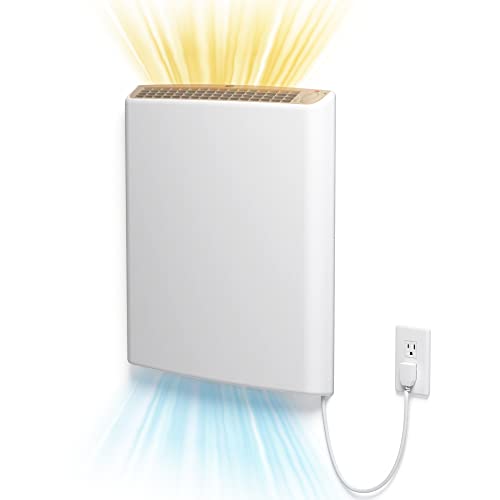
The ENVI 1000W wall heater emphasizes energy efficiency and safety with a 90°F surface and a wall-sense safety sensor. It supports 24/7 operation and is designed to maintain comfortable rooms while minimizing energy consumption. A fan-less, quiet operation helps reduce noise, making it suitable for bedrooms and nurseries. The unit’s build aims to minimize dust circulation, supporting cleaner indoor air in allergy-prone households.
Key considerations
Fan-less design reduces dust disturbance and noise, but ensure the unit can deliver adequate heat for your room size without central heating supplementation.
GiveBest Electric Wall Heater 1500W With WiFi

GiveBest offers a flexible 1500W wall heater with WiFi and remote control. This model supports floor or wall mounting, expanding placement options. The device emphasizes ECO heating with a precise thermostat and auto-adjustment to conserve energy after reaching the target temperature. It’s designed for large rooms or spaces where quick preheating is desired, with versatile installation to fit various layouts.
Key considerations
Consider where you’ll place the unit to maximize airflow; if mounting on a wall, ensure clearance around furniture and outlets to avoid overheating nearby objects.
Dreo Smart Wall Heater 1500W 30° Oscillation

This Dreo model delivers 1500W heating with 30° oscillation for targeted warmth. It supports remote control and app-enabled operations, including voice compatibility with Alexa. The ECO mode provides precise temperature management, helping reduce energy use while maintaining comfort. It is a practical option for bedrooms, offices, or compact living spaces where quiet operation and convenient control are valued.
Key considerations
Check your room’s heat load and ensure the heater’swattage aligns with the space. Smart controls are beneficial for households with varied schedules or occupants who prefer automation.
Buying Guide: What to Consider When Choosing an Inside Wall Heater
- Room size and heat output: Match wattage and heating pattern (infrared vs. convection) to the room’s volume and insulation. Heaters with 1000–1500W are common for bedrooms and small living areas, while larger rooms may benefit from higher output or multiple units.
- Heat distribution: Oscillation and airflow design improve even warmth. Consider models with 30° or 120° oscillation for larger spaces.
- Smart controls and integration: Wi-Fi/app control, voice assistant compatibility, and timers help automate heating and improve energy efficiency.
- Safety features: Look for tip-over shut-off, overheat protection, cool-to-touch surfaces, and safety sensors. For bathrooms or damp spaces, IP ratings (IP24) and ALCI plugs add protection.
- Installation and placement: Wall-mount options save floor space; ensure proper electrical capacity and sufficient clearance from furniture and walls. Some units offer floor mounting as a backup.
- Noise level and comfort: Quiet operation (low dB levels) is important for bedrooms and study areas. PTC heating elements typically provide stable warmth with reduced noise.
- Energy efficiency: ECO or smart temperature calibration helps reduce energy use. Consider models with precise temperature control (often within 1°F).
- Maintenance and durability: Fan-less designs reduce dust circulation, while sealed or protected components help prolong lifespan in living spaces.
- Warranty and reliability: Check manufacturer warranties and support options, especially for frequently used or high-heat settings.
Choosing an inside wall heater involves balancing space savings with heat needs, safety, and smart features. For rooms where rapid warmth is desired, infrared models offer instant comfort; for steady heat and quiet operation, fan-less or well-insulated options may be preferable. Always assess room size, insulation, and electrical capacity before selecting a model.