Answering the need for precise, battery-free, and easy-to-read low-pressure tire readings, these gauges cover commonATV, golf cart, lawn equipment, and off-road tires. This guide highlights top picks, who they’re best for, and key trade-offs to help you choose. Ideal buyers include vehicle owners who regularly service low-pressure tires, DIY enthusiasts seeking rugged tools, and professionals needing reliable deflation or inflation accuracy.
Summary of selected products:
| Product | Best For | PSI Range | |
|---|---|---|---|
| JACO Elite Low Pressure Tire Gauge – 15 PSI | ATVs, dirt bikes, tractors | 0-15 PSI | Robust brass build, built-in bleeder valve |
| ATsafepro Low Pressure Tire Gauge 1-20 PSI (2-Pack) | Golf carts, RO tanks, small off-road gear | 1-20 PSI | All-metal, battery-free, built-in deflator |
| WYNNsky Low Pressure Pencil Tire Gauge 1-20 PSI | Compact vehicles and precision low readings | 1-20 PSI | Chrome/plated head; aluminum tube |
| JACO Elite Low Pressure Tire Gauge – 30 PSI | ATV/UTV and off-road vehicles with higher low-PSI needs | 0-30 PSI | Deflator valve; 360 swivel chuck |
| ETENWOLF T300 Digital Tire Pressure Gauge 3-200 PSI | Versatile vehicles and extreme ranges | 3-200 PSI | Digital with AI thermal compensation |
JACO Elite Low Pressure Tire Gauge – 15 PSI
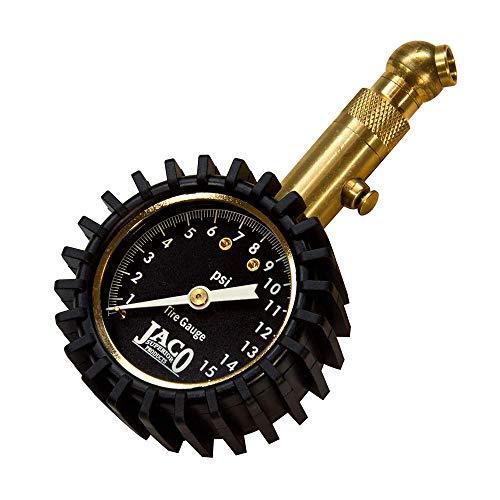
Reference features: Mechanic recommended; ANSI-standard accuracy within ±1.5% at a NIST-accredited facility; zero battery dependency; 0-15 PSI scale suited for low-pressure tires on ATVs, dirt bikes, tractors, and quads; rugged brass components with shock-resistant protection; thick 2.25″ stem; built-in air bleeder valve; 360-degree swivel chuck for valve access from any angle.
Best for: Owners of ATVs, sport quads, and small tractors who need a compact, durable gauge with reliable low-PSI readings. Why selected: Combines high-precision, battery-free operation with a lightweight form factor and a built-in deflator for quick adjustments. Limitations: Narrower 0-15 PSI range compared to higher-PSI models; not ideal for vehicles regularly requiring readings above 15 PSI.
ATsafepro Low Pressure Tire Gauge 1-20 PSI (2-Pack)

Reference features: 1.1-20 PSI range with 1.5 PSI precision; all-metal, battery-free, durable stainless steel body; built-in deflator to release excess air without tools; pencil gauge design with clip for portability.
Best for: Golf carts, RO systems, ATVs, UTVs, and lawn equipment where compact, reliable readouts are needed and battery-free operation matters. Why selected: Exceptional low-range accuracy and portable form factor; Limitations: Only 1-20 PSI, so not suited for vehicles needing higher low-PSI values.
WYNNsky Low Pressure Pencil Tire Gauge 1-20 PSI

Reference features: Precision 1-20 PSI range; pressure units in 1/2 PSI increments; chrome-plated zinc head and aluminum tube for longevity.
Best for: Users needing a slim, lightweight tool with precise low-PSI readouts in tight spaces. Why selected: Pencil design reduces bulk and increases accessibility in crowded engine bays. Limitations: May require careful handling to avoid accidental deflation during quick checks.
JACO Elite Low Pressure Tire Gauge – 30 PSI

Reference features: ANSI-standard accuracy within ±1.5%; rugged brass with shock-resistant guard; 2.25″ stem; built-in deflator; 360-degree swivel chuck; extended tip for reliable seal.
Best for: Off-roaders and larger low-PSI needs where a broader 0-30 PSI range improves versatility. Why selected: Maintains JACO’s durability and accuracy at higher low-PSI readings; Limitations: Not ideal for extremely low PSI needs below 0 PSI, and the larger size may impact compact storage.
ETENWOLF T300 Digital Tire Pressure Gauge 3-200 PSI

Reference features: Digital display; pressure range 3-200 PSI; ANSI B40.7 Grade 2A accuracy; several units (PSI, Bar, Kgf/cm², KPa) accessible via a single button; designed for reliable readings across vehicles and conditions.
Best for: Drivers who need a versatile digital gauge with wide range and unit options. Why selected: Provides clear, backlit readouts and multiple unit options; Limitations: Requires battery power and may be more expensive than mechanical options.
Buying Guide
Key purchase considerations help you pick the right low-pressure gauge for your needs.
- Range and precision: Choose 1-20 PSI for small equipment and ATVs, or 0-30 PSI for broader low-PSI needs. For digital versatility, 3-200 PSI can cover car tires and more.
- Display type: Analog pencils provide quick readings in tight spaces; digital displays offer backlighting and unit conversion for precise measurements.
- Durability: Look for brass or stainless steel bodies and a protective housing for rugged use outdoors or on farms.
- Ease of use: Built-in bleeder/deflator valves speed up adjustments; 360-degree swivels improve access to valve stems from awkward angles.
- Portability and storage: Pencil gauges are compact; multi-pack options can be cost-efficient for fleets.
- Battery-free options: Mechanical gauges avoid battery failures in cold environments; digital models add convenience with backlight and memory functions.
FAQ
- What PSI range is best for ATVs and golf carts?
– For most ATVs and golf carts, a gauge with a 1-20 PSI or 0-20 PSI range provides precise low-pressure readings needed for proper tire inflation. - Are digital gauges better than mechanical gauges?
– Digital gauges offer backlit displays and easy unit switching, but mechanical gauges are battery-free and often tougher in rough conditions. - Do I need a deflator valve?
– A built-in deflator helps quickly relieve excess air without tools, which is convenient for low-PSI adjustments. - Can I use a 0-30 PSI gauge on all my equipment?
– A 0-30 PSI gauge covers low and moderate pressures; confirm your tires’ recommended PSI to avoid overinflation or underinflation. - What is the advantage of a wide-range gauge like 3-200 PSI?
– It handles a broader set of vehicles, from small carts to passenger cars, making it a versatile choice for mixed-use households or fleets.