Answering your search for a quiet cooling solution, this guide highlights low-noise options suited to bedrooms, offices, and living spaces. The top picks blend silent operation with strong cooling and modern controls. Best for sleepers, small apartments, or home offices, these units minimize disruption while delivering reliable comfort. A quick summary table follows the introduction to help you compare at a glance.
| Product | Best For |
|---|---|
| Temprium 12,000 BTU Portable | Large rooms up to 600 sq. ft.; smart control |
| KoolSiln 14,000 BTU Portable | Larger spaces; quiet night mode |
| Garvee 8,000 BTU Portable | Small-to-mid rooms; budget-friendly |
| Midea 6,000 BTU U Shaped Window | Window installation; ultra-quiet |
| KoolSiln 12,000 BTU U Shaped Window | Window cooling; strong efficiency |
Temprium 12,000 BTU Portable Air Conditioner
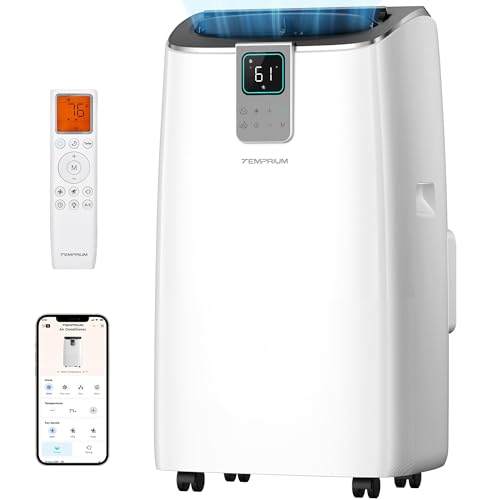
Best for large rooms up to 600 sq. ft., this dual-motor portable unit delivers strong airflow (350 CFM) while focusing on energy efficiency with a 7.2 CEER rating. It operates in Silent Mode at 41 dB, making it suitable for bedrooms or adult living areas. Four control options include TEMPRIUM app, Alexa, Google Assistant, remote, and LED touch panel. Cools quickly, with smart scheduling to fit daily routines. A potential limitation is the larger footprint needed for installation in smaller spaces.
KoolSiln 14,000 BTU Portable Air Conditioner

Best for rapid cooling in larger spaces up to 700 sq. ft., this unit emphasizes quiet operation with noise levels around 48 dB in Sleep Mode. Its 14,000 BTU rating provides robust cooling, while 360° auto-evaporation helps reduce maintenance. A caution: higher cooling capacity may lead to higher energy use if not matched with appropriate room size. It’s a strong pick for both homes and small offices that require quiet, steady cooling.
Garvee 8,000 BTU Portable Air Conditioner

Best for bedrooms, apartments, or small offices up to 350 sq. ft., this 3-in-1 portable unit provides cooling, dehumidification (up to 45 pints/day), and a two-speed fan. It includes sleep mode and a 24-hour timer, with R32 refrigerant to support energy-conscious operation. Limitations include smaller cooling capacity than larger units, so choose this if your space is modest and you want simple one-unit control.
Midea 6,000 BTU U Shaped Smart Inverter Window AC

Best for window installation with ultra-quiet operation, this 6,000 BTU unit cools up to 250 sq. ft. and features a U-shaped design to reduce outdoor noise intrusion. It is Wi-Fi enabled and supports Alexa/Google Assistant voice control, offering significant energy savings (over 37%) and ENERGY STAR Certification. Choose this if you want a window solution with smart control and minimal sound disruption; it may require a suitable window setup.
Midea 12,000 BTU U Shaped Smart Inverter Window AC
Best for large spaces up to 550 sq. ft., this higher-capacity U-shaped unit brings ultra-quiet operation (as low as 32 dBA) and strong energy savings (over 37%). It’s Wi-Fi enabled with voice control via Alexa/Google Assistant and supports a broad smart-control ecosystem. Limitations include the need for proper window compatibility and installation space. This option suits homes seeking persistent quiet cooling with smart features.
Hykolity 10,000 BTU WiFi Portable AC

Best for versatile year-round comfort in rooms up to 450 sq. ft., this 5-in-1 portable unit includes Turbo, Cool, Fan, Dehumidify, and Sleep modes. It can be controlled via the Smart Life app or remote, with dual LED displays for clear performance visibility. It operates quietly at about 45 dB thanks to dual motor design. Use this if you want flexible, app-based control in a medium-sized space; note that higher noise could appear in Turbo mode.
Buying Guide — Key Considerations For Low Noise Cooling
What room size should guide your choice? Larger spaces often demand higher BTU ratings, but not at the expense of excessive noise. For bedrooms or home offices, prioritize units with sleep or quiet modes and sound levels under 45 dB. Windows vs. portable options depend on installation feasibility and whether you want a semi-permanent setup.
How to compare noise and energy efficiency
- Look for dB ratings in Sleep or Quiet modes; lower is better for night use.
- Check energy efficiency ratings (CEER, ENERGY STAR). Higher CEER or ENERGY STAR certification means lower operating costs.
- Consider inverter technology; in window units, U-shaped designs can reduce external noise.
Smart features and control options
- Apps, voice assistants (Alexa/Google), and remotes offer convenient operation from across the room.
- Auto-evaporation and timers reduce maintenance and unnecessary energy use.
Durability, installation, and maintenance
- Portable units require space for exhaust hoses; ensure your room can accommodate this without obstruction.
- Look for easy-filter access and washable components to maintain performance.
Choosing the right form factor
- Portable units are flexible across rooms but may be louder than window units on some modes.
- Window units offer strong, stable cooling with space efficiency but require compatible windows and installation.
Energy efficiency vs. cooling speed
Higher BTUs mean faster cooling but can increase energy consumption if misapplied. Match BTU to the actual room size and insulation level to balance comfort with energy use.
FAQ
- What is considered a quiet decibel level for an air conditioner? For bedrooms and living spaces, 40-45 dB in Sleep or Quiet modes is generally considered quiet.
- Do window units cool as quietly as portable units? It depends on the model; some U-shaped inverter window units use design features to reduce outside noise and can be very quiet.
- Is higher BTU always better for noise? Not necessarily. If a unit is oversized for a room, it may cycle on/off more often, potentially increasing perceived noise and reducing efficiency.
- Do smart-enabled air conditioners save energy? Yes, smart controls can optimize cooling schedules, reducing unnecessary operation and energy use.
- How important is energy certification (ENERGY STAR) for portable units? ENERGY STAR certification indicates higher efficiency, which often translates to lower energy costs over time.
- What maintenance helps keep noise down? Regularly clean or replace filters, keep vents clear, and use sleep or low-speed modes during nighttime use.