Answering the search for reliable natural gas hot water comes down to choosing units that deliver steady heat, handle multiple outlets, and fit your home’s usage pattern. This guide highlights five top picks suited for different households, from compact indoor installs to outdoor models with high flow. If you need endless hot water for several showers or a family kitchen and bath setup, one of these options can fit.
Quick product snapshot. The table below compares the five selected models by capacity, typical flow, indoor/outdoor use, and best-use scenario.
| Product | ||||
|---|---|---|---|---|
| ThermoMate CZ422NG | Up to 5 | 113,000 | ||
| FOGATTI 170S | Up to 7.5 | 170,000 | ||
| MIZUDO 199k | Up to 10.3 | 199,000 | ||
| APUS 190k Outdoor | 8.1 | 190,000 | ||
| Rheem RTG-84XLN-3 | Up to 8.4 | 180,000 |
ThermoMate CZ422NG Natural Gas Tankless Water Heater

The ThermoMate CZ422NG is an indoor tankless unit designed for households that require hot water on demand with stable temperatures. It handles two showers at once, maintaining around 105°F from a 65°F inlet, thanks to a smart flow sensor and control chip that makes rapid adjustments. It’s best for mid-sized homes where you want fast hot water without storage tanks.
Best for: Homes needing reliable on-demand hot water for multiple outlets without a tank. It emphasizes stable temperature with quick response times.
Why selected: High BTU input coupled with precise temperature control helps prevent cold-water sandwich effects during simultaneous use.
Caution: While it emphasizes energy efficiency, the unit uses gas as the heat source, so venting and installation clearances must follow local codes.
FOGATTI Natural Gas Tankless Water Heater Indoor — 170S Series

The FOGATTI 170S Series delivers robust performance with up to 170,000 BTU and 7.5 GPM, providing abundant hot water for multitasking households. Its four-stage combustion system and temperature sensing help maintain comfort across showers and appliances. It’s especially suitable for homes that demand continuous hot water for several outlets.
Best for: Larger households or homes with multiple simultaneous hot water needs indoors.
Why selected: High flow and strong BTU power make it a strong match for frequent simultaneous use while maintaining temperature accuracy.
Caution: Outdoor or indoor installation may require proper venting and clearances; ensure compatibility with local codes and exhaust requirements.
MIZUDO Natural Gas Tankless Water Heater — 199,000 BTU

The MIZUDO 199k BTU heater provides 10.3 GPM and is geared toward large families. It includes smart WiFi connectivity for remote management and schedules, plus an array of safety systems to protect against common failures. The design aims to deliver efficient hot water on demand for multiple fixtures while offering modern control features.
Best for: Large households seeking remote management and high flow for many outlets.
Why selected: Very high BTU and flow make it a versatile choice for kitchens, baths, and laundry with dependable delivery.
Caution: Smart features rely on app connectivity; ensure robust WiFi coverage and device compatibility for remote control.
Rheem RTG-84XLN-3 Outdoor Tankless Natural Gas Water Heater
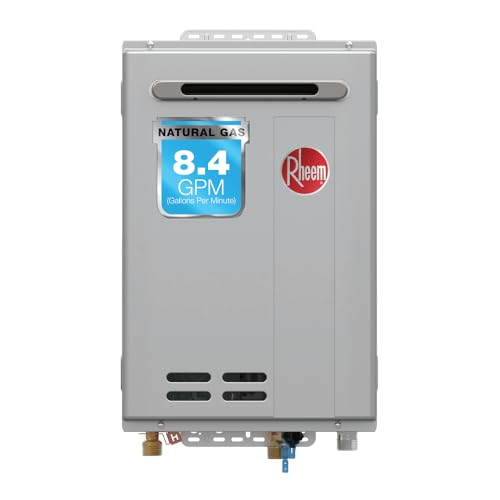
The Rheem RTG-84XLN-3 provides 8.4 GPM at up to 180,000 BTU for outdoor installations. Built for reliability in homes with consistent hot water needs across multiple bathrooms, it is designed for straightforward wall mounting and outdoor exposure. It’s a solid pick for houses where indoor space is limited and outdoor mounting is feasible.
Best for: Outdoor installations where space inside is at a premium and multiple hot water needs exist.
Why selected: Durable outdoor model with strong flow capacity and robust heat output to handle busy households outdoors.
Caution: Outdoor units require weatherproofing and appropriate venting; consider climate impacts on performance and component longevity.
APUS 190k Outdoor Tankless Water Heater

The APUS outdoor model delivers 8.1 GPM with 190,000 BTU, designed to support three showers and two faucets simultaneously. It emphasizes a stable temperature range with remote control via an app, plus a compact outdoor footprint. It’s a practical choice for homes with outdoor installation capability and a need for reliable, whole-house hot water.
Best for: Outdoor installation with strong demand across multiple fixtures and a willingness to manage via app or remote controller.
Why selected: Combines high flow with smart temperature control, making temperature consistency easier to manage across use points.
Caution: Outdoor units demand appropriate weather protection and secure electrical wiring; verify compatibility with local electrical codes and venting requirements.
Buying Guide: Natural Gas Tankless Water Heaters
What should you consider when buying?
- Flow rate vs. demand: Assess how many outlets typically run simultaneously and choose a unit with enough GPM to handle peak usage.
- BTU and efficiency: Higher BTU means faster heat and higher immediate supply, but check for energy efficiency ratings and operating costs.
- Indoor vs. outdoor: Indoor models save space but require venting and installation considerations; outdoor units avoid indoor venting but require weather protection.
- Safety features: Look for protections against freeze, flame-out, overheating, and anti-dry firing for longevity and reliability.
- Controls and connectivity: WiFi or app-based controls are helpful for centralized scheduling and temperature management, especially for larger homes.
- Installation considerations: Ensure adequate clearances, venting, gas supply, and electrical support per local codes.
How to compare models effectively?
- Compare GPM at your typical inlet water temperature. Real-world performance varies with climate and water quality.
- Check the minimum input temperature rise and stability. Look for units that maintain ±1°F temperature consistency for comfort.
- Evaluate the size of the unit and required clearances to determine suitability for your space.
Common questions buyers ask
- Q: Do tankless water heaters waste more gas than a traditional tank?
A: Tankless models heat water on demand, which can reduce standby energy losses; actual savings depend on usage and system efficiency. - Q: Can I install a tankless heater myself?
A: Installation usually requires professional gas plumbing, venting, and electrical work to meet safety and code standards. - Q: How long do these heaters last?
A: With proper maintenance, many tankless units are designed for 10–15+ years, depending on model and installation conditions. - Q: Is a larger unit always better?
A: Not necessarily. Choose a unit that matches peak household demand to avoid over- or under-sizing. - Q: Do these heaters require venting?
A: Most indoor models require venting; outdoor models may skip indoor venting but still need weatherproofing and proper gas connections. - Q: How do I maintain a tankless water heater?
A: Regular descaling, filter checks, and periodic professional servicing help maintain efficiency and longevity.
FAQ Quick Answers
- What is the typical flow rate for a whole-house gas tankless heater? Usually 6–10 GPM depending on BTU and inlet water temperature.
- Is natural gas more cost-effective than electric for hot water? In many homes, natural gas can be more economical for high-demand usage, though costs vary by region.
- Can I upgrade to a higher-GPM unit in a multi-bath home? Yes, but consider gas supply, venting, and installation clearances before upgrading.
- Do tankless heaters ever run out of hot water? They provide on-demand heat; if water flow exceeds capacity, temperature falls may occur.
- Are there safety concerns with natural gas heaters? Modern units include multiple protections; proper venting and professional installation are essential.