When choosing a one-way air compressor valve, the goal is to prevent backflow, protect equipment, and ensure reliable air delivery in various setups. This guide highlights five suitable valves for different applications—from small portable rigs to shop-grade systems. Best for hobbyists, professionals needing durable stainless steel, or systems requiring compact inline valves, these selections cover diverse materials, thread sizes, and installation orientations. Use the brief product table below to compare essentials at a glance.
| Product | Material | Thread Type | Best For |
|---|---|---|---|
| ChillWaves 304 Stainless In-Line Siamese Check Valve (1/4″ NPT) | 304 Stainless Steel | 1/4″ NPT Male x 1/4″ NPT Female | Corrosion-resistant, compact backflow protection |
| FOCMKEAS Air Check Valve (3/8″ PT, Nickel-Plated Brass) | Nickel-Plated Brass | 3/8″ PT Female | Durable, higher flow in mid-size systems |
| Conrader New In Tank Check Valve (1/2″ FPT x 1/2″ MPT) | Brass with Threaded Ports | 1/2″ Female NPT x 1/2″ Male NPT | Tank integration and un-loader compatibility |
| ChillWaves 304 Stainless In-Line Siamese Check Valve (1/4″ NPT, Another Variant) | 304 Stainless Steel | 1/4″ NPT Male | Backflow prevention in tight spaces |
| Boltigen 1/4″ NPT Female Spring Check Valve | SS 304 Stainless Steel | 1/4″ NPT Female | High-pressure resilience, inline use |
| Conrader New In Tank Check Valve (1/2″ comp x 1/2″ MPT) | USA-Made Brass | 1/2″ Compression x 1/2″ Male | Tank connections and universal usage |
ChillWaves 304 Stainless In-Line Siamese Check Valve 1/4″ NPT Male x 1/4″ NPT Female

The ChillWaves valve is a 304 stainless steel, one-way valve designed to prevent backflow in pipelines handling gases, water, or oil. It features a 1/4″ NPT Male x 1/4″ NPT Female configuration and can be installed vertically or horizontally. Best for compact setups and environments requiring corrosion resistance. The stainless steel spring supports reliable closure and quick response to flow changes. A limitation is the need to verify exact diameter against the dimension drawing, since NPT sizing denotes nominal pipe size rather than actual screw diameter.
FOCMKEAS Air Check Valve, 3/8 PT Nickel-Plated Brass

This nickel-plated brass one-way valve provides good corrosion resistance and high-temperature tolerance, with a full-port, 3/8″ PT female connection and a compact profile. It handles pressures up to 150 PSI and operates across -20 to 60°C. Best for mid-sized air systems where ductility and moderate wiring ease matter. Choose this if you need a brass body for compatibility with other brass components; caution: brass may require more attention in highly corrosive environments.
Conrader In Tank Check Valve, 1/2″ FPT x 1/2″ MPT

This in-tank valve connects 1/2″ female NPT to 1/2″ male NPT outlets, designed for air tanks. It supports a relatively high operating temperature and offers a straightforward installation path via standard NPT threads. Best for systems where the valve must sit between the tank and line with minimal adapters. A potential limitation is the need to ensure port compatibility with your specific tank model; some setups may require adapters or extra fittings.
Boltigen 1/4inch NPT Female Spring Check Valve, Stainless Steel 304
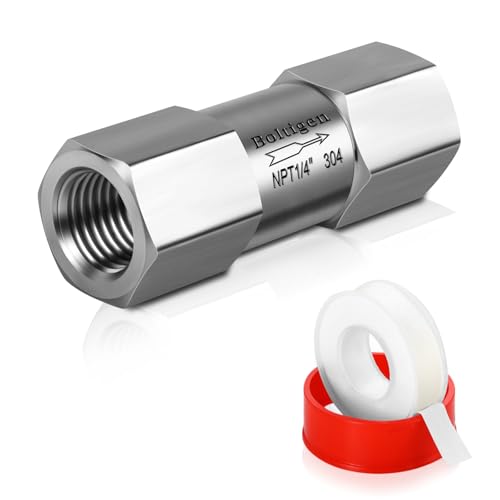
The Boltigen valve is a stainless steel 304 inline check valve with 1/4″ NPT female connections. It’s built to withstand pressures up to 1000 PSI and features a low opening pressure around 1 bar, enabling quick response in pressurized lines. Best for high-pressure systems in which compact inline installation matters. Consider potential limitations like the need for precise torque during installation to maintain a proper seal.
Conrader New In Tank Check Valve, 1/2″ comp x 1/2″ MPT

This valve uses a 1/2″ compression inlet and 1/2″ male pipe outlet to tank connections, rated for up to 450 PSI and up to 400°F. It is U.S.-made and well-suited for installations where a compression-to-NPT transition is desirable. Best for shop tanks or compressor assemblies requiring a secure, high-temperature-rated connection. A limitation is that some portable setups may not have compression fittings readily available, requiring additional adaptors.
Buying Guide: Key Considerations For One-Way Air Compressor Valves
What material is best for your environment? Stainless steel valves offer excellent corrosion resistance and durability in moist or oily environments, while brass valves offer good ductility and ease of threading for certain systems. Consider operating temperatures and pressures to ensure the valve can handle your workload without leaking.
- Thread compatibility: Match port sizes to your hoses, tanks, or manifolds. NPT and PT sizes come in different standards; verify the exact diameter before purchase.
- Flow direction and orientation: Ensure the valve’s preferred flow direction aligns with your piping layout. Some valves support vertical or horizontal installation, others are restricted.
- Backflow prevention effectiveness: A reliable check mechanism reduces risk of oil, moisture, or debris traveling back toward the compressor or tank.
- Temperature and pressure ratings: Select valves rated for your system’s peak pressures and temperatures to avoid failure over time.
- Ease of installation: Consider whether your system uses compression, NPT, or custom adapters. Inline valves with standard threads simplify setup.
- Maintenance needs: Stainless steel typically requires less maintenance than brass in humid environments, but both should be inspected for leaks and seal integrity.
FAQ
- What is a one-way air compressor valve used for?
– It prevents backflow in compressors and air lines, protecting equipment and maintaining consistent pressure. - Do I need a stainless steel or brass valve?
– Stainless steel is preferred in corrosive or damp environments; brass suits many general-purpose applications and can be easier to thread with existing brass fittings. - Will these valves fit my tank or hose?
– Check thread size and port type (NPT vs. compression) and match to your tank, hose, or manifold. - Can I install these valves in any orientation?
– Many valves support vertical and horizontal installation, but verify the specific model’s installation guidelines. - What pressures can these valves handle?
– Ratings vary; some models handle up to 1000 PSI, others around 150 PSI. Choose based on your system’s maximum pressure. - Are these valves suitable for air, water, and oil?
– Most listed valves are designed for gases and air, with some compatible with water or oil depending on material and seals.