Choosing the right paint booth exhaust fan is essential for smoke, fumes, and overspray control. This guide highlights five reliable options suited for professional shops, home garages, and industrial spaces. The top picks balance airflow, durability, and installation flexibility, helping buyers match exact needs—from explosion-proof safety in hazardous environments to portable, budget-conscious ventilation. The table below summarizes key specs to compare at a glance.
| Product | Airflow (CFM) | Power | Best For |
|---|---|---|---|
| VEVOR 12″ Air Mover | 3198 | 585W | General paint booths, small shops |
| VEVOR Explosion Proof 12″ | 3450 | 550W | Hazardous environments |
| Fenjidrop 16″ Explosion-Proof | 5400 | 370W | Large booths, warehouses |
| Bghdas 8″ Utility Blower | 1300 | 60W | Basements, welding, small spaces |
| Hon&Guan 12″ Utility Blower | 3243 | 550W | Workshops, basements |
VEVOR Air Mover Blower Fan 12 Inch — 3198 CFM

Best for: Small to medium paint booths and shop floors that require strong, versatile ventilation. The 585W motor achieves 3198 CFM, making it effective at clearing smoke and odors quickly. The included flexible duct adds installation flexibility for intake or exhaust setups. This unit is portable, with a carry handle and non-slip feet for stable operation.
- Pros: High airflow, ETL certified, durable steel build, corrosion-resistant finish.
- Limitations: Large size may require dedicated space in tight setups.
VEVOR Air Mover Blower Fan 12 Inch — Standard
Best for: Similar to the first VEVOR unit, but a more budget-conscious choice for typical spray booth ventilation. It offers comparable airflow (3198 CFM) and the same durable construction with ETL certification and portability features. Choose this if you want a parallel option for backup or additional exhaust points in larger setups.
- Pros: Consistent performance, reliable build, easy to move between stations.
- Limitations: Not explosion-proof; avoid in high-risk environments without extra safety measures.
VEVOR Explosion Proof 12 Inch Fan

Best for: Hazardous environments where explosion safety is a concern. This model features an explosion-proof switch and a 550W motor delivering high speed for efficient air circulation. Its heavy-duty, compact axial design withstands demanding industrial use and helps maintain safer work conditions in paint application areas.
- Pros: Enhanced safety for flammable atmospheres; robust motor performance.
- Limitations: Higher safety features may come with a larger price tag and heavier weight.
Fenjidrop 16 Inch Explosion Proof Exhaust Fan

Best for: Large paint booths, factories, and warehouses needing high-volume ventilation with explosion-proof safety. The 370W copper motor runs at high speed (1420 RPM) and delivers 5400 m³/h of airflow. Its protective grids reduce the risk of large objects entering, supporting reliable operation in hazardous environments.
- Pros: High airflow for large spaces; explosion-proof design for safety.
- Limitations: Larger footprint may require more installation space and mounting considerations.
Bghdas Utility Blower — 8 Inch
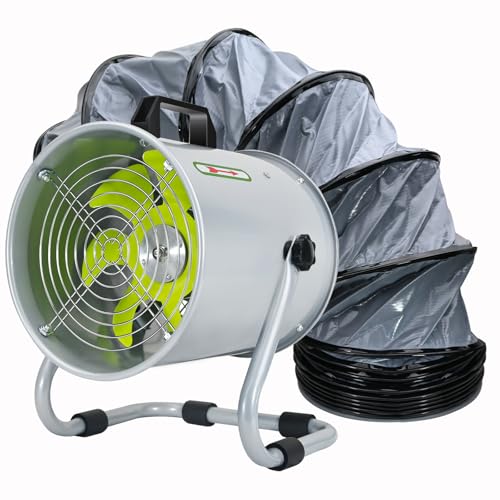
Best for: Compact spaces like basements or small welding or paint booths where a smaller footprint is necessary. It features a strong 2800 RPM suction and 1300 m³/h airflow, with a 60W copper motor and a steel housing for durability. Includes 16.4 feet of flexible ducting for versatile installation.
- Pros: Lightweight and portable; easy to install with long ducting.
- Limitations: Lower airflow compared to larger 12–16 inch fans; best for smaller zones.
Hon&Guan 12 Inch Utility Blower
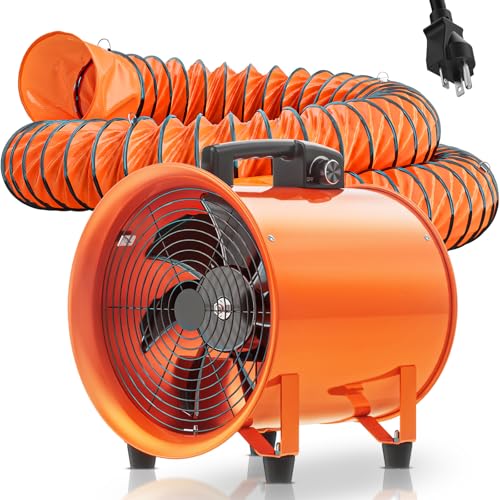
Best for: Medium to large garage or workshop spaces requiring robust exhaust with flexible ducting. The 12-inch design delivers strong airflow with a ceiling-friendly footprint and 33-foot ducting option. It is suitable for paint booths, basements, and warehouses where substantial ventilation is needed.
- Pros: Strong exhaust capability; long flexible ducting provides installation options.
- Limitations: May be louder at high speed; ensure proper mounting to minimize vibration.
Buying Guide
What should you consider when choosing a paint booth exhaust fan?
- Airflow needs: Larger booths require higher CFM (cubic feet per minute). Look for models in the 3000–5400 CFM range for big spaces and 1300–2300 CFM for small to medium areas.
- Safety features: Explosion-proof designs are essential in hazardous environments. Verify motor protection and protective grids where applicable.
- Power and efficiency: Compare motor wattage and RPM to gauge efficiency and noise. Higher RPM with adequate ducting provides better air movement.
- ducting and installation: Flexible PVC ducting helps with placement flexibility. Check duct length (ft) and compatibility with your setup.
- Durability and materials: Steel housings and corrosion-resistant coatings extend service life in paint and solvent environments.
- Portability vs. static install: Portable units are easier to move between stations; wall- or ceiling-mounted fans save space in permanent booths.
- Noise considerations: Higher airflow can mean more noise. Consider models with vibration-dampening features if noise is a concern in occupied spaces.
Practical installation tips
- Place intake and exhaust points to optimize air exchange and minimize overspray recirculation.
- Seal duct connections to prevent leaks and improve efficiency.
- Secure units to a stable surface to reduce vibration and prolong motor life.
FAQ
- What is the difference between a standard blower and explosion-proof exhaust fan? Explosion-proof units are designed for hazardous environments to reduce ignition risk, with specialized enclosures and switches.
- How do I choose the right CFM for my booth? Multiply booth volume (length × width × height) by recommended air changes per hour (ACH). Divide by 60 to estimate required CFM.
- Are portable fans suitable for large paint booths? Yes, but ensure they provide sufficient airflow and ducting options to cover the space evenly.
- Can I install a fan without professional help? For simple, portable setups, DIY may be possible. For explosion-proof or high-heat environments, consult a licensed technician.
- Is duct length important? Yes. Longer ducts reduce effective airflow and increase backpressure. Choose models designed for your duct length or shorten runs if possible.
- Do these fans require maintenance? Regular checks for dust buildup, motor cleanliness, and duct integrity help maintain performance and safety.