Staying warm on the road is essential for comfort and safety in an RV. The right portable heater combines rapid heat, safety features, and flexible control to keep your space cozy without draining power. This guide reviews five top portable options designed for indoor use, RV compatibility, and energy-conscious operation. Each product is selected for reliable performance, safety protections, and user-friendly controls to suit both short trips and extended adventures.
| Product | Brand | Key Highlights |
|---|---|---|
| Dreo Space Heater, 2025 Upgraded | Dreo | Fast heat with 1500W PTC, remote, digital display, 12H timer, 5 modes |
| Dreo Space Heater, 1500W with Remote | Dreo | Quick warm-up, ECO mode, Shield360° protection, temperature control 41–95°F |
| Dreo Space Heater, 1500W With Thermostat | Dreo | Thermostat control, 70° oscillation, 12H timer, multiple safety protections |
| GiveBest Portable Electric Space Heater | GiveBest | 2-in-1 heater/fan, 1500W/750W, thermostat, compact carry handle |
| Mr. Heater F232017 MH9BXRV Buddy | Mr. Heater | Radiant propane heater, 4,000–9,000 BTU, indoor/outdoor suitable |
Dreo 2025 Upgraded 1500W Space Heater

The Dreo 2025 Upgraded model combines a Hyperamics 1500W PTC heating system with a redesigned heat funnel to deliver warmth quickly and project heat farther. It features a tilt-detection sensor for improved tip-over protection and uses ETL-certified V0 flame-retardant materials with overheat protection. An enhanced NTC chipset enables precise thermostat control across a wide range, helping conserve energy while maintaining comfort.
Dreo 1500W Space Heater With Remote
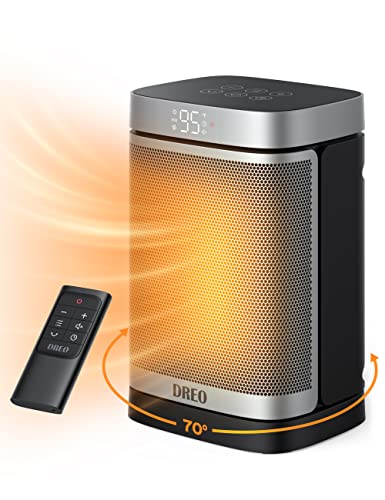
Powered by Dreo Hyperamics Technology, this unit heats up rapidly, delivering warm air quickly to spaces such as RV living areas or bedrooms. It includes Shield360° protection and an enhanced safety plug, with UL94 V-0 flame-retardant materials. An ECO mode minimizes energy use, while the digital thermostat ranges from 41 to 95 ℉ in 1 ℉ increments, allowing precise comfort adjustments without overspending on power.
Dreo 1500W With Thermostat And 70° Oscillation

This model emphasizes comprehensive safety and extended coverage: ETL-Certified construction with multiple protections including smart tip-over and auto-off features, a 12-hour timer, and a long 6-foot cord. Its 270 sq.ft. heating capability makes it suitable for RV living areas, bedrooms, and small living spaces. A quiet operation profile helps maintain restful environments while delivering steady warmth.
GiveBest Portable Electric Space Heater

GiveBest offers a 2-in-1 heater/fan with two heat levels (1500W or 750W) and a cool air option for year-round use. The built-in thermostat cycles the unit on and off to maintain the preset temperature, preventing overheating. Its flame-retardant materials and automatic shutdown features contribute to safe operation, with a compact form factor and carrying handle ideal for RV setups where space and portability matter.
Mr. Heater F232017 MH9BXRV Buddy
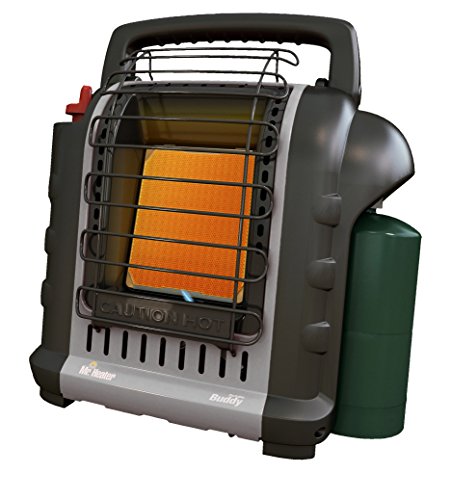
The Mr. Heater Buddy is a radiant propane heater designed for indoor/outdoor use, rated from 4,000 to 9,000 BTU, sufficient for spaces up to roughly 225 square feet. It provides clean-burning operation and high efficiency. Auto shut-off is triggered by tipping, pilot light status, or oxygen level sensors, offering a reliable option for RVs where permanent electrical heating might be less feasible or when traveling to regions with limited electrical access.
Buying Guide: Key Considerations For RV Heating
Coverage and room size matter: Choose a heater that comfortably heats your RV’s square footage without overheating. For larger RVs or open floor plans, models with 70° wide-angle heat distribution or 250 sq.ft. coverage can offer more uniform warmth.
Power source and energy use: Electric heaters are common in RVs with shore power or high-capacity batteries. Look for ECO modes, precise thermostats, and energy-saving features that balance comfort with power consumption.
Safety features: Prioritize tip-over protection, overheat shutoff, flame-retardant materials, and ETL or UL safety listings. For propane models, ensure proper ventilation and certified usage for indoor settings.
Noise and comfort: Quiet operation (around 30–40 dB) helps in bedrooms and living areas where sleep or work occurs. Oscillation can improve warmth distribution but may impact noise level and air flow patterns.
Portability and setup: A lightweight unit with a carry handle, compact footprint, and simple controls is ideal for RV life. Consider cord length and whether the heater is designed for vertical or low-profile placement under furniture.
Safety in RV contexts: In vehicles, vibration, tilt, and limited space require robust tip-over protection and stable bases. Models with tilt-detection sensors, flame retardant housings, and automatic shutoff are typically better suited for mobile environments.
Fuel vs. electric trade-offs: Propane heaters deliver independence from electrical power but require ventilation and gas safety practices. Electric heaters demand power supply but offer easier integration with onboard electrical systems and fewer emissions concerns.
Durability and warranty: RV use exposes units to shifting temperatures and vibration. Look for durable builds, easily replaceable parts, and solid warranty terms to protect your investment on the road.
In choosing among these options, consider room size, available power, and how you plan to use the heater. For frequent travel with access to shore power, electric models with precise thermostats and safety protections provide reliable warmth with straightforward operation. If you often camp in areas with limited electrical supply, a propane-powered option like the Mr. Heater Buddy can be a practical supplement, provided you follow all safety guidelines for indoor use.