If you’re seeking portable cooling that can handle server rooms, offices, garages, or large living spaces without permanent installation, these units are strong candidates. This guide highlights five portable air conditioners ideal for server rooms, emphasizing cooling power, noise level, and ease of placement. Best for IT spaces needing rapid, flexible cooling, or for environments where window access is limited. The selections balance efficiency, control options, and multi-function capabilities to match different cooling priorities.
Summary table of chosen products
| Product | Best For | Key Benefit | Limitations |
|---|---|---|---|
| 14,000 BTU Portable AC with WiFi (KoolSiln) | Large server rooms or offices | Fast cooling, low noise | Heavier, needs space |
| GarveeHome No-Window 14,000 BTU | Server rooms without windows | 3-in-1 function | Bulky for small spaces |
| Garvee 8,000 BTU 3-in-1 | Smaller server rooms and dorms | Compact, versatile | Lower BTU for larger rooms |
| MEPTY 8,000 BTU | Medium rooms and offices | Self-evaporation, portable | Panel could be bulky |
| Garvee 8,000 BTU 3-in-1 (Second model) | Bedrooms and small offices | Quiet with timer | Limited airflow vs larger units |
14,000 BTU Portable AC With WiFi — KoolSiln

The KoolSiln 14,000 BTU unit offers strong cooling for large spaces up to 700 sq. ft. It uses eco-friendly R32 refrigerant and features Auto-Evaporation, reducing maintenance. This model emphasizes quiet operation, with noise levels around 48dB in Sleep Mode, making it better for server rooms that require minimal disruption. Best for: large server rooms or open-plan offices where rapid cooling and low noise are priorities. Limitation: larger footprint may require steady placement and clearance for exhaust hose routing.
GarveeHome No-Window 14,000 BTU AC

This 3-in-1 unit delivers cooling, dehumidification, and fan modes without requiring a window. It’s well suited for server rooms or garages where external venting isn’t feasible, offering a flexible climate solution. Best for: server spaces or workshops without easy window access. Caution: higher BTU units can be less energy-efficient in small rooms; ensure the space matches the recommended area to avoid overcooling.
Garvee 3-in-1 Portable AC — 8,000 BTU

Garvee’s 8,000 BTU model provides a compact, versatile solution with cooling, dehumidifying, and fan modes. It includes a window kit and sleep mode, which are beneficial for server rooms adjacent to living spaces or dorm rooms. Best for: smaller server rooms or office nooks where space is at a premium. Limitation: 8,000 BTU may be insufficient for larger open areas; consider a higher BTU unit if the server room grows.
MEPTY 8,000 BTU Portable AC
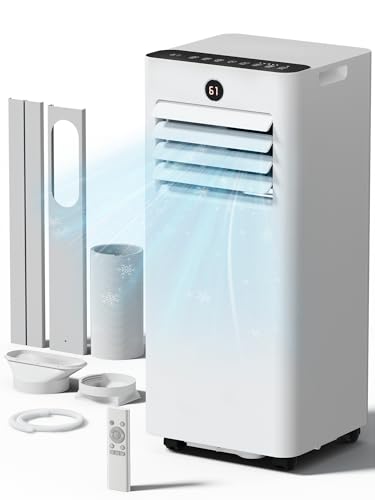
MEPTY’s 8,000 BTU model emphasizes a dual-evaporation system and a 24-hour timer, offering efficient moisture control and flexible scheduling. This unit suits medium-sized server rooms or offices with humidity considerations. Best for: spaces needing reliable dehumidification alongside cooling. Caution: self-evaporation systems reduce drainage work, but manual drainage remains possible in high-humidity conditions.
Garvee 8,000 BTU Portable AC — 3-in-1

This Garvee unit combines cooling, dehumidification, and a fan, with sleep mode and a 24-hour timer. It is suitable for rooms up to 350 sq. ft and includes a window kit for easy setup. Best for: compact server rooms or bedrooms that require steady, quiet cooling. Limitation: airflow and coverage are best for smaller spaces; for larger server rooms, a higher BTU model may be needed.
Buying Guide: Portable AC Units for Server Rooms
- How to choose the right BTU: For server rooms, select a BTU that matches room size and heat load. Overpowered units waste energy; underpowered units fail to maintain stable temperatures during peak loads.
- Energy efficiency and refrigerant: Look for units using eco-friendly refrigerants (like R32) and check ENERGY STAR or efficiency ratings when available. This reduces running costs in server environments.
- Noise considerations: In server rooms, silent operation minimizes disruption to equipment and staff. Sleep or quiet modes are valuable features to prioritize.
- Ventilation options: If window access is possible, a window kit can simplify installation. For no-window setups, consider units designed for vent-free operation or with integrated exhaust solutions.
- Moisture management: Humidity control matters in server rooms. Dehumidifier modes and self-evaporation features help prevent moisture buildup that could affect equipment.
- Portability and placement: Rolling casters and handles ease movement between rooms. Ensure hoses reach exhaust points and that the unit has adequate clearance for airflow.
- Control and automation: Remote control, digital panels, timer functions, and Wi-Fi control enable centralized management in a server environment.
FAQ
- What size portable AC is best for a server room?
– Choose a unit with a BTU rating that matches the room size and heat load. For large server rooms, 12,000–14,000 BTU units are common, while smaller rooms may be comfortable with 8,000 BTU models. - Do portable AC units require professional installation?
– No, most portable units are plug-and-play and use window kits or no-window venting options. Some installations may require basic assembly or venting setup. - Can portable ACs cool a server room without a window?
– Yes, some models offer no-window operation or vent-free configurations, but ensure proper airflow and drainage as recommended by the manufacturer. - Is self-evaporation better for server rooms?
– Self-evaporation reduces drainage tasks by recycling condensate. It is convenient, but in high-humidity environments manual drainage may still be necessary. - How important is noise level in server rooms?
– Very important. Lower noise units reduce ambient disruption to staff and reduce vibrations that can affect sensitive equipment. Sleep mode often offers the quietest operation. - Should I prioritize dehumidification in a server room?
– Yes, humidity control mitigates corrosion and condensation risk. A unit with a dehumidify mode or a separate dehumidifier function is advantageous.