Looking to purchase air conditioning units that fit your space and budget? This guide highlights five top options across portable, window, and ductless styles, with clear uses for different rooms and needs. It’s ideal for buyers seeking easy installation, energy efficiency, and reliable cooling. The top picks below cover small bedrooms, mid-size living areas, and larger spaces, helping you decide which type best suits your environment and daily routine.
Summary table of chosen products:
| Product | Best For | Cooling Capacity | Notes |
|---|---|---|---|
| Garvee 3-in-1 Portable Air Conditioner | Small to mid-size rooms | 8,000 BTU | Portable with window kit; dehumidifier and fan modes |
| GE Window Air Conditioner 5,000 BTU | Compact spaces like bedrooms | 5,000 BTU | Simple mechanical controls; quiet operation |
| VACOOR Portable 14,000 BTU | Large rooms up to 700 sq ft | 14,000 BTU | 3-in-1 with energy efficiency features |
| QZMDSM 16,000 BTU Portable | Very large spaces or open-plan areas | 16,000 BTU | Smart features and multiple modes |
| BSUIAK 4-in-1 Evaporative Cooler | Small spaces or desks; personal cooling | Evaporative cooler | Compact with humidifier and LED light |
Garvee 3-in-1 Portable Air Conditioner

The Garvee unit combines cooling, dehumidification, and a fan in a compact 8,000 BTU package. Best for small to mid-size rooms up to 350 sq ft, it offers a sleep mode and a 24-hour timer for customized comfort. The included window kit supports quick, tool-free installation. Ideal for renters or spaces where a permanent installation isn’t feasible. A caution: performance may vary with high ambient humidity and window size compatibility should be confirmed before purchase.
GE Window Air Conditioner 5,000 BTU

GE’s 5,000 BTU window unit is best for small rooms up to 150 sq ft. It uses simple mechanical controls with two cooling modes and two fan speeds, avoiding digital beeps and app dependencies. The compact profile fits tighter windows and keeps noise lower at night. It’s a solid choice for bedrooms or offices where straightforward operation is valued, though it lacks smart connectivity and requires a compatible window frame for installation.
VACOOR Portable 14,000 BTU

The VACOOR model delivers 14,000 BTU cooling for larger spaces up to 700 sq ft. It emphasizes energy efficiency with a CEER rating and provides cooling, dehumidifying, and fan modes. This unit is best for open-plan living areas or multifunction rooms where strong cooling is required. A potential limitation is size and weight, making it less portable than smaller units and requiring a suitable window or ducted vent setup.
QZMDSM 16,000 BTU Portable Smart AC

QZMDSM’s 16,000 BTU portable unit targets very large spaces up to 750 sq ft. It offers three-in-one cooling, fan, and dehumidifier modes, plus smart features and a sleep timer. It’s best for large living rooms or lofts where a single unit must manage a big area. Choose this if you need robust cooling that can handle open layouts; a caveat is higher energy usage in continuous cooling scenarios and the need for proper venting planning.
BSUIAK Portable 4-in-1 Evaporative Cooler
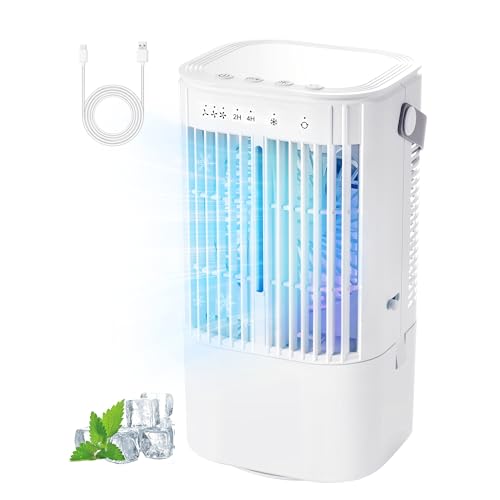
The BSUIAK unit combines evaporative cooling with a humidifier, fan, and LED light in a compact form. It’s suited for small spaces like desks, bedrooms, or dorm rooms where portable, low-cost cooling is preferred. It uses water or ice for cooling and runs quietly, but evaporative cooling is most effective in dry climates. It’s not designed to replace a traditional air conditioner in hot, humid environments.
Buying Guide
- Room size and BTU matching: Choose BTU ratings aligned with room area. Oversized units cool quickly but may cycle on/off more, wasting energy; undersized units struggle to reach comfortable temperatures.
- Portability vs. installation: Portable units offer flexibility but require venting and can be heavier. Window units are typically easier to install in existing frames, while ductless minisplits require professional setup but save space long-term.
- Energy efficiency: Look for CEER or EER/tighter energy specifications. Higher efficiency reduces ongoing operating costs, especially for large or long-running cooling.
- Noise and comfort: Sleep modes and low dB ratings improve comfort in bedrooms and nurseries. Consider units with adjustable fan speeds and sleep timers.
- Controls and smart features: Apps, remotes, and programmable timers add convenience. If simplicity is preferred, mechanical controls reduce potential annoyances.
- Maintenance and filtration: Check filter accessibility and the ease of cleaning; dehumidifier modes generally require regular water tank drainage or bucket emptying.
- Climate considerations: Evaporative coolers work best in dry climates; in humid regions, traditional AC or dehumidifier features may perform better.
Frequently Asked Questions
- What type of AC should I buy for a small apartment? A window or compact portable unit (roughly 5,000–8,000 BTU) is typically suitable for rooms up to 150–350 sq ft, depending on insulation and sun exposure.
- Do portable AC units require professional installation? Most portable units simply vent through a window with the included kit and do not require professional installation.
- Is a higher BTU always better? Not necessarily. Oversized units cool quickly but can waste energy and cause humidity issues. Match BTU to room size for balanced comfort.
- Are mechanical window units easier than smart ones? Mechanical window units are usually simpler to operate, with fewer connectivity issues, while smart units offer scheduling and remote control benefits.
- What’s the advantage of a 3-in-1 or 4-in-1 model? These combine cooling with dehumidification and ventilation, improving comfort and reducing equipment clutter in spaces with humidity or multiple needs.
- Can I use an evaporative cooler in humid climates? Evaporative coolers are less effective in high humidity and may add moisture; traditional AC is often preferred in such settings.