Answering the search for a reliable roof mount solar attic fan, this guide compares five high-performance models to help homeowners, DIY enthusiasts, and small business property managers choose the best fit for their attic cooling needs. Top picks are evaluated by airflow (CFM), weather resistance, ease of installation, and smart features. The best option depends on roof type, desired automation, and whether you prefer purely solar operation or hybrid options for cloudy days.
The following table summarizes the five recommended products, highlighting who they’re best for and why they stand out.
| Product | Best For | Why It Stands Out |
|---|---|---|
| DuskSnug 40W Solar Attic Fan | Homes with sun-focused climates | High airflow (1800–2000 CFM), controller-free operation, rugged copper motor |
| VEVOR 42W Solar Attic Fan | Home garages and utility spaces | Up to 2800 CFM, smart temp/humidity control with remote |
| iLiving Hybrid 40W Attic Exhaust | Areas needing adjustable control | Smart thermostat, up to 1150 CFM, adjustable panel |
| DC HOUSE 32W Solar Attic Fan | Large spaces, durable build | Up to 3000 CFM, weatherproof, durable shell |
| BINGLUX 55W Solar Attic Fan | Energy-saving, automatic operation | Thermostat with on/off, 1300 CFM, hybrid option |
DuskSnug 40W Solar Attic Fan

Best for homes in sunny climates needing strong airflow with minimal setup. This 40W solar attic fan provides 1800–2000 CFM with a 12-inch blade design and a rugged copper motor. The design emphasizes plug-and-play operation, avoiding controllers or complex wiring. It automatically operates at sunrise and powers down at dusk, delivering reliable, maintenance-free ventilation for attics, garages, greenhouses, or sheds. The heavy-duty metal housing adds durability against hail and weather exposure.
- Best for: Quick, simple installation with high airflow and weather resistance.
- Why chosen: Superior passive operation with minimal components; low maintenance.
- Caution: No smart controls—depends on daylight, which may produce variable performance on cloudy days.
VEVOR 42W Solar Attic Fan

Best for larger attic spaces and users who want smart controls. This model uses a 42W MPPT regulator to maximize sun exposure and deliver up to 2800 CFM. It features an integrated intelligent temperature and humidity controller and a remote control for convenience. The design supports all-weather operation and shifts from solar to electric power after sunset, enabling 24/7 cooling even on variable days.
- Best for: Attics requiring higher airflow with flexible remote operation.
- Why chosen: Strong cooling capacity with adaptive controls improves comfort and energy savings.
- Caution: Remote control range is finite; ensure unobstructed signal in your installation area.
iLiving Hybrid Ready Smart Thermostat Solar Roof Attic Exhaust Fan

Best for tech-minded buyers who want programmable comfort. This 14-inch, 40W unit offers 1150 CFM cooling and supports a smart thermostat interface (temperature settings from 50°F to 122°F). It comes with an adjustable solar panel, allowing angle settings (0°, 15°, 30°, 45°) for better sun capture. A long-term benefit includes potential compatibility with hybrid setups, and it carries an extended warranty from the brand.
- Best for: Homes seeking programmable, thermostat-driven operation.
- Why chosen: The thermostat control reduces energy use by matching attic ventilation to need.
- Caution: Moderate airflow compared to higher-CFM models; best for mid-sized spaces.
DC HOUSE 32W Solar Attic Fan
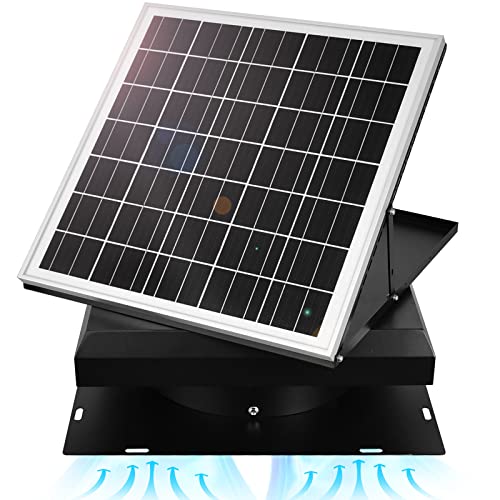
Best for large spaces and rugged outdoor conditions. This model offers up to 3000 CFM with a 9-inch aluminum blade set housed in a steel shell. It emphasizes all-weather reliability and hail resistance, with a brushless copper motor and IP68 waterproofing. It’s designed to run automatically in daylight and can push hot air efficiently out of bigger attic or garage spaces.
- Best for: Large, weather-prone installations needing strong performance.
- Why chosen: High CFM with durable construction and weatherproof features.
- Caution: Higher airflow may require additional attic venting planning to avoid over-ventilation in milder climates.
BINGLUX 55W Solar Attic Fan

Best for energy-conscious buyers who want automatic operation. With a 55W solar panel, this model delivers 1300 CFM and includes a smart thermostat function that starts at a set temperature and turns off when cooled. It also features a hybrid option to run on AC power when solar is insufficient, ensuring continuous venting. The thermostat-based control helps save energy and maintain steady attic conditions.
- Best for: Automated, energy-efficient attic ventilation with hybrid capability.
- Why chosen: Thermostat-driven start/stop reduces unnecessary operation and energy use.
- Caution: 1300 CFM is lower than some premium models; better for mid-sized attics or combined vent strategies.
Buying Guide: Key Considerations For Choosing A Roof Mount Solar Attic Fan
What attic size and layout influence fan choice?
Attic size and venting needs determine required CFM. Larger spaces typically need higher airflow (2000–3000 CFM). Roof type and construction (metal vs. asphalt shingle, vent placement) affect installation and performance. Consider pairing multiple smaller units for even air distribution in very large attics.
Should you choose pure solar or a hybrid model?
Pure solar fans operate automatically during daylight with no electrical hookup, ideal for sunny climates and straightforward installations. Hybrid models offer continued operation after sunset or on cloudy days by switching to AC power, improving reliability in variable weather.
What about noise, durability, and weather resistance?
Look for weatherproof housings, IP ratings, and copper or premium motors for durability. Noise is often linked to blade design and motor type; seek models described as low-noise or quiet if the attic is near living spaces.
Smart features and remote control
Smart thermostats, humidity sensors, and remote controls help optimize ventilation and energy use. When choosing, verify the control methods (built-in thermostat vs. remote, app compatibility) and whether they need ongoing calibration.
Installation and maintenance considerations
Wiring complexity varies by model. Some units are plug-and-play with minimal wiring, while others require more extensive installation. Maintenance typically involves cleaning blades and inspecting weather seals; consider accessibility from the attic for routine checks.
Safety and compatibility
Check compatibility with existing roof vents and weatherproofing. Ensure proper mounting to handle wind uplift and that electrical components are protected from rain and moisture. Consider smoke and flame resistance ratings if your attic houses electrical equipment.
Summary of choosing the right product
- For highest airflow with minimal setup: DuskSnug or VEVOR models.
- For programmable control and hybrid operation: iLiving or BINGLUX models.
- For large, weather-prone spaces with robust construction: DC HOUSE models.
FAQ
- Can I install a roof mount solar attic fan myself? Most models are designed for DIY installation, but verify mounting requirements and weatherproofing steps in the user manual.
- Do solar attic fans work on cloudy days? Pure solar units reduce efficiency on cloudy days; hybrid models can continue operating using AC power.
- What is a good CFM range for a typical attic? For small to mid-sized attics, 1000–2000 CFM is common; larger spaces may require 2000–3000 CFM or multiple units.
- How important is a thermostat or humidity sensor? They help optimize energy use and maintain comfortable attic conditions, especially in variable climates.
- Will a higher CFM unit save more on cooling bills? Higher CFM can reduce attic temperatures more quickly, potentially lowering AC load, but overall savings depend on attic leakage, insulation, and climate.
- Are these units weatherproof? Look for IP ratings and rugged housings; many models advertise weatherproof or hail-resistant construction.