If you’re shopping for a space heater that prioritizes safety and energy efficiency, this guide highlights five top options and explains who they’re best for. These heaters combine automatic safety features, stable thermostat control, and efficient heat output for various room sizes. Ideal buyers include home office workers, small apartment dwellers, and anyone seeking rapid, reliable warmth without high energy costs.
| Product | Best For | Why It Stands Out |
|---|---|---|
| GiveBest Portable Electric Space Heater | Small to medium offices | 2-in-1 heater and fan with automatic thermostat; solid safety features |
| DREO 2026 Upgraded Space Heater | Quick heat and broad room reach | Advanced PTC system with wide reach and smart safety protections |
| DREO 1500W with Remote & Thermostat | Quiet rooms and desks | Thermostat, remote, multiple modes, ECO option for energy savings |
| Dreo 1500W with Thermostat & Oscillation | Living rooms and larger spaces | Large coverage with 70° oscillation and robust safety features |
| PELONIS 30” Ceramic Tower | Large bedrooms or family rooms | Wide coverage up to 280 ft² with rapid heating and timer |
GiveBest Portable Electric Space Heater with Thermostat

Best for small offices or desks, this 1500W/750W ceramic heater includes a built-in thermostat and a cool-air option. Its dual heating modes let users switch between warmth and airflow as needed. The safety package includes an automatic shut-off for overheating and tip-over protection. The compact design supports easy mobility with a carry handle. Choose this if you want a budget-friendly, quiet heater for personal spaces. A potential limitation is that coverage is best for smaller areas, not entire rooms.
DREO Space Heater 2026 Upgraded

Best for quick warmth in rooms up to medium size, this heater combines Hyperamics 1500W PTC with a redesigned heat funnel for faster reach. It features tilt-detection for improved tip-over protection, V0 flame-retardant materials, and safety certifications. Best for users who want strong warmth with enhanced safety in shared living spaces. The device’s advanced safety sensors may be overkill for very small cubes or spaces where heat is not desired constantly.
DREO Space Heater With Remote And Thermostat
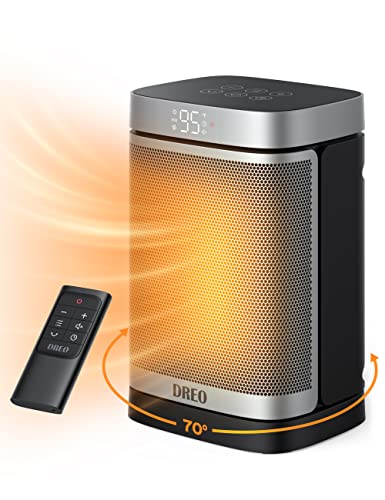
Best for quiet bedrooms or offices, this 1500W model uses DREO’s Hyperamics technology to deliver warmth quickly. It includes a thermostat with a wide adjustable range, a remote for convenience, and safety features like overheating protection and tilt sensors. Choose this if you value precise temperature control and distant operation. A limitation to note is that the unit should be plugged directly into a wall outlet for optimal safety and performance.
PELONIS 30” Ceramic Tower Space Heater

Best for large rooms, this 1500W tower heater covers up to 280 ft² with 75° oscillation for comprehensive heat distribution. It features rapid heating, a digital control panel, and a remote for easy adjustments. It’s a strong pick when you need even warmth across bigger spaces. The benefit of tower design is improved air circulation, but ensure you have adequate space around the unit for safe operation.
DREO Space Heater with Thermostat and Eco Mode

Best for energy-conscious users, this model combines a precise thermostat and ECO mode to regulate heat output and reduce energy use. It offers a broad temperature range (41–95°F) with small increments and reliable safety systems, including tilt detection and ETL-certified components. Choose this if you want consistent comfort while keeping monthly energy costs moderated. A note: the more features, the more there is to manage; simple settings may be preferable for basic needs.
Buying Guide
What room size should guide my heater choice?
For small offices or personal spaces, 750–1500W units are typically sufficient. For larger living spaces, look for 1500W models with 70°+ oscillation or tower designs that can cover 200+ ft².
Why is thermostat control important?
Thermostats maintain your preset temperature automatically, reducing energy waste. A precise range (1–2°F increments) helps balance comfort with efficiency.
What safety features are essential?
- Tilt-over or tip-over shut-off
- Overheat protection
- Flame-retardant housing (V0 or better)
- ETL or UL certification when available
Is oscillation or a tower design better for coverage?
Oscillating or tower heaters distribute heat more evenly across wide spaces. They are ideal for rooms where people sit or gather, preventing hot spots and cold corners.
What about noise and placement?
Quiet operation (roughly 34 dB or lower) is preferable for bedrooms and offices. Place heaters on stable, flat surfaces away from curtains, beds, or desks to prevent heat exposure on vulnerable objects.
Energy-saving settings to consider
Look for ECO or energy-saving modes, smart thermostats, and auto-off timers. Pairing these with proper room sizing yields the best efficiency without sacrificing comfort.
How should I choose between a compact unit and a tower?
Compact units excel for desks or small rooms; towers suit larger spaces and offer broader heat distribution with minimal footprint.
FAQ
- What is the safest space heater for families with pets?
- Do space heaters use a lot of electricity?
- Can I leave a space heater on overnight?
- Is it better to buy a heater with remote control?
- What features help with energy bills in winter?
- Should I choose a ceramic heater or a fan-forced heater?
Heaters with tip-over protection, automatic shut-off on overheating, and flame-retardant housings (V0) are best. Consider models with tilt sensors and certified safety features.
Most space heaters run at 1500W on high, with energy-saving modes reducing usage. Selecting a thermostat-controlled model improves efficiency.
Only if the heater has reliable overheat protection, tip-over shut-off, and a timer that powers off after a set period. Never leave a non-certified unit unattended.
Remote control adds convenience for adjusting temperature and settings from a distance, especially for wall-bed setups or desks.
Thermostats with precise increments, ECO modes, and good room size matching reduce unnecessary heat loss and lower bills over time.
Ceramic heaters provide safer, more even heating and faster warm-up with low surface temperatures. Fan-assisted models can distribute air quickly but may be louder.