Discover leading silicone heater and sealant options from trusted brands. This guide highlights five top products, focusing on high-temperature silicone sealants and flexible silicone heating mats used in DIY projects, appliances, and industrial settings. Each entry includes an overview, key features, and practical considerations to help you choose the right solution for sealing, insulation, and controlled heating tasks.
| Product | Brand | Type | Use Case |
|---|---|---|---|
| RUTLAND PRODUCTS | Gaskets, non-corrosive adhesive in high-heat environments | ||
| RUTLAND PRODUCTS | Clear gaskets and seals in metal/plastic assemblies | ||
| LMS | DIY gaskets, seals, protection and insulation | ||
| DERNORD | Localized heating for objects and surfaces | ||
| DERNORD | Industrial heating, rapid heat transfer on surfaces |
Rutland Black High-Temp Silicone Sealant

Rutland High Temperature Silicone provides a tough, flexible seal suitable for a range of clean surfaces such as glass, metal, plastics, fiberglass, wood, brick, and stone. It is UV stable, oil resistant, and non-corrosive, making it a versatile choice for high-heat gasket and adhesive applications. The formulation adheres to many common substrates, helping reduce leaks and improve durability in ovens, stoves, and other heat-exposed assemblies.
Rutland Clear High-Temp Silicone Sealant
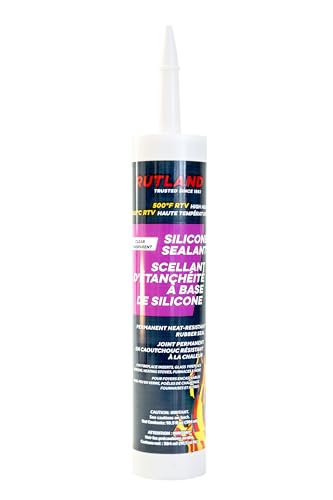
Rutland’s clear variant offers the same high-temperature performance with a transparent finish, ideal for areas where appearance matters. It seals effectively around glass, metal, and plastics while maintaining flexibility under repeated heating cycles. This makes it suitable for sealing interfaces in appliances, heaters, and custom builds where visibility of the seal is important.
LMS Black Heat Resistant Silicone Rubber Roll Strips

These silicone rubber strips provide high-temperature resistance and excellent elasticity without adhesive. They are suited for gaskets, protection, and insulation projects, with good electrical insulation properties. The strips are easy to cut to shape and can be used to create custom seals, protect surfaces from scratches, or act as a waterproof seal in kitchen and workshop tasks.
DERNORD 12V 15W Silicone Heating Pad

This compact heating pad operates at 12V with 15W power, using silicone as an outer insulator and Ni-Cr wire as the heating element. Its thin, flexible design enables close contact with the target object, delivering efficient heat transfer. Suitable for small-scale heating tasks, prototypes, and thermal maintenance on equipment or pipes where space is limited.
DERNORD 12V 20W Silicone Heating Pad

With 12V and 20W, this heating pad provides stronger heat output in a similar compact form factor. The silicone exterior offers durability and electrical insulation, while the Ni-Cr element inside ensures rapid heat transfer to the surface. It is suitable for industrial or hobbyist projects requiring reliable, localized heating across small to medium surfaces.
Buying Guide: Key Considerations When Choosing Silicone Heaters And Sealants
- Temperature rating and chemical compatibility: Verify maximum exposure temperatures and substrate compatibility to ensure a durable seal or heating solution in your environment.
- Electrical and dielectric properties: For heating pads, check dielectric strength, insulation quality, and resistance to moisture or solvents to prevent shorts or degradation.
- Flexibility and form factor: Flexible mats and strips conform to curved or irregular surfaces, improving heat transfer and seal integrity in tight spaces.
- Adhesion vs. no-adhesive options: Adhesive-backed sheets or tapes simplify installation, while non-adhesive rolls require mechanical fastening or surface prep.
- UV, ozone, and weather resistance: Outdoor or kitchen environments benefit from UV stability and weather resistance to extend lifespan.
- Ease of cutting and shaping: Materials that are easy to cut with scissors or knives save time during custom fabrication and gasket making.
- Electrical safety and insulation: For heating applications, ensure compatibility with power supplies, wiring, and safety standards to avoid overheating.
- Intended use scenario: Seals and gaskets may prioritize chemical resistance and flexibility, while heating mats emphasize efficient heat transfer and surface contact.
- Maintenance and replacement cycle: Consider longevity and the ease of re-sealing or replacing worn sections in appliances or industrial lines.
- Cost-to-performance balance: Compare temperature range, durability, and installation effort to determine the best value for your project.
In selecting silicone heater and sealant products, consider the specific operating environment, required temperature range, and substrate materials. The highlighted items illustrate a spectrum of options—from high-temperature silicone sealants for durable gaskets to flexible silicone heating pads designed for precise heat application. Balancing performance, durability, and ease of use will guide you to the most effective choice for home repairs, DIY projects, or professional applications.