Answering the top buyer questions: these solar heat transfer fluids are designed for closed-loop solar thermal systems, delivering high heat transfer, freeze protection, and stable performance across a wide temperature range. This guide highlights five strong options, showing who each product is best for, and why they stand out for American homeowners and professionals. The quick-reference table below helps compare core traits at a glance.
| Product | Brand | Best For | Key Benefit |
|---|---|---|---|
| ComStar Solar ProFlow (01-175) | ComStar | Solar enthusiasts who want ready-to-use, high-temperature performance | No dilution needed; high heat tolerance |
| ComStar Solar ProFlow (01-176) | ComStar | Large closed-loop solar installations needing reliable protection | Same ready-to-use convenience with large-volume option |
| Chemworld NexFrost HD Propylene Glycol | ChemWorld | Industrial or HVAC-like solar cooling scenarios needing corrosion protection | Corrosion inhibitors and precise freeze protection |
| Northern Lights Group ZM-ProSol LH-T | Northern Lights Group | Non-toxic, food-contact-safe applications or sensitive environments | Non-toxic glycol blend with premixed ratio |
| BioFROST Concentrate 5 Gallon | Orison | Biobased, food-contact-safe installations | Biobased, NSF-listed for incidental food contact |
Note: This article focuses on five relevant options that address common solar thermal needs, including ready-to-use formulations, corrosion protection, and non-toxic blends for sensitive environments.
ComStar Solar ProFlow 01-175

ComStar’s Solar ProFlow 01-175 is a ready-to-use heat transfer fluid designed for closed-loop solar systems. It emphasizes high heat transfer and robust freeze protection, with no dilution required. The formulation targets continuous operation up to 350°F (177°C) and short-term exposure up to 450°F (232°C), aiming for reliable performance in challenging conditions. Best for homeowners or installers seeking a hassle-free, pre-mixed solution that minimizes setup time.
Who this is best for: Small to medium residential solar heating systems or DIY installers who want quick deployment without measurements.
Why chosen: It delivers strong heat transfer with a straightforward “pour-and-go” experience.
Caution: Verify system compatibility with high-temperature fluids and ensure proper expansion allowance for your loop.
ComStar Solar ProFlow 55 Gallon

This is the larger-volume option from ComStar’s ProFlow line, designed for bigger, closed-loop solar installations. It shares the same high-temperature performance and ready-to-use convenience as the 1-5 gallon version, making it suitable for commercial-looking residential builds or multi-zone solar networks. Best for systems that require extended runs between service intervals.
Who this is best for: Homeowners with larger solar thermal arrays or small commercial setups needing less frequent fluid handling.
Why chosen: Volume efficiency paired with consistent heat transfer and freeze protection.
Caution: Handle and store in appropriate containers to prevent accidental spills in larger volumes.
Chemworld NexFrost HD Propylene Glycol

NexFrost HD from ChemWorld is an inhibited propylene glycol heat transfer fluid designed for closed-loop HVAC, snow-melt, solar thermal, and process cooling applications. The product includes corrosion inhibitors to help protect common system metals, supporting longer service life in demanding environments. Best for industrial or mixed-use sites where corrosion control is critical and a dilution strategy is acceptable to tailor temperature protection.
Who this is best for: Industrial operators or installers needing a reliable, corrosion-protected glycol blend for diverse solar or cooling systems.
Why chosen: Inhibition package reduces metal degradation in extended operation.
Caution: Confirm the final glycol-to-water concentration with a refractometer to achieve required freeze protection level.
BioFROST Concentrate 5 Gallon

BioFROST Concentrate from Orison is a biobased, food-contact-safe propylene glycol blend. It is NSF-listed for incidental food contact and emphasizes environmental stewardship alongside practical heat transfer performance. Best for projects where non-toxicity and environmental considerations are priorities, such as in homes near food-growing activities or in buildings with strict safety standards.
Who this is best for: Health-conscious homeowners or facilities seeking a biobased, non-toxic fluid.
Why chosen: Provides reliable heat transfer with a favorable safety profile for sensitive settings.
Caution: Concentrate-based; ensure correct mixing ratios for effective freeze protection in your climate.
RecPro RV Heat Transfer Fluid (4) Concentrate
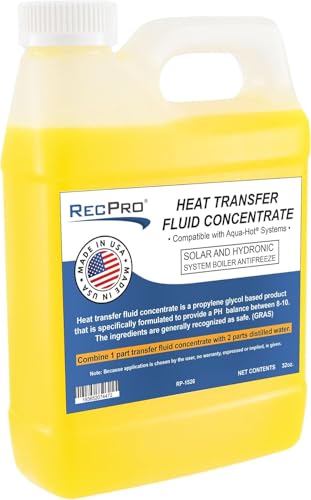
RecPro offers a non-corrosive, propylene-glycol-based heat transfer concentrate in a 4-pack option. This product emphasizes stability over a wide temperature range and high boiling point, along with availability in multiple quantities to fit varied budgets. Best for RV professionals or homeowners who want flexible, scalable quantities and robust thermal performance.
Who this is best for: Users needing scalable supplies or RV installations with non-toxic formulation.
Why chosen: High compatibility with various system designs and easy stocking.
Caution: Ensure proper dilution in line with system design to achieve ideal freeze protection.
Buying Guide
What matters most when selecting solar heat transfer fluid?
- Consider continuous-use temperatures and short-term peaks your system experiences. Fluids designed for higher continuous temps reduce degradation risk.
- Oil-to-water or glycol composition: Glycol-based blends provide freeze protection but require correct dilution. Non-toxic or biobased options suit sensitive environments.
- Corrosion and compatibility: Look for inhibitors that protect common metals in your loop. Confirm compatibility with existing pumps, hoses, and sensors.
- Volume and handling: Ready-to-use fluids save time but may be pricier per gallon. Concentrates offer cost savings with proper mixing care.
- Safety and environmental considerations: Biobased or NSF-listed fluids reduce environmental impact and may be preferred in food-adjacent settings.
Practical selection tips
- For small, residential systems with a priority on ease of use, choose ready-to-use fluids like ComStar ProFlow 01-175.
- For large installations, consider higher-volume options such as ComStar ProFlow 55 Gallon for fewer fill-ups.
- When corrosion risk is a concern in metal-heavy loops, opt for fluids with a strong inhibitor package like NexFrost HD.
- If non-toxicity or environmental safety is critical, BioFROST Concentrate offers a biobased alternative.
FAQ
- What is the difference between ready-to-use and concentrate fluids? Ready-to-use fluids require no mixing; concentrates need dilution to achieve the desired glycol percentage.
- Can I switch fluids in an existing solar loop? Switching requires system flush and compatibility checks to avoid precipitation or reduced heat transfer.
- Which fluid is best for extremely cold climates? Fluids with tested freeze protection and stable viscosity at low temperatures are preferred; refer to each product’s stated temperature range.
- Are non-toxic fluids suitable for all solar applications? Non-toxic options are ideal for sensitive environments but ensure they still meet your performance requirements.
- Why is corrosion protection important? Inhibitors help prevent metal degradation, leaks, and system downtime in long-running solar loops.