Answering the question, “which solar mini split AC is best for my needs?” this guide reviews five top off-grid and hybrid-ready models. These units are chosen for different use cases: off-grid cabins, small homes, apartments, or rooms where grid reliability matters. The selections balance solar compatibility, efficiency, and installation practicality. Use the quick reference below to compare the core strengths of each model.
| Product | Best For | Key Benefit |
|---|---|---|
| Photon AC 18,000 BTU Solar Mini Split | Off-grid homes with day-time cooling | True solar-powered daytime cooling with hybrid AC/DC operation |
| Nexmetal 48V DC Mini Split 9,000 BTU | Battery-backed remote sites | Completely DC operation without inverter loss |
| Albott 12,000 BTU SEER2 18 | Small-to-mid rooms | Inverter efficiency with self-cleaning features |
| Senville LETO 12,000 BTU 110/120V | Home and small business spaces | Alexa-enabled, versatile 4-in-1 functionality |
| Albott 24,000 BTU SEER2 18 | Larger living areas | High-capacity cooling with energy efficiency |
Photon AC 18,000 BTU Solar Mini Split AC & Heat Pump
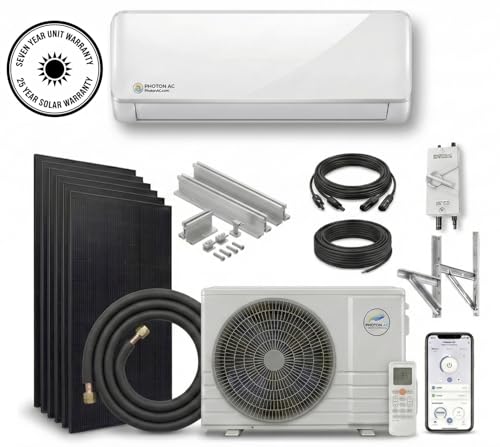
Best for: Off-grid daytime cooling where solar power can run the system for free. This 18,000 BTU unit is designed as a true solar-powered option with an all-in-one installation kit, including solar panels and racking. It supports DC solar priority with a 220V-240V AC backup for continuous comfort on cloudy days, or at night. Choose this if your goal is self-sufficiency and maximized solar utilization during daylight hours.
Why selected: It integrates a complete kit and a long warranty, emphasizing reliability and off-grid capability. The system uses R-32 refrigerant and provides robust daytime performance that reduces grid dependency. It is best for buyers who want a turnkey solar solution with strong daylight operation.
Caution: The kit requires roof attachment points and professional installation to ensure proper mounting and wiring safety.
48V DC Battery Powered Mini Split (9,000 BTU)

Best for: Off-grid locations with 48V battery banks or solar storage. This model runs directly on 48V DC and does not require an inverter for peak efficiency, making it ideal for battery-tied solar systems where minimal losses are desired. It includes heating functionality and memory of last settings after power interruptions.
Why selected: Its true 48V DC operation can deliver higher efficiency, reducing energy conversion losses. It’s a strong pick for users prioritizing energy efficiency and fast recovery after outages.
Caution: It requires a compatible 48V DC power setup and may be less compatible with standard AC electrical infrastructure without proper planning.
Albott Mini Split 12,000 BTU SEER2 18

Best for: Small-to-medium spaces needing year-round comfort with energy efficiency. It provides cooling and heating, plus self-cleaning and app/remote controls for convenient operation in homes or small offices.
Why selected: The SEER2 18 rating and inverter-based design deliver energy-efficient performance across a broad temperature range. It’s well-suited for spaces up to 750 sq ft and supports reliable all-season use.
Caution: Installation depth and line-set routing should be planned to fit within existing walls and ceilings; professional setup is recommended.
Senville LETO Series 12,000 BTU Mini Split
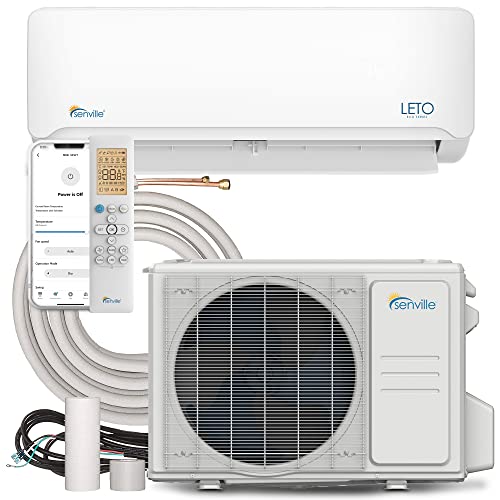
Best for: Homes and small businesses requiring Alexa-enabled control and flexible 4-in-1 functionality. This unit handles AC, heat pump, dehumidification, and fan modes with a compact footprint.
Why selected: The integration with voice control and its inverter-based efficiency support modern smart homes. It suits spaces where smart routines and remote adjustments are valuable.
Caution: While versatile, 12,000 BTU may be insufficient for larger rooms; verify square footage needs before purchase.
Albott 24,000 BTU SEER2 18
Best for: Larger living areas or open-plan spaces requiring substantial cooling. It combines a high-capacity compressor with inverter technology for efficient, consistent climate control.
Why selected: The SEER2 18 rating supports energy savings at higher load, making it a practical choice for bigger rooms. It scales well for mid-to-large homes seeking steady comfort.
Caution: Higher BTU means more demanding installation; verify ducting or wall space and structural support for mounting before purchase.
Buying Guide: Solar Mini Split AC Buying Considerations
- Solar integration level: Do you want a unit that runs primarily off solar during the day and switches to grid backup, or a DC-only system with batteries? Your power source strategy will influence the expected efficiency and upfront kit requirements.
- BTU and area coverage: Match BTU rating to room size. Oversized units can waste energy; undersized units struggle to maintain comfort.
- Voltage and power architecture: DC-powered mini splits save energy in off-grid setups but may require compatible wiring and inverters. Ensure compatibility with your solar array and battery setup.
- Smart features and controls: Alexa or app integration can simplify operation and energy management, especially in multi-room layouts or rental properties.
- Installation considerations: Some models come as complete kits with mounting hardware, solar racking, and line sets; others may require separate components. Evaluate roof attachment needs and local codes.
- Warranty and service: Look for long-term coverage for both indoor/outdoor units and solar components. A robust warranty reduces long-term ownership risk.
Frequently Asked Questions
- What is a solar mini split AC?
A solar mini split AC is a ductless cooling/heating system designed to run on solar energy, either directly via DC power or through solar-assisted inverters and backup grid power.
- Do solar mini splits require batteries?
Not always. Some configurations use daytime solar power with grid backup, while others are battery-backed for true off-grid operation.
- Can I install these myself?
Professional installation is recommended for safety and performance, especially when solar panels, inverters, and refrigerant lines are involved.
- Which model suits a small apartment?
Models around 9,000–12,000 BTU with inverter efficiency are typically ideal for small to mid-sized rooms in apartments.
- What should I consider before buying?
Consider room size, climate, solar capacity, available roof space for panels, and whether you need daytime-only cooling or continuous comfort with grid backup.