Answering the common search for spray foam roofing kits, this guide highlights five kits that balance coverage, performance, and practicality for common American roof projects. Each option is suited for different buyers: DIY homeowners tackling small-to-mid projects, contractors seeking faster jobs, and spaces needing strong air sealing with fire-rated options. Below, you’ll find concise comparisons, clear buying cues, and a practical buying guide to help you choose.
| Product | Best For | Approx. Coverage | Notable Feature |
|---|---|---|---|
| Froth Pak 630 | Homeowners with larger roofs needing high yield | Up to 630 sq ft at 1 inch | USA-made, Class-A fire rated up to 2 inches |
| Vega Bond V600 | DIY projects across multiple surfaces | Up to 600 sq ft at 1 inch | Airtight, high-yield closed-cell foam |
| Vega Bond V200 | Smaller or targeted insulation jobs | Up to 200 sq ft at 1 inch | Low GWP; high density |
| BEEST FullStop 720 | Smaller to mid-size spaces needing fire resistance | About 720 board ft | Class A fire-rated; hybrid closed/open cell |
| ixirpro 18 Pack | Comprehensive DIY projects with included accessories | Expanded by cans; up to many square feet | Premium gun, cleaners and safety gear included |
Froth Pak 630 Spray Foam Insulation Kit
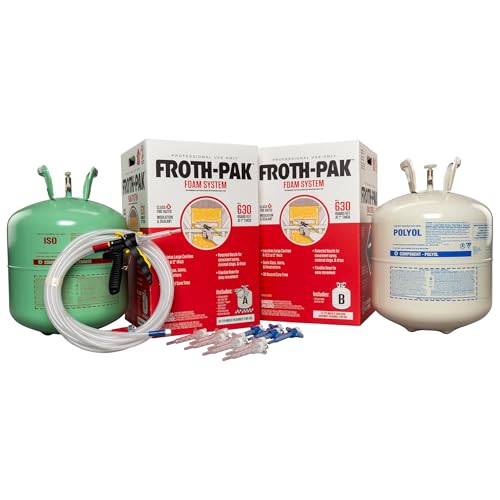
The Froth Pak 630 is best for larger roof projects needing substantial yield per kit. It uses a two-component polyurethane foam system and offers Class-A fire rating up to 2 inches thick, making it suitable for spaces where fire safety is a priority. It provides an R-value of 6.2 at 1 inch and 12.2 at 2 inches, making it a solid choice for sealing and insulation on vented or raftered roofs. This kit is ideal for DIYers or small contractors focusing on residential reroofing with high coverage needs.
Best for: homeowners or contractors handling medium-to-large roof areas who require strong fire resistance and high coverage. Choose this if you need a single kit that can deliver substantial insulation thickness with fire-rated performance.
Caution: Requires customer signature and appropriate safety gear; ensure proper ventilation during application and follow all handling instructions.
Vega Bond V600 – Closed Cell
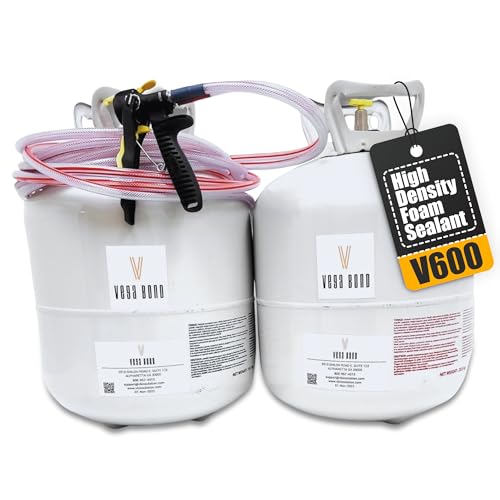
The Vega Bond V600 is best for ambitious DIY projects across multiple surfaces. It delivers airtight coverage for gaps, cracks, rim joists, crawl spaces, and around ducts, helping seal air and moisture intrusion. The kit’s closed-cell formula expands to form a firm thermal barrier, with an R-value around 7 per inch. It’s well-suited for basements, roof decks, subfloors, and exposed foundations where lasting thermal performance matters.
Best for: DIY enthusiasts tackling full-room or multi-surface projects who value airtight sealing and a strong thermal barrier. Pick this for broad applications where a durable, moisture-resistant layer is needed.
Caution: As with all foam kits, avoid over-application on delicate substrates and ensure proper surface prep for best adhesion.
Vega Bond V200 – Closed Cell

The Vega Bond V200 is best for smaller projects requiring high-density insulation. It provides 200 board feet coverage at 1 inch and features low GWP formulation for a more environmentally conscious choice. Its high density and R-7 per inch make it suitable for walls, roofs, basements, and crawl spaces where space efficiency and thermal performance are important.
Best for: projects with tighter budgets or smaller spaces where a compact, fast-curing kit can deliver solid insulation value. Consider this if you need a portable solution for limited-area upgrades.
Caution: Limited coverage per kit means more units for larger jobs; plan accordingly to avoid gaps in application.
BEEST FullStop 720 Spray Foam Kit

BEEST FullStop 720 stands out for its all-in-one packaging and Class A fire-rated performance, suitable for walls and attics in residential or light commercial settings. The kit includes a heavy-duty gun, cleaners, safety gear, and 36 cans, delivering around 720 board feet of coverage with an R-value of 8.24 at 2 inches. Its hybrid formulation combines closed-cell strength with open-cell expansion for solid moisture resistance and flexible fill.
Best for: users needing a comprehensive kit with safety gear included and a high fire rating. This is a strong all-in-one choice for DIY installers seeking a balance of coverage, safety, and performance.
Caution: Be mindful of ventilation and respiratory safety when spraying; verify that your workspace is well-ventilated and compliant with local codes.
ixirpro Spray Foam Insulation Kit (18 Pack)

The ixirpro kit is well-suited for extensive DIY insulation projects with an 18-pack offering. It includes a complete gun setup, cleaners, multiple nozzle tips, and protective gear, making it a practical choice for larger home projects requiring precise coverage and a high-density spray foam solution. The kit’s instructions emphasize proper nozzle distance and spraying technique to achieve smooth, even coverage on walls, attics, and ceilings.
Best for: DIYers undertaking broad insulation tasks across multiple rooms, where having a full suite of accessories in the box reduces extra shopping trips. Consider this if you value a feature-rich kit with comprehensive safety gear.
Caution: Follow the recommended distance (25-30 cm) to avoid foam bursting or uneven application; use the included PPE for safe handling.
Buying Guide
Key considerations when choosing a spray foam roofing kit include coverage needs, substrate compatibility, fire-safety requirements, and long-term performance.
- Coverage and thickness: Match kit output to your roof’s area and the desired insulation thickness. Larger roofs benefit from kits with higher board-foot ratings or higher yield per can.
- Fire rating: For living spaces and roofs, Class A fire-rated formulations provide enhanced safety and code compatibility. Verify the thickness at which the rating applies.
- Density and R-value: Closed-cell foams deliver higher R-values per inch and superior moisture resistance, but may be stiffer. Open-cell foams expand more and offer flexibility but lower R-values.
- GWP and environmental impact: Low GWP formulations reduce environmental impact and are increasingly preferred for new builds and retrofits.
- Safety and accessories: Kits that include guns, cleaners, cleaners, and protective gear save time and ensure proper handling. Always use PPE and ensure adequate ventilation.
- Application distance and technique: Follow manufacturer guidelines for nozzle distance and spray pattern to avoid gaps, voids, or foam blowouts.
- Ease of use vs. professional results: Some kits are beginner-friendly with all-in-one contents; others are more suited for experienced installers and may require additional tools or safety measures.
FAQ
- What is the typical coverage per kit for most spray foam roofing kits?
Coverage varies by product and thickness. Typical figures range from about 200 to 630 square feet at 1 inch thickness, with higher thicknesses providing greater R-values per inch.
- Are spray foam roofing kits fire-rated?
Several kits offer Class A fire-rated performance at specific thicknesses, which is important for safety and code compliance in many regions.
- Do kits include all safety gear?
Many kits include essential safety gear such as gloves and goggles, but check each listing to confirm and prepare additional PPE if needed.
- What is the difference between closed-cell and open-cell foams?
Closed-cell foam delivers higher density, greater R-value per inch, and moisture resistance. Open-cell foam expands more, offering flexibility and easier coatings but lower R-value per inch.
- Can I use these kits for exterior roof applications?
Yes, many kits are suitable for exterior roof surfaces, but confirm substrate compatibility and local code requirements. Some applications may require additional weatherproofing or coatings.